 The Itinerary
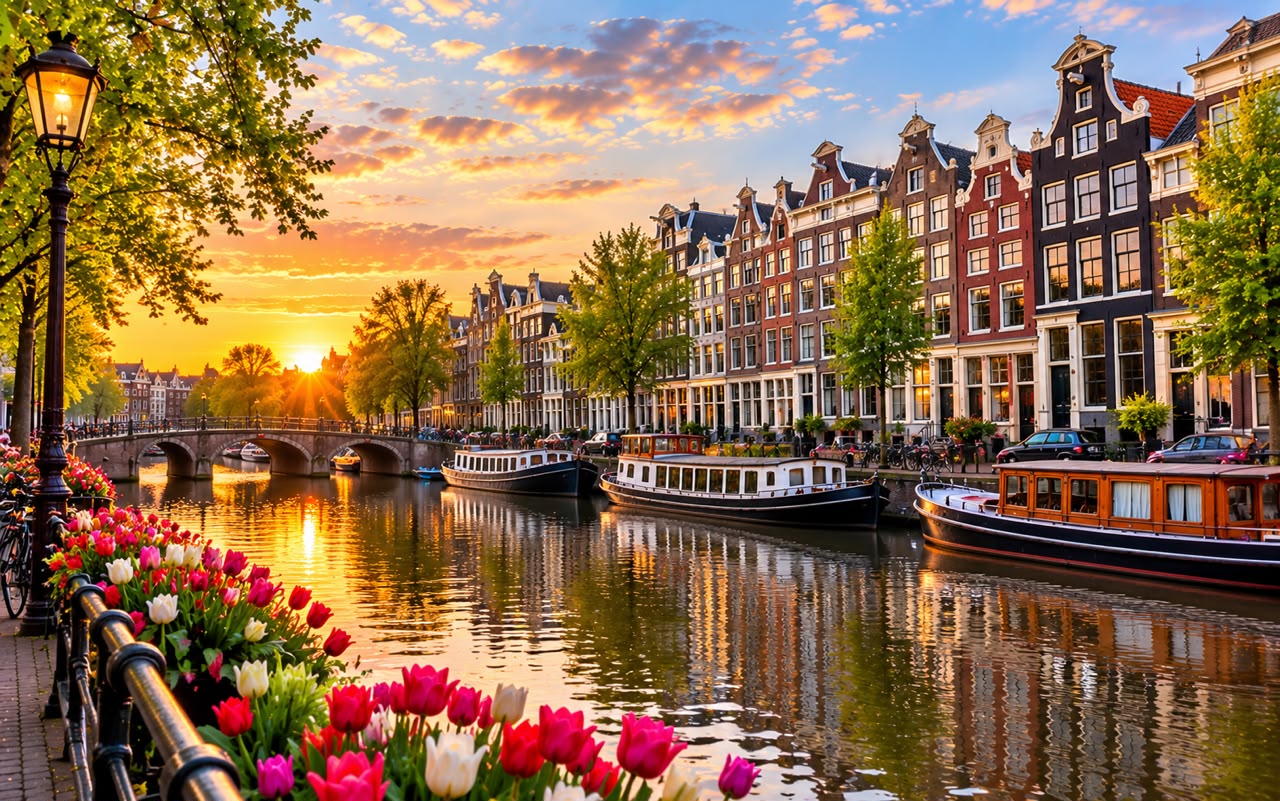
Amsterdam in 2 days: the canals, the Rijksmuseum and Anne Frank
The Anne Frank House releases tickets six weeks ahead and they go within hours — that single fact shapes the whole trip. Plus the Rijksmuseum with a plan, the Jordaan on foot, and the bike lanes that are traffic.
- Western Europe
- 2 days
- ≈ AED 1,100 / person
- Two days, and the one ticket you must book six weeks out
Before you go
Amsterdam in two days is straightforward, walkable and almost entirely dictated by one booking.
The Anne Frank House sells online only and releases tickets about six weeks ahead. They go within hours. If you have not booked, you will not get in — there is no queue, no standby, and no exception. It is the single most common disappointment in the city, and it is entirely avoidable.
The rest arranges itself: the Rijksmuseum and the canal belt on day one, Anne Frank and the Jordaan on day two.
Figure the budget below. April–May and September–October.
Before you go: the short version
Entry and visas
- The Netherlands is in the Schengen area. Around 60 nationalities enter visa-free for 90 days in any 180; everyone else needs a short-stay (Type C) Schengen visa in advance.
- ETIAS is being phased in for visa-exempt visitors — check whether it applies by your dates.
- Our full guide: how Schengen visas actually work.
Getting in and around
- Schiphol (AMS) is 15 minutes by train to Centraal for about €5.90, and the trains run every few minutes.
- Amsterdam is small. The canal belt is about 2km across and walking is the default.
- Trams are frequent; tap a contactless bank card on the reader as you board and again as you leave.
- Hiring a bike is the local way — but see the warning below.
Look both ways, twice
- The bike lanes are traffic, not a pavement extension. Cyclists have right of way, they move fast, and they do not slow down for people standing in the lane taking photographs.
- This is the most common way visitors get hurt here, and stepping off a kerb without checking the red lane is the specific mistake.
- If you hire a bike, remember you are then subject to the same rules — lights after dark are a legal requirement and fined.
Day by day
Day 1 — The Rijksmuseum and the canal belt
Walking order: Rijksmuseum → Museumplein (on the doorstep) → Van Gogh Museum (2 min) → Vondelpark (5 min) → canal belt back toward the centre (2.5km). About 5km, flat.
- 09:00 — The Rijksmuseum at opening. The Night Watch, four Vermeers, and the Delftware. Two hours minimum, and go to the Gallery of Honour first before it fills.
- 11:30 — The Van Gogh Museum, two minutes away, booked with a timed slot. It holds the largest collection of his work anywhere — 200 paintings and 500 drawings — and it is arranged chronologically, which makes the last rooms difficult in the right way.
- 13:30 — Lunch at Museumplein or in De Pijp.
- 15:00 — The canal belt on foot, UNESCO-listed — Herengracht, Keizersgracht, Prinsengracht, the three concentric rings dug in the seventeenth century.
- Look at the gables and the hoisting beams — the houses were taxed on their width, which is why they are narrow and deep, and the beam at the top is still how furniture goes in.
- 17:00 — A canal boat, which is touristy and is also the right way to understand the city’s shape. The small open boats beat the big glass-topped ones.
- 19:30 — Dinner in De Pijp or the Nine Streets.
Day 2 — Anne Frank and the Jordaan
Walking order: Anne Frank House → Westerkerk (next door) → the Jordaan lanes (2km of wandering) → Noordermarkt (5 min). About 4km, flat.
- 09:00 — The Anne Frank House, booked weeks ago. The Secret Annexe is behind the bookcase and the rooms are left unfurnished at Otto Frank’s insistence — he asked that they stay empty, as they were found after the raid.
- Allow 90 minutes. It is quiet, the route is one-way, and there is no photography inside.
- 11:00 — The Westerkerk next door, whose bells Anne wrote about hearing, and the tower climb if it is running.
- 12:00 — The Jordaan — former working-class district, now the prettiest part of the city. The hofjes are the thing to look for: almshouse courtyards behind unmarked doors, several of which are open to quiet visitors.
- 13:30 — Noordermarkt if it is a Saturday — farmers’ market and flea market — or lunch in the Nine Streets.
- 15:00 — Pick one: the Rembrandt House, where he lived and went bankrupt; the Portuguese Synagogue and the Jewish Historical Museum; or Micropia, the only museum of microbes in the world and far better than that sounds.
- 17:00 — A brown café — Hoppe, ‘t Smalle, Papeneiland. The name is from the tobacco-stained ceilings, and they are the city’s own institution.
- 19:00 — Dinner, and an Indonesian rijsttafel is the Dutch colonial dish to have here.
What to skip, honestly
- The Heineken Experience is a brand tour, not a brewery.
- The Red Light District is a residential neighbourhood with a regulated industry in it. Photographing the windows is prohibited and taken seriously. Walk through if you like; do not treat it as an attraction.
Costs and practicalities
Getting around, and what it costs
| Train, Schiphol to Centraal | €5.90 |
| Tram, contactless, per journey | €1.08 plus €0.20/km |
| Bike hire, per day | €12–18 |
| Rijksmuseum | €25 |
| Van Gogh Museum | €24 |
| Anne Frank House | €16 |
| Canal cruise | €18–25 |
| Rembrandt House | €20 |
- The I amsterdam City Card includes most museums and transport — it pays off only on a heavy museum day, and notably does not include the Anne Frank House.
Best time to visit
- April–May — tulip season. Keukenhof runs about eight weeks from mid-March to mid-May and the bulb fields peak in late April.
- September–October — mild, quieter, and the canals at their best.
- June–August — busiest and warmest, and the city is genuinely full.
- November–March — cold, dark and cheap, and the museums are a pleasure.
Travel tips
- Book the Anne Frank House the day tickets release, six weeks out. Everything else can be arranged later.
- Book the Van Gogh Museum too — timed slots, and it sells out.
- Look for the red bike lane before stepping off any kerb.
- The small open canal boats beat the glass-topped ones.
- No photography in the Red Light District.
- Cash is rarely needed, but some places take only Dutch Maestro cards — carry a backup.
What this trip actually costs
Two people, 1 night, mid-range comfort, international flights excluded:
| Item | Cost |
|---|---|
| Hotel, 1 night | EUR 180 (≈ AED 737) |
| Food and drink, 2 days | EUR 160 (≈ AED 655) |
| Rijksmuseum, Van Gogh, Anne Frank, two people | EUR 130 (≈ AED 532) |
| Canal cruise, two people | EUR 40 (≈ AED 164) |
| Trains, trams and the airport both ways | EUR 30 (≈ AED 123) |
| Total for two | EUR 540 (≈ AED 2,211) |
- Amsterdam hotels are expensive for what they are — small rooms, steep stairs, and a tourist tax on top.
- Staying in Haarlem or Utrecht, 15–25 minutes by train, costs substantially less.
- Hotel picks here are chosen on location, not on commission — always check prices and recent reviews before booking.
What to pack
- Shoes for cobbles, and the canal bridges are all steps.
- A waterproof. It rains in every season.
- A layer; the wind off the IJ is cold even in summer.
- A Type C/F adapter, 230V.
Part of a bigger trip?
- Benelux in 9 days runs from here to Bruges, Ghent, Brussels and Luxembourg.
- London in 3 days is four hours by train.
- Paris in 3 days is 3h20 by Thalys.
FAQ
How far ahead must I book the Anne Frank House? Tickets release about six weeks before the date and sell out within hours. Set a reminder for the release — there is no queue and no standby.
Is two days enough for Amsterdam? Yes. The city is small, the three main museums are within walking distance of each other, and the canal belt is best wandered rather than toured.
Is the I amsterdam card worth it? Only on a heavy museum day, and note that it does not include the Anne Frank House — which is the one ticket people assume it covers.
Should I hire a bike? If you are a confident urban cyclist, yes. If not, walk — the city is 2km across and the bike lanes are fast-moving traffic.
What about the Red Light District? It is a residential area with a regulated industry in it. Photographing the windows is prohibited and enforced. Walk through respectfully or not at all.
Prices and entry rules change, and what you need depends on your passport; last checked 29 October 2026, so confirm with the embassy or your airline before booking.


