 The Itinerary
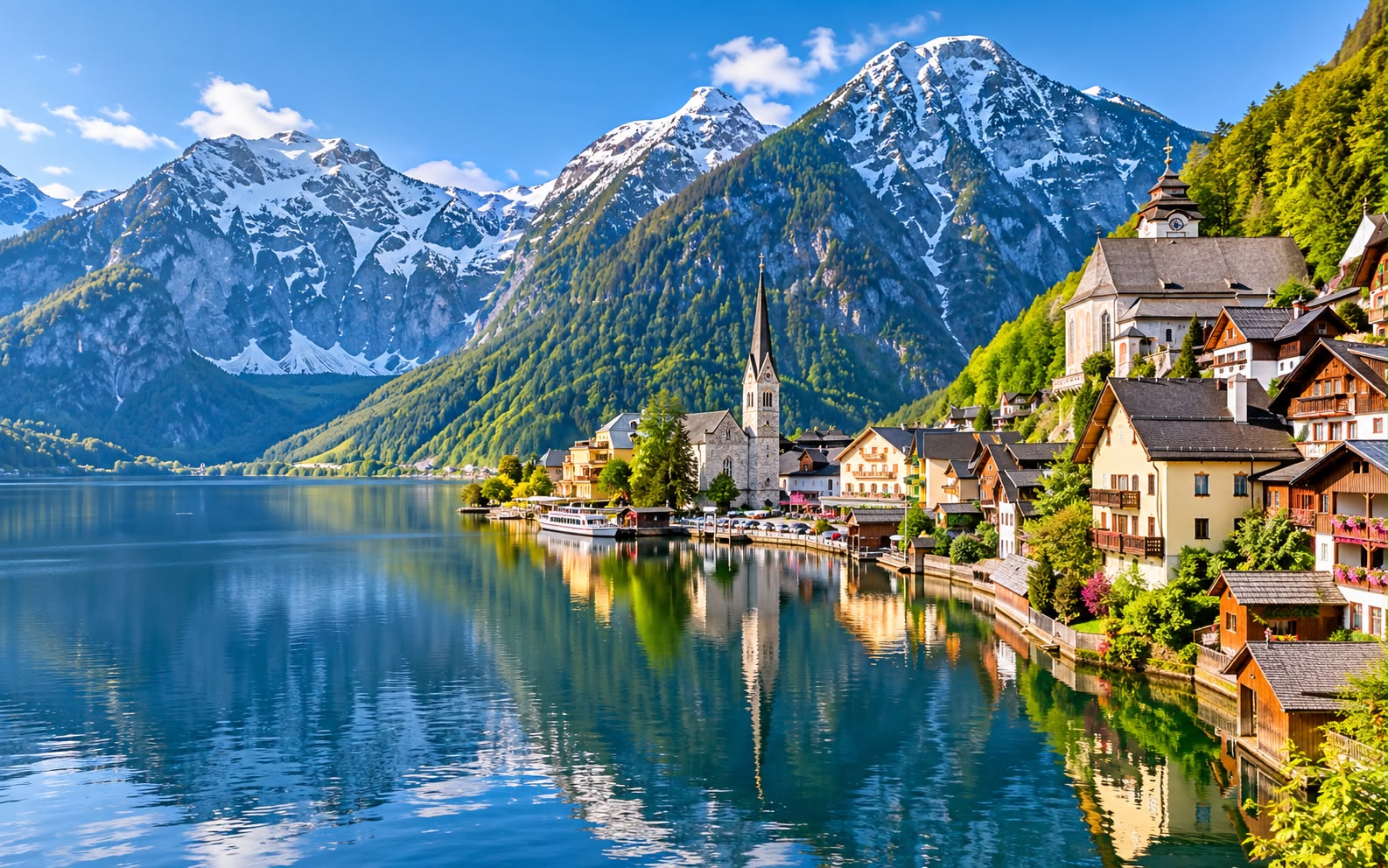
Austria in 9 days: Vienna, Hallstatt and Salzburg
The empire, the lake village and the Sound of Music: four Viennese days of palaces, Klimt and €15 opera (the standing-ticket hack), a night in Hallstatt so you own it at dawn, then Salzburg's fortress and singing hills — with the café-culture rulebook and the ferry arrival that built a million posts.
- Central Europe
- 9 days
- ≈ AED 7,150 / person
- First-time visitors
Before you go
Austria runs on three registers. Vienna is the imperial one: a capital built to rule half of Europe, still wearing the Habsburgs’ palaces, gilded cafés and an opera house where the best deal in classical music costs less than a kebab. Hallstatt is the postcard one: a 16th-century village pressed between mountain and lake, so photogenic China built a copy. Salzburg is the musical one: Mozart’s birthplace, a fortress on a crag, and the meadows where Julie Andrews spun.
A tidy rail line strings them together — including the trip’s best five minutes, the ferry across the Hallstätter See from station to village — and this guide adds the one move most itineraries miss: sleeping in Hallstatt, so you meet it empty at dawn instead of shoulder-to-shoulder at noon.
Go April–June or September–October (December is its own magic — Vienna and Salzburg run some of Europe’s loveliest Christmas markets; see our German markets guide, whose Salzburg day already belongs to this country). July–August is busy but never Rome-hot. All costs are in euros (EUR).
Before you go: the admin
Visa and money
- Visa: Austria is Schengen — the full process (€90, EES biometrics, 4–8 weeks of appointment lead, bank statements + refundable bookings) is in our Schengen visa guide. Austria’s applications run through VFS Global.
- Money: cards near-universal; carry €40–60 for sausage stands, church towers and tips. Tipping: round up ~5–10% (“machen Sie 20”). Tap water is free, Alpine-fresh and served without eye-rolling if you ask.
The Sunday rule and the trams
- Sundays: shops close (museums, cafés and bakeries don’t) — plan shopping for Saturday.
- Transport honour system: Vienna’s U-Bahn has no gates — buy and validate (stamp) your ticket; plain- clothes inspectors fine €105 with genuine indifference to your tourist status. A 72-hour Vienna pass (~€17.10) covers everything.
The café rulebook
- The café rulebook (this matters in Vienna): a coffee-house table is rented, not borrowed — one melange buys you hours, the newspaper is communal, the tuxedoed waiter’s aloofness is the service. UNESCO lists Viennese café culture as heritage; treat it as the attraction it is.
Day by day
Day 1 — Land in Vienna, cathedral first
- Afternoon — Land VIE, which takes non-stops from across Europe, the Gulf and Asia. CAT train or S7 into town (~€12–15/€4.40), check in.
- 17:00 — First walk: Stephansplatz — the chevron-tiled cathedral filling the square — then the Graben’s plague column and Kohlmarkt’s golden shopfronts toward the Hofburg gates.
- 19:30 — The schnitzel initiation: Figlmüller (the plate-sized original; queue or book) or any honest beisl (~€18–26 with a radler). Note for halal readers: classic schnitzel is veal/pork — the Turkish grills’ chicken versions solve it deliciously (Vienna’s kebab scene is vast).
Where to stay in Vienna (four nights)
- Luxury: Hotel Sans Souci — 4.9/5 on TripAdvisor (~3,100 reviews), MuseumsQuartier polish with a proper pool. ~€300–420.
- Location king: Boutique Hotel Am Stephansplatz — 4.8/5 (~4,300 reviews), literally on the cathedral square; breakfast with gargoyle views. ~€220–300.
- Value-boutique: The Harmonie Vienna — 4.8/5, quiet street, afternoon tea included. ~€150–200.
Day 2 — Schönbrunn, Klimt, and €15 at the opera
- 08:30 — Schönbrunn Palace at opening (timed slots — book ahead): the Grand Tour (€42 adult / €30 child) walks the full imperial floor; the gardens are free — climb to the Gloriette for the city-over-palace panorama, lose the kids in the maze (Classic Pass €49 bundles it all).
- 13:00 — Naschmarkt lunch: Vienna’s mile-long market — falafel, cheese stalls, Austro-Levantine everything (~€10–18).
- 15:00 — Upper Belvedere (~€18, timed): Klimt’s The Kiss in its golden room — plus Schiele and the garden view back over Vienna.
- 18:00 — The opera hack, executed: the Staatsoper sells standing tickets (~€13–18) from 80 minutes before curtain (app or box office) — full Puccini or Mozart from the rail, smart-casual fine, leave at the interval if the kids wilt and it still beat any cinema. (Sold out? The Musikverein’s cheap seats or a Mozarthaus concert stand in.)
- 21:30 — Late würstelstand käsekrainer by the opera (~€6) — the traditional post-performance meal of duchesses and students alike.
Day 3 — Empire in the morning, coffee-house afternoon
- 09:00 — The Hofburg: the Sisi Museum + Imperial Apartments (~€19) — the empire told through its most reluctant, fascinating empress; add the Imperial Treasury (the actual crown) if regalia calls.
- 12:30 — Lunch, then the day’s real appointment: a grand café — Café Central’s palm-court vaults (queue moves fast) or Sacher’s red velvet for the Sachertorte ceremony (melange + torte ~€15). Sit. Stay. That’s the exercise.
- 15:30 — Climb St Stephen’s south tower (343 steps, €7) for the tiled-roof dragon up close, or the catacombs tour below.
- 17:30 — Choose your Vienna evening: the Prater’s 1897 Riesenrad ferris wheel (~€14, Third-Man vintage) — or tram to a heuriger wine tavern in Grinzing: new wine, buffet by weight, gemütlichkeit by the litre (~€25–35 pp).
Day 4 — Art or armour, canal or Hundertwasser
- 09:30 — Pick your palace of art: the Kunsthistorisches Museum (Bruegel’s Tower of Babel, the Habsburg loot, arguably Europe’s most beautiful museum café) or the Albertina’s Dürer-to-Monet run (~€18–21 either).
- 13:00 — MuseumsQuartier courtyard lounging on the famous colored deckchairs; lunch nearby.
- 15:00 — The un-imperial Vienna: Hundertwasserhaus’s wobbly fairy-tale facade, then the Danube Canal’s street-art mile back to centre.
- 19:00 — Farewell-Vienna dinner; pack for the lakes. (Trivia your readers enjoy: Vienna tops the world’s most-liveable-city rankings almost annually — four days here explains why.)
Day 5 — The ferry to Hallstatt
- 09:30 — Train west (ÖBB/Westbahn via Attnang-Puchheim, ~3.5 h total, ~€30–40 booked ahead) along the Salzkammergut lakes to tiny Hallstatt station — which is across the water, by design.
- 13:15 — The ferry “Stefanie” (timed to every train, ~€4, 15 minutes): the village assembles itself across the lake as you approach — church spire, stacked wooden houses, mountain wall. The single best arrival in the Alps.
- 14:00 — Check in (bags roll fine; the village is 600 m long), then let the afternoon crowds thin.
- 16:30 — The classic lane walk: Marktplatz, the swans, the famous viewpoint at the north end (Gosaumühlstraße) as day-trippers drain away — then the tiny Bone House (€2.50): 610 hand-painted skulls in the chapel, the village’s strangest, tenderest tradition.
- 19:00 — Lakeside trout dinner (~€25–35 pp), evening silence the day-visitors never hear.
- The respect note: Hallstatt (pop. ~750) has battled overtourism — drones are banned, lanes are homes, and overnighting (you, tonight) is exactly the visitor the village asks for.
Where to stay in Hallstatt (one night — book months ahead, rooms are few)
- The lakefront classic: Seehotel Grüner Baum — balconies directly over the water on Marktplatz. ~€250–350.
- Heritage: Heritage Hotel Hallstatt — three historic houses by the ferry dock. ~€200–280.
- Value: the village’s family pensions (~€120–180) — or Obertraun across the lake at 30% less.
Day 6 — Dawn photos, salt slides, on to Salzburg
- 06:45 — Sunrise with the village to yourself — the photographs of the trip, mist on the lake included at no charge.
- 09:30 — Funicular up for the Salzwelten salt mine + Skywalk combo (€49 adult / €23 child, ages 4+): the world’s oldest salt mine — 7,000 years of “white gold”, banked wooden miners’ slides (the photo-speed-trap tells your km/h), the Bronze-Age staircase — then the Skywalk platform hanging 360 m over the rooftops. Funicular-only: €29.
- 13:30 — Buses to Salzburg via Bad Ischl (~2.5 h, ~€20 — scenic the whole way; a driver-transfer ~€180 is the luggage-heavy alternative).
- 16:30 — Check in, then Mirabell Gardens — yes, the Do-Re-Mi steps and gnome garden — with the fortress framed beyond the roses.
- 19:30 — Old-town dinner (~€20–30) and the cathedral quarter lit up.
Where to stay in Salzburg (three nights)
- Riverside icon: Hotel Sacher Salzburg — 4.6/5 (~2,300 reviews), torte included by osmosis. ~€350–500.
- Boutique: Hotel & Villa Auersperg — 4.7/5 (~2,000 reviews), garden calm ten minutes’ walk in. ~€200–280.
- Value: IMLAUER Hotel Pitter — 4.5/5, TripAdvisor’s #1 value: rooftop restaurant staring at the fortress. ~€150–210.
Day 7 — Fortress, Mozart, monastery beer
- 09:00 — Hohensalzburg Fortress by funicular (~€15–17 combined): Europe’s largest intact medieval castle — the Golden Chamber, marionette museum, and the city-and-Alps panorama from the ramparts.
- 11:30 — Down into the lanes: Getreidegasse’s wrought-iron guild signs, Mozart’s Birthplace (~€13 — the boy-wonder’s violin, properly moving), the cathedral’s marble hush.
- 14:00 — Lunch, then DomQuartier (the prince-archbishops’ state rooms) or the Kapuzinerberg woodland stairs for the reverse view.
- 18:00 — Augustiner Bräu Mulln: the monastery-founded beer hall — stone mugs rinsed at the fountain, chestnut garden, snack counters (radler and alcohol-free exist; the pretzels are ecumenical). ~€15–25.
Day 8 — The hills are alive (or the ice is)
- 09:00 — The Sound of Music tour (~€65–70, 4 h — Panorama/Bob’s, both good): the Leopoldskron lake terrace, Hellbrunn’s gazebo, Nonnberg Abbey gates, then out to the Salzkammergut lakes and Mondsee’s wedding church — with a busload singing Edelweiss by the end. Resistance is futile; joy is standard. (Fun fact for the bus: Austrians largely haven’t seen the film.)
- The alternatives: Werfen ice caves (~€48 with cable car — the world’s largest ice cave, jacket weather in August; 40 min south) or Hellbrunn’s trick fountains (€13.50 — the archbishop’s 400-year-old practical jokes; children leave soaked and converted).
- 16:00 — Last old-town hours: Fürst’s original Mozartkugel (the silver-blue ones) for the suitcase, riverside walk.
- 19:30 — Farewell: a fortress dinner-concert (Mozart by candlelight above the city, ~€70–90) or St. Peter Stiftskulinarium — serving since 803, plausibly Europe’s oldest restaurant (~€35–60).
Day 9 — Out, three ways
- Morning — Choose your exit: Salzburg airport (Europe-hub connections, 20 min); the Munich exit-hack (~1.5 h by train — more long-haul non-stops, and it stitches this trip to our Germany guides); or rail back to Vienna (2.5 h) for a VIE departure. Mozart balls distributed among hand luggage per convention.
Costs and practicalities
Best time to visit
April–June and September–October — the months when the cities are comfortable and the mountain valleys are open without being full.
- April–June — alpine meadows in flower by late May, Vienna at its best, and lower prices before the summer.
- July–August — warm and busy. The Salzburg Festival runs late July into August and takes the city’s accommodation with it; book months ahead or avoid it deliberately.
- September–October — the best walking month, clear air, and Sturm and new wine in the Heurigen around Vienna.
- December–March — ski season, with the best snow usually in February. Christmas markets run from mid-November to Christmas Eve and are a genuine reason to come.
- November and late April are the two dead spots: lifts shut, mountain huts closed, weather unreliable.
Travel tips
- ÖBB trains are excellent and cheaper booked ahead. Sparschiene fares are released about six months out and are a fraction of the walk-up price.
- Vienna’s public transport works on trust, and inspectors are frequent. Validate or buy; the fine is immediate and unsympathetic.
- Almost everything closes on Sunday, including supermarkets. Buy food on Saturday; stations are the exception.
- Cash is still normal, especially in coffee houses and mountain huts. Do not assume a card will be taken.
- Round up and add 5–10% in restaurants, handed to the server with the payment rather than left on the table.
- A motorway vignette is compulsory if you drive. Buy the sticker or the digital version before you join the autobahn — checks are automated.
- Mountain huts must be booked, and many take cash only. Half-board is the norm and you bring a sleeping liner.
What this trip actually costs
Two people, 8 nights (4+1+3), mid-range comfort, international flights excluded:
| Item | Cost |
|---|---|
| Hotels, 8 nights (incl. the Hallstatt splurge night) | EUR 1,450 (≈ AED 5,937) |
| Trains, ferry, buses, Vienna 72h passes, airport links | EUR 200 (≈ AED 819) |
| Sights: Schönbrunn Grand Tour, Belvedere, opera standing, Sisi Museum, tower, salt mine combo, fortress, Mozart house, Sound of Music tour | EUR 450 (≈ AED 1,843) |
| Food and cafés, 9 days (torte ceremonies included) | EUR 1,000 (≈ AED 4,095) |
| eSIM, extras | EUR 40 (≈ AED 164) |
| Buffer: a concert night, Werfen ice caves, Mozartkugel ballast | EUR 360 (≈ AED 1,474) |
| Total for two | EUR 3,500 (≈ AED 14,331) |
- Roughly EUR 1,750 (≈ AED 7,166) per person — between Italy and Germany on the site’s board, with Vienna’s standing tickets and free palace gardens doing quiet budget work throughout. Pension beds and würstelstand dinners pull it under EUR 1,400 (≈ AED 5,732); Sacher suites and nightly concerts float past EUR 2,400 (≈ AED 9,827).
- Book in this order: Schengen visa (VFS, 4–8 weeks) → flights (VIE in; SZG/MUC/VIE out) → the Hallstatt hotel (fewest rooms on the route — months ahead in summer) → Vienna and Salzburg hotels free-cancel → Schönbrunn timed slot and Sound of Music tour a week out → train tickets when ÖBB’s Sparschiene opens (~3 months, from €9–19) → opera standing tickets: 80 minutes before, that’s the point.
- Hotel and restaurant picks here are unsponsored — no affiliate links in this article. Chosen on location and current ratings; always check prices and recent reviews before booking.
What to pack
- Smart-casual layer for the opera and concert nights (jeans-plus-nice-top clears every bar in the house).
- Real walking shoes: cobbles, fortress ramps and 343 cathedral steps.
- Layers + rain shell — Alpine lakes make their own weather; the salt mine runs at 8°C (jacket even in August; Werfen colder still).
- A book for café afternoons — sitting long is the culture, arrive equipped.
- Swimwear in summer (Hallstatt’s lake lido; hotel spas).
- Suitcase space rated for Mozartkugeln and one snow-globe (Vienna invented them, 1900 — the original Perzy shop still blows them).
FAQ
How does the opera standing-ticket hack actually work? The Staatsoper releases Stehplätze (~€13–18) daily — via the app/online from 10:00 and at the box office ~80 minutes before curtain. Claim your rail spot with a scarf (honoured custom), dress tidy-casual, and you’re watching a full production from the best acoustics in the house. With kids: one act is a victory; leave at the interval guilt-free.
Is Hallstatt worth it — isn’t it overrun? Both true, and the overnight resolves the paradox: 10:00–16:00 the lanes belong to coach tours; dawn and dusk belong to the 750 residents and the handful who slept there. Day-tripping from Salzburg (the standard mistake) delivers only the crowded hours. Go gently — it’s a village, not a set — and it repays you with the trip’s best morning.
Sound of Music tour — even if I’ve never seen the film? Then swap it without guilt (locals mostly haven’t either): Werfen’s ice caves or Hellbrunn’s trick fountains are the equal-value alternatives. Fans, though, report it among their favourite half-days in Europe — the Salzkammergut scenery carries even the songless.
Best time — and the December question? May–June and September win on weather-per-crowd. December is a legitimate rival: Vienna’s Rathausplatz and Salzburg’s cathedral-square markets are top-tier (our Christmas markets guide already routes a Salzburg day) — pack for 0°C and gain the glühwein layer. Hallstatt in snow is absurdly beautiful and requires bus-schedule patience.
Halal and vegetarian food? Vienna is one of Europe’s easier halal capitals — the Turkish/Balkan grill scene is everywhere, Naschmarkt runs on falafel and levantine counters, and chicken-schnitzel versions solve the national dish. Salzburg is smaller but covered (old-town kebab, Indian options). Vegetarians thrive: käsespätzle, knödel, strudel both savoury and sweet — and every café’s cake counter is meat-free by definition.
What’s Austria guide #2? The Tyrol Alps (Innsbruck, Zillertal cable cars, Swarovski caves) or Vienna-deep + the Wachau (Melk Abbey, Dürnstein’s wine terraces by Danube boat). And Bratislava sits 1 h from Vienna for a two-country afternoon whenever you’re ready.
Prices and entry rules change, and what you need depends on your passport; last checked 8 October 2026, so confirm with the embassy or your airline before booking.


