 The Itinerary
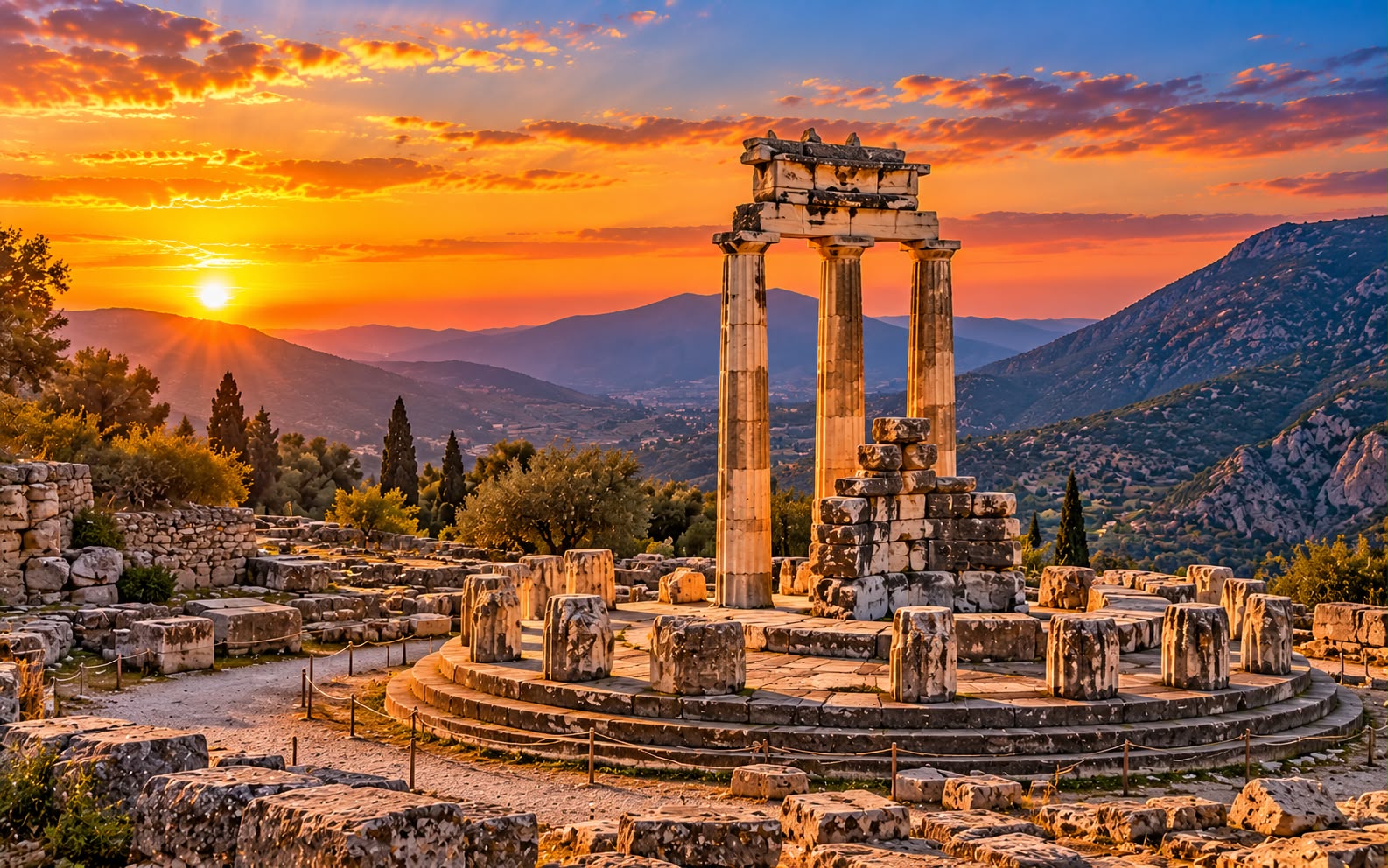
Greece in 14 days: Athens, Delphi, Meteora, Santorini and Crete
Two weeks is where Greece stops being Athens and two islands. Delphi was the centre of the ancient world, Meteora is six monasteries on rock pillars, and Crete is big enough to be its own country. A hire car for the mainland, ferries for the rest.
- Southern Europe
- 14 days
- ≈ AED 11,050 / person
- The mainland as well as the islands, which is the half most visitors never see
Before you go
Most Greek holidays are Athens and the Cyclades. Two weeks lets you see the mainland, which is where the ancient world actually happened, and Crete, which is less an island than a small country.
Delphi was the navel of the world — the oracle every Greek state consulted before going to war, in a ravine on the slope of Parnassus. Meteora is six working monasteries built on top of sandstone pillars, reached by steps cut into rock. Neither is on an island and neither is on most itineraries.
Then Santorini and Crete, which between them cover the volcano and the Minoans.
Seven days is Athens and Santorini; ten adds Mykonos.
Figure EUR 2,700 (≈ AED 11,055) per person. May, June, September and early October.
Before you go: the admin
Entry
- Schengen. Visa-free for many nationalities; Indian passport holders need a Schengen visa, applied for six to eight weeks ahead.
- 90 days in any 180 across the whole area.
- ETIAS is being phased in — check whether it applies by your dates.
Getting around
- Hire a car for the mainland loop — Athens, Delphi, Meteora and back is four days and the public alternative is slow buses.
- Return the car in Athens, then fly or sail to Santorini.
- Santorini to Crete is a 2-hour ferry to Heraklion, which runs daily in season and sparsely out of it.
- Fly home from Heraklion or Chania, which both have good connections — no need to backtrack.
- Book ferries on the operator sites, not aggregators, and never on the day you fly home; summer wind cancellations are routine.
Money
- Euro. Cards nearly everywhere; cash for small tavernas, village petrol and monastery entries.
- Lunch is at 2pm and dinner from 9pm. A taverna busy at seven is a tourist taverna.
Day by day
Day 1 — Athens, and the old quarters
- 14:00 — Drop bags in Plaka, Koukaki or Monastiraki, all within a fifteen-minute walk of the Acropolis.
- 16:00 — Plaka, Anafiotika and Monastiraki on foot. Anafiotika is a Cycladic village built into the Acropolis slope by island masons brought over in the 1840s — they built themselves homes in the style they knew.
- 18:30 — Lycabettus at sunset, by funicular or 25 minutes of steps.
- 20:30 — Dinner in Psyrri. Athens eats after nine.
Day 2 — The Acropolis and the Agora
- 08:00 — The Acropolis at opening. By ten it is a queue in full sun with no shade.
- Buy the combined ticket, which covers the Ancient Agora, Hadrian’s Library, the Roman Agora, Kerameikos and the Temple of Olympian Zeus, and pays for itself twice over.
- 10:30 — The Acropolis Museum, whose top floor is aligned with the Parthenon so the frieze sits as it was carved to be seen.
- 16:30 — The Ancient Agora and the Temple of Hephaestus, the best-preserved Doric temple in Greece.
Day 3 — The National Archaeological Museum
- 09:00 — The National Archaeological Museum: the Mask of Agamemnon, the Antikythera mechanism — a geared bronze computer from the second century BC — and the best bronze collection anywhere. Its hours differ from the Acropolis sites, so check the day before.
- 14:00 — Lunch in Exarchia or Kolonaki.
- 16:00 — Kerameikos, the ancient cemetery, which is on your combined ticket and almost always empty.
- Pick up the hire car tonight or first thing tomorrow.
Day 4 — Delphi
- 08:30 — Two and a half hours north-west, climbing Parnassus.
- 11:00 — The Sanctuary of Apollo: the Sacred Way up past the treasuries, the temple where the Pythia gave her answers, the theatre, and the stadium above it all. Go up to the stadium — most people stop at the temple and it is the best part.
- 13:30 — The museum, which holds the Charioteer, one of the few surviving large Greek bronzes and worth the trip on its own.
- 17:00 — Stay in Delphi village or Arachova above it, which is the prettier of the two and a ski town in winter.
Day 5 — North to Meteora
- 09:00 — Three hours north.
- 14:00 — Your first monastery. Six remain of the twenty-four built on sandstone pillars from the fourteenth century, reached originally by rope ladders and nets hauled up by windlass.
- Each closes on a different day of the week — check before you plan the order, because getting it wrong costs you one of the six.
- Dress code is enforced: long trousers for men, skirts for women. Wrap skirts are lent at the gates.
- 19:00 — Sunset from the Psaropetra viewpoint, which is free and is the photograph.
Day 6 — Meteora, and back to Athens
- 08:00 — Great Meteoron, the largest, and the one with the original windlass and net still in place.
- 09:30 — Rousanou and St Nicholas Anapafsas, the prettiest two, and Holy Trinity, the one from the Bond film — which is also the steepest climb.
- 13:00 — Drive back to Athens, about four and a half hours, and drop the car.
- Fly or sail to Santorini tomorrow.
Day 7 — Over to Santorini
- 09:00 — Fly or sail from Athens. The flight is 45 minutes; the ferry is five to eight hours.
- Stay in Imerovigli or Firostefani for the caldera at a fraction of Oia’s price, or Kamari for the beach. The caldera villages are 300m above the sea.
- 19:00 — Sunset from Imerovigli, not Oia. Oia at sunset is famously crowded; Imerovigli and the Skaros Rock path give the same light without it.
Day 8 — The caldera walk
- 06:00 — Fira to Oia, 10km along the rim, three to four hours. The best thing on the island, and there is no shade on it — which is the whole reason for the hour.
- 09:30 — Into Oia ahead of the coaches.
- 14:00 — The afternoon off. You have walked 10km in the sun.
- 19:00 — Wine tasting. The vines are trained into baskets on the ground against the wind, a method found almost nowhere else, and Assyrtiko is unlike any other white.
Day 9 — Akrotiri and the beaches
- 09:00 — Ancient Akrotiri, a Minoan town buried by the eruption around 1600 BC: three-storey buildings, drainage and frescoes, under a modern roof — which makes it the right thing to do in heat. This is the island’s real history.
- 11:30 — Red Beach below it, then Kamari or Perissa for a proper swim. Black and red volcanic sand, and the water shelves steeply.
- 17:00 — A last evening on the rim.
Day 10 — Ferry to Crete
- 09:00 — Two hours by ferry to Heraklion.
- 13:00 — The Heraklion Archaeological Museum, which holds the actual finds — the bull-leaping fresco, the snake goddesses, the Phaistos disc. Go here before Knossos, not after; it is the difference between seeing a site and understanding it.
- 17:00 — The Venetian harbour and the Koules fortress.
Day 11 — Knossos, then west
- 08:00 — Knossos at opening: the Minoan palace, Europe’s oldest city, and the labyrinth of the Minotaur legend. Arthur Evans’s reconstructions are controversial — he poured concrete and repainted frescoes to his own taste, and what you see is part excavation and part Edwardian imagination. Go anyway, having seen the museum yesterday.
- 12:00 — West along the coast.
- 14:00 — Rethymno, halfway, for the Venetian fortress and lunch in the old town.
- 17:00 — Into Chania. Two nights minimum — a Venetian harbour, an Ottoman mosque, and the best old town in Greece.
Day 12 — The Samaria Gorge
- 05:30 — The early bus to Omalos, which is how almost everyone does it.
- 07:00 — Into the gorge. 16km downhill through the White Mountains, five to seven hours, ending at Agia Roumeli — a beach you can only leave by boat. Open May to October only, and it is a serious walk: loose stone, no shortcuts, and no way out once you start.
- 15:00 — The ferry to Sougia or Chora Sfakion, then the bus back over the mountains.
- 20:00 — Back in Chania, and you will not want dinner standing up.
Day 13 — Elafonissi or Balos
- 07:30 — Elafonissi or Balos for the pink and turquoise beaches. Both need an early start or a boat — Balos is a rough track then a walk down, or a day boat from Kissamos; Elafonissi is a long drive that fills by ten.
- 16:00 — Back to Chania, and the harbour at dusk.
- 20:00 — Dinner in the old town, away from the waterfront where the prices are.
Day 14 — Home
- Fly home from Chania or Heraklion. Chania is the smaller airport and usually the easier one; Heraklion has more connections and is two and a half hours east.
Costs and practicalities
Best time to visit
- May, June, September and early October — warm, swimmable, and the mainland comfortable for walking. September is the best single month.
- July–August — 35°C and more, the islands at capacity, the meltemi cancelling ferries, and Samaria closed on the hottest days.
- April and late October — excellent for Athens, Delphi and Meteora; thinner on the islands, with some closures.
- November–March — the mainland is fine and very cheap, Crete stays open, and Santorini largely closes.
Orthodox Easter moves and is the biggest week of the year — book far ahead or avoid it.
Travel tips
- Hire the car for the mainland only, days four to six, and drop it in Athens.
- Check which Meteora monasteries close on which days.
- Dress for the monasteries — trousers and skirts, and the lent wraps run out.
- Never book a ferry for your departure day.
- Walk Fira to Oia at dawn.
- Read the Heraklion museum before Knossos, not after.
- Samaria is downhill but it is 16km on stones. Proper shoes, and do not start late.
- Fly home from Crete, not Athens.
What this trip actually costs
Two people, 13 nights, mid-range comfort, international flights excluded:
| Item | Cost |
|---|---|
| Hotels, 13 nights | EUR 2,200 (≈ AED 9,008) |
| Food and drink, 14 days | EUR 1,400 (≈ AED 5,732) |
| Ferries, internal flights and car hire | EUR 900 (≈ AED 3,685) |
| Sites, museums, monasteries and Samaria | EUR 600 (≈ AED 2,457) |
| Fuel, parking, buses and transfers | EUR 300 (≈ AED 1,228) |
| Total for two | EUR 5,400 (≈ AED 22,111) |
- Roughly EUR 2,700 (≈ AED 11,055) per person for two weeks across the mainland and two islands.
- The mainland is far cheaper than the islands — Delphi and Meteora cost a fraction of Santorini for the same standard.
- July and August run 50–80% above this, almost entirely on island accommodation.
- Hotel picks here are chosen on location, not on commission — always check prices and recent reviews before booking.
What to pack
- Proper walking shoes for Samaria, the caldera path and polished marble.
- Long trousers and a wrap skirt for Meteora.
- A hat and high-factor sun cream — no shade at Delphi, the Acropolis or on the rim walk.
- A light layer for ferry decks and mountain evenings.
- Swimwear and reef shoes for volcanic and pebble beaches.
- A Type C/F adapter, 230V.
FAQ
Is the mainland worth four of the fourteen days? Yes. Delphi and Meteora are among the most remarkable places in the country and almost no island-focused visitor sees them.
Do I need a car? For the mainland loop, yes — buses to Delphi and Meteora are slow and infrequent. On the islands, a car for two days on Santorini and the whole stay on Crete.
Is Knossos worth it given the reconstructions? Yes, with the caveat understood. Evans rebuilt in concrete and repainted frescoes speculatively. Visit the Heraklion museum first and you will read the site far better.
How hard is the Samaria Gorge? 16km downhill on loose stone, five to seven hours, with no way out once you start. It is a serious walk in proper shoes, not a stroll.
Santorini and Crete, or two Cyclades? Santorini and Crete. Crete is big, varied and open year-round, and it gives the trip something the Cyclades cannot — mountains, gorges and a proper city.
Prices and entry rules change, and what you need depends on your passport; last checked 26 October 2026, so confirm with the embassy or your airline before booking.


