 The Itinerary
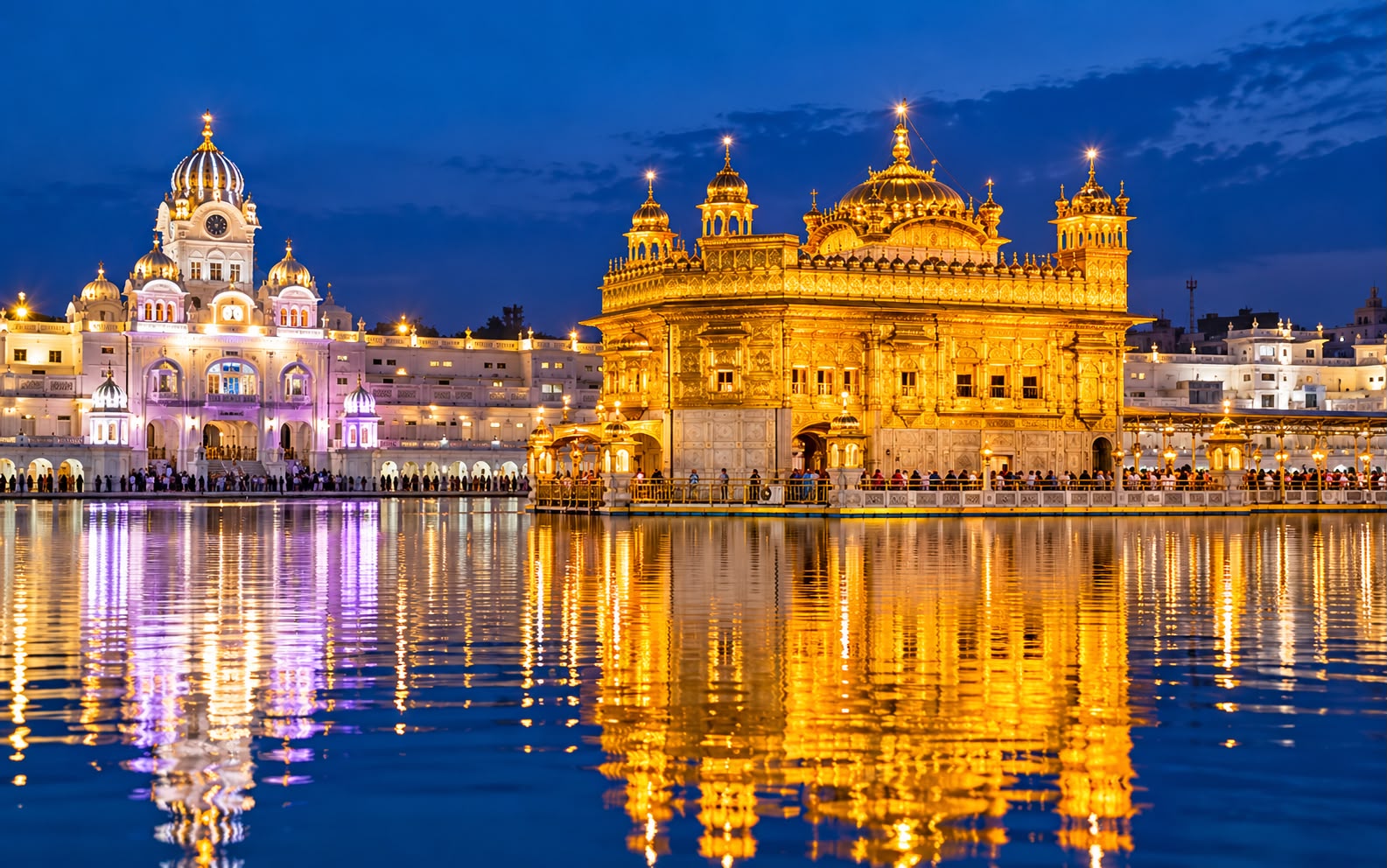
Amritsar in 3 days: the Golden Temple, Jallianwala Bagh and Wagah
Three days is all Amritsar needs and more than most people give it — the Golden Temple at dawn and after dark, the kitchen that feeds 100,000 people a day for nothing, Jallianwala Bagh next door, the Partition Museum, and the border ceremony at Wagah.
- South Asia
- 3 days
- ≈ AED 550 / person
- A long weekend around one of the most welcoming buildings on earth
Before you go
Three days is the right length for Amritsar, and more than the overnight stop most itineraries give it.
The city is really one building and its consequences. The Harmandir Sahib — the Golden Temple — is open to everyone, free, at every hour, and its kitchen feeds around 100,000 people a day without charge or distinction. A hundred metres away is Jallianwala Bagh, where British troops fired on a trapped crowd in 1919. Twenty-eight kilometres west is the Wagah border, where India and Pakistan lower their flags at each other every evening in front of cheering crowds.
Those three places in one small city are why three days is worth it and one night is not.
Varanasi is the other great pilgrimage city on this site, and a very different experience.
Figure INR 14,000 (≈ AED 547) per person — the cheapest trip on this site, partly because the main sight costs nothing. October to March.
Before you go: the short version of the admin
Visas
- e-Visa at the official indianvisaonline.gov.in/evisa and nowhere else. Amritsar (ATQ) is an e-Visa port of entry.
- Six months’ validity, two blank pages.
Flying in from the Gulf
- Amritsar (ATQ) takes directs from Dubai, Sharjah and Doha — about three and a half hours, and it is a far better way in than flying to Delhi and driving.
- From Delhi, the Vande Bharat Express does it in about five hours and is the civilised option; the drive is eight.
- This is an easy trip for Gulf-based families. Short flight, one hotel, no internal transfers, and a city where the central attraction is free and open at 3am.
Golden Temple etiquette
- Heads must be covered by everyone, regardless of faith or gender. Bandanas are handed out free at the entrance, or bring a scarf.
- Shoes off and socks off at the shoe deposit, which is free and staffed by volunteers. You then walk through a shallow water channel before entering.
- No alcohol or tobacco anywhere in the complex, and do not arrive having drunk.
- Photography is allowed around the pool but not inside the sanctum.
- Shoulders and legs covered. Nobody will be rude about it, which is rather the point.
- Everyone is welcome. This is not a grudging tolerance; it is the founding principle of the place.
Money
- UPI QR payments everywhere.
- ₹2,000 in small notes. You will barely need it — the temple takes nothing and the langar is free.
Day by day
Day 1 — The Golden Temple, twice
- 13:00 — Arrive and drop bags on Heritage Street. The approach is pedestrianised and everything in Amritsar is a short auto ride from the complex, so stay here rather than out by the airport.
- 14:00 — The Harmandir Sahib, first visit. It sits in the middle of the Amrit Sarovar, the pool that gives the city its name, reached by a causeway. The upper storeys carry roughly 750kg of gold leaf, added by Maharaja Ranjit Singh in the 1830s. Head covered, shoes and socks off, and you walk through a water channel on the way in.
- 14:30 — Walk the parikrama, the marble walkway around the pool, clockwise and slowly, at least once. This is the best thing to do in Amritsar and it costs nothing.
- 15:30 — Eat in the langar. The free kitchen serves dal, roti, rice and kheer continuously, to anyone, seated on the floor in rows. You queue, you sit, you are served. Stay afterwards and volunteer — most visitors end up washing dishes, and should; it is the point of the place rather than a curiosity.
- 20:00 — Come back after dark. Gold against black water, the reflection, and the continuous recitation from inside all carry differently at night. The complex never closes, so there is no wrong hour.
Day 2 — Jallianwala Bagh, the Partition Museum, and Wagah
- 04:00 — The Palki Sahib ceremony, roughly this hour in winter and earlier in summer, when the Guru Granth Sahib is carried into the temple on a palanquin. Cold, early, and worth the alarm. Go back to bed afterwards.
- 10:00 — Jallianwala Bagh, a hundred metres from the temple. On 13 April 1919 Brigadier-General Dyer’s troops fired into a walled garden holding a trapped festival crowd for ten minutes. The narrow entrance lane they blocked is still there, with the bullet-marked walls and the well people jumped into. Official British figures put the dead at 379; Indian counts run past a thousand. The garden was heavily renovated in 2021 and much criticised for it — the lane is now a lit corridor with murals.
- 11:00 — The Partition Museum in the old Town Hall, the world’s only museum devoted to 1947, built largely from survivors’ oral histories. Give it two full hours, and note it is closed on Mondays. It is the best explanation of why this border exists, and it sets up the afternoon completely.
- 13:30 — Lunch, then collect anything you need. Large bags and cameras are refused at Wagah — take a phone and nothing else.
- 14:30 — Leave for the Wagah border, 28km west, about 45 minutes.
- 15:30 — Arrive and queue. Two hours early is not excessive; there are separate queues and stands, passports are checked, and the good seats go first.
- 17:15 — The Beating Retreat, around this hour in winter and about an hour later in summer. High-stepping, moustache-bristling, flag-lowering theatre performed simultaneously by Indian and Pakistani forces to roaring crowds on both sides. Genuinely stirring and faintly absurd, and the crowd is the real show.
- 19:30 — Back in Amritsar.
Day 3 — The old city, and out
- 07:00 — The walled city on foot, before it wakes properly. The lanes around Katra Jaimal Singh and the bazaars sell phulkari embroidery, juttis and woollens.
- 08:30 — Breakfast properly. Amritsar is one of the great food cities of India: kulcha straight from a tandoor with chole, Amritsari fish fry, and lassi in a steel tumbler from a shop that has done one thing for sixty years.
- 10:00 — The Durgiana Temple, a Hindu temple built on the Golden Temple’s plan and also set in a tank.
- 11:30 — Gobindgarh Fort if you have the time — eighteenth-century, now a rather commercial heritage attraction.
- 13:00 — One last walk round the parikrama. Most people do.
- Amritsar airport is about 30 minutes from the centre.
Costs and practicalities
Best time to visit
- October to March — the season. Days 18–25°C, clear, and the marble is walkable barefoot.
- November to February are the best of it, though December and January nights drop to 4–7°C and the dawn ceremony is genuinely cold on bare feet.
- Baisakhi in mid-April is the great Sikh festival and the city fills completely.
- April to June — 40°C+, and the marble parikrama becomes impossible barefoot in the middle of the day. Go at dawn and after dark or not at all.
- July to September — monsoon, humid, and the Wagah ceremony can be cancelled in heavy rain.
Travel tips
- See the temple at least twice — once at night, once at dawn. They are different buildings.
- Eat in the langar, and volunteer for twenty minutes. It is the point of the place rather than a curiosity.
- Carry a scarf so you are not reliant on the free bandanas.
- Socks come off too, not just shoes.
- Wagah: arrive two hours early, take a small bag and no camera. Confirm it is running — it is suspended during periods of India–Pakistan tension, which happens.
- The Partition Museum before Wagah, on the same day. The ceremony lands completely differently afterwards.
- In midsummer, the marble will burn your feet. Dawn or evening only.
- Amritsar is a dry-ish city around the complex — no alcohol near the temple, and plenty elsewhere.
What this trip actually costs
Two people, 2 nights, mid-range comfort, international flights excluded:
| Item | Cost |
|---|---|
| Hotel, 2 nights near Heritage Street | INR 9,000 (≈ AED 351) |
| Airport transfers, Wagah return trip, autos around the city | INR 7,000 (≈ AED 273) |
| Partition Museum, Gobindgarh, guide | INR 3,000 (≈ AED 117) |
| Food and drink, 3 days | INR 6,000 (≈ AED 234) |
| SIM, tips, extras | INR 3,000 (≈ AED 117) |
| Total for two | INR 28,000 (≈ AED 1,093) |
- Roughly INR 14,000 (≈ AED 547) per person — the cheapest itinerary on this site, and it is not a compromise. The Golden Temple is free, the langar is free, Jallianwala Bagh is free, and Wagah is free.
- You are essentially paying for a hotel, a car to the border and very good food.
- The temple runs free accommodation for pilgrims in its sarais, including basic rooms for foreign visitors. It is genuinely used by travellers, though rooms are limited and the spirit of it is pilgrimage rather than budget tourism.
- Hotel picks here are chosen on location, not on commission — always check prices and recent reviews before booking.
What to pack
- A scarf or bandana for covering your head.
- Socks you do not mind losing, and shoes that slip off.
- A warm layer for the 4am ceremony in winter — the marble is cold and you are barefoot.
- A small bag for Wagah; large ones are refused.
- Modest clothing — shoulders and legs covered throughout.
FAQ
Is three days too long for Amritsar? No, and one night is too short. The temple needs two visits at different hours, Wagah takes an afternoon, and the Partition Museum deserves two hours on its own.
Can non-Sikhs enter the Golden Temple? Yes, everyone, at any hour, free. Cover your head, remove shoes and socks, and dress modestly. You will be made welcome.
Is the langar really free? Yes, for everyone, with no expectation of payment or conversion. Around 100,000 meals a day, more at weekends, run almost entirely by volunteers. You can donate, and you can help.
Is the Wagah ceremony worth it? Yes, with the Partition Museum seen first. Arrive two hours early and check it is running — it is suspended during periods of India–Pakistan tension.
Can I combine this with Delhi? Easily. The Vande Bharat Express is about five hours each way, which makes Amritsar a comfortable extension to a Golden Triangle trip.
Prices and entry rules change, and what you need depends on your passport; last checked 26 October 2026, so confirm with the embassy or your airline before booking.


