 The Itinerary
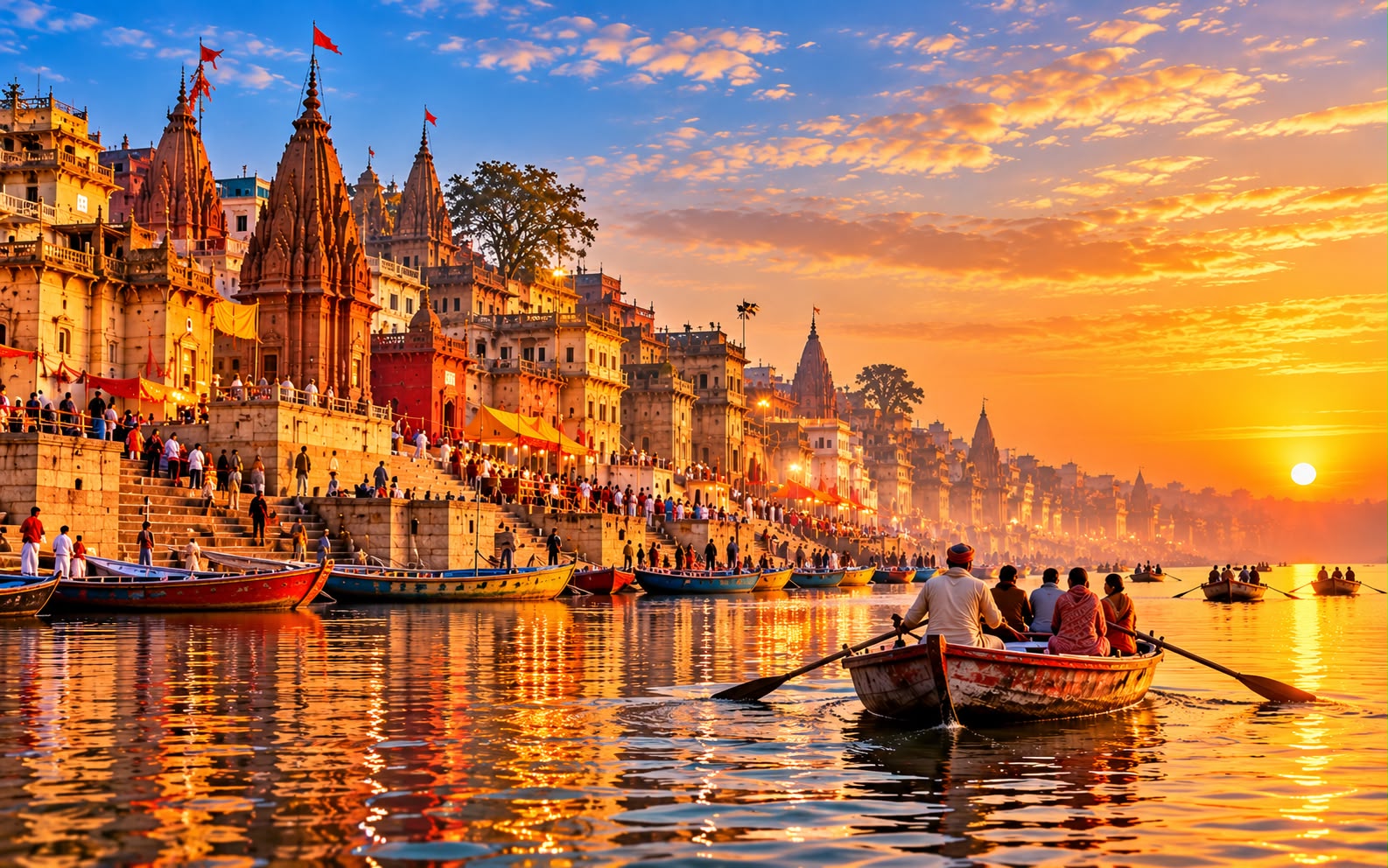
Varanasi in 5 days: the ghats, Sarnath, Ayodhya and Prayagraj
Five days around the oldest living city on earth — two nights on Varanasi's ghats with a dawn boat and the evening aarti, the Buddha's first sermon at Sarnath, then Ayodhya and the confluence at Prayagraj. One region, four cities, and no flying between them.
- South Asia
- 5 days
- ≈ AED 1,000 / person
- The Ganges plain's four great religious cities in one loop
Before you go
Five days here is Varanasi and the three cities around it: the Buddha’s first sermon at Sarnath, Ayodhya on the Sarayu, and the river confluence at Prayagraj. All four sit within a few hours of each other on the Ganges plain, and together they cover most of what the plain means to four religions.
Varanasi is the reason you come and two nights is the minimum. It is the oldest continuously inhabited city on earth, and the most intense place most travellers will go. The dawn hour on the river is what people remember for the rest of their lives.
The Varanasi and Amritsar route pairs this city with the Golden Temple instead, if the contrast appeals more than the region.
Figure INR 26,000 (≈ AED 1,015) per person. October to March.
Before you go: the short version of the admin
Visas
- e-Visa at the official indianvisaonline.gov.in/evisa and nowhere else. Varanasi (VNS) is an e-Visa port of entry.
- Six months’ validity, two blank pages.
Flying in from the Gulf
- Varanasi (VNS) has limited direct international service and is usually reached via Delhi, about 90 minutes by air.
- From the Gulf, fly to Delhi (directs from everywhere) and connect, or take the overnight train, which is 12–14 hours and an experience in itself.
- Ayodhya now has an airport (AYJ), opened in 2024, with domestic connections — useful if you want to reverse this loop.
- The whole route is drivable. Varanasi–Ayodhya is about 4 hours, Ayodhya–Prayagraj about 4, Prayagraj–Varanasi about 3.
What to expect, honestly
- Varanasi is confronting. Cremations happen in public and continuously, the lanes are medieval and crowded, cows and traffic share them, and nothing is arranged for a visitor’s comfort.
- It is also extraordinary, and people who give it two days almost never regret it.
- The touts are persistent around the main ghats and the station. A clear, friendly, repeated no works; engaging does not.
Money
- UPI QR payments everywhere.
- ₹4,000 in small notes for boats, offerings and autos.
- Cards at hotels only, realistically.
Day by day
Day 1 — Arrive, and the evening aarti
- 15:00 — Get your bearings on foot along the southern ghats, which are calmer. Assi Ghat is the usual place to start. The ghats run about 6.5km along the west bank in a continuous stone staircase — 84 of them, each with its own name and purpose.
- 17:30 — Book a boat at the ghat for a fixed price, agreed before you step in, for the aarti.
- 18:30 — Ganga Aarti at Dashashwamedh Ghat: synchronised priests, tiered brass lamps, bells, incense and a very large crowd. Watch from the boat — you see it properly and you are not in the crush.
- Stay near the ghats, not near the station. The old city is where you want to be able to walk out at 05:00.
Day 2 — Dawn on the river, and the lanes
- 05:30 — The dawn boat, and it is the whole trip. Leave in the dark. The sun comes up across the flat eastern bank and the entire west bank begins at once: bathers, laundry, yoga, prayer, buffalo, pilgrims pouring water back into the river. Row, do not motor, and go north from Assi.
- 06:30 — Past Manikarnika Ghat, a working cremation ground. Cremations burn continuously, day and night, and families are present. Photography is forbidden and deeply resented — put the phone away entirely. Anyone offering a “viewing” from an upper floor for a donation is running a scam on the grieving.
- 08:30 — Breakfast, then the lanes. The old city behind the ghats is a medieval warren, genuinely easy to get lost in, and best entered without a destination.
- 11:00 — Kashi Vishwanath Temple, one of the twelve Jyotirlingas and the most important Shiva temple in India. Security is airport-grade, phones are not allowed, and the inner sanctum is restricted to Hindus. The Vishwanath Corridor, opened 2021, cleared a wide approach from the river through what were previously lanes and houses.
- 19:00 — A sitar or classical concert. Varanasi is one of the homes of Hindustani music and small venues run nightly.
Day 3 — Sarnath, then on to Ayodhya
- 08:30 — Sarnath, 10km out, and a complete change of register: quiet, green and ordered. This is where the Buddha gave his first sermon after his enlightenment, setting out the Four Noble Truths — one of the four great Buddhist pilgrimage sites.
- 09:00 — The Dhamek Stupa, 43 metres, in its present form from around 500 AD on a much older base, and the Mulagandha Kuti Vihara beside the deer park.
- 10:00 — The Archaeological Museum, which holds the Lion Capital of Ashoka — the third-century-BC sculpture that is the State Emblem of India and sits on every banknote and passport. Worth the trip on its own. Closed Fridays.
- 12:30 — Drive to Ayodhya, about four hours.
- 17:00 — Into Ayodhya, and the Sarayu ghats at sunset, quieter than Varanasi’s and worth an hour.
Day 4 — Ayodhya, then Prayagraj
- 07:00 — The Ram Mandir, early. Queues are long on weekends and festival days, and security is airport-style with no phones — plan a locker or leave them at the hotel.
- Ayodhya sits on the Sarayu and is held in the Ramayana to be the birthplace of Rama, one of Hinduism’s seven sacred cities. The temple was consecrated in January 2024. The site was previously occupied by the Babri Masjid, demolished in 1992; the dispute ran through Indian courts until a 2019 Supreme Court judgment awarded the site for the temple and allotted separate land for a mosque. It remains a politically sensitive subject and visitors are best served by observing rather than debating it.
- 09:30 — Hanuman Garhi, up 76 steps, and Kanak Bhawan — both older and calmer than the new temple.
- 12:00 — Drive to Prayagraj, about four hours.
Day 5 — Prayagraj, and the confluence
- 07:00 — The Triveni Sangam, the meeting of the Ganges and the Yamuna and, by tradition, the invisible Saraswati. The two visible rivers run different colours and you can see the line where they meet. Take a boat out — it is the only way to see it, and the boatmen row you to the exact line. Early, before the haze lifts and the crowds build.
- This is the site of the Kumbh Mela, the largest human gathering on earth: the Magh Mela each January–February, and the far larger Kumbh on six- and twelve-year cycles, when tens of millions come. If your dates fall in a Kumbh year that is a different trip entirely — book a year out or avoid it deliberately.
- 10:00 — Akbar’s fort on the bank, largely military and only partly accessible, with the Ashoka pillar inside.
- 11:30 — Anand Bhavan, the Nehru family house and now a museum. The most interesting building in the city and a good account of the independence movement. Closed Mondays.
- 14:00 — Back to Varanasi, about three hours, or fly out of Prayagraj.
Costs and practicalities
Best time to visit
- October to March — the season, and the only comfortable one. Days 20–28°C, and the dawn river is cold enough for a jacket.
- November and February are the best of it. December and January bring dense Gangetic fog, which delays flights and trains and can hide the far bank entirely at dawn — atmospheric, and a real risk to tight connections.
- Dev Deepawali, fifteen days after Diwali in November, lights every ghat with oil lamps and is the most spectacular night of the Varanasi year. Book months ahead.
- April to June — 42–45°C on the plain. The ghats are stone and there is no shade.
- July to September — monsoon. The river rises dramatically, lower ghats flood, boats are restricted and the aarti sometimes moves. Not the time for this trip.
Travel tips
- Two nights minimum in Varanasi. One is not enough for both a dawn boat and an evening aarti.
- Camera away at Manikarnika, completely.
- Agree every boat price before boarding.
- Phones are banned at Kashi Vishwanath and the Ram Mandir; plan a locker or leave them at the hotel.
- Walk the lanes without a destination — and accept you will get lost, which is fine.
- Do not swim in the Ganges here. Water quality at Varanasi is genuinely poor regardless of what you see pilgrims doing.
- Drink bottled or filtered water only, and be stricter here than elsewhere in India.
- A car and driver for all five days is the right call for this loop — ₹2,800–3,500 a day, and the alternative is slow trains.
- Check for Kumbh and Magh Mela dates before booking anything in Prayagraj.
What this trip actually costs
Two people, 4 nights, mid-range comfort, international flights excluded:
| Item | Cost |
|---|---|
| Hotels, 4 nights (2 Varanasi + 1 Ayodhya + 1 Prayagraj) | INR 20,000 (≈ AED 781) |
| Car and driver, 5 days, including airport runs | INR 14,000 (≈ AED 547) |
| Boats, museums, guides, entries | INR 6,000 (≈ AED 234) |
| Food and drink, 5 days | INR 8,000 (≈ AED 312) |
| SIM, tips, extras | INR 4,000 (≈ AED 156) |
| Total for two | INR 52,000 (≈ AED 2,031) |
- Roughly INR 26,000 (≈ AED 1,015) per person, and this is one of the cheaper routes in India — the temples are free, the boats are inexpensive, and only Varanasi has hotels with real prices.
- Varanasi’s riverfront heritage hotels are the one line that can run away with the budget, and a river-facing room is worth paying for.
- Ayodhya’s accommodation is new and thin. It has expanded rapidly since 2024 and quality is uneven; book somewhere established.
- Hotel picks here are chosen on location, not on commission — always check prices and recent reviews before booking.
What to pack
- A warm layer for the dawn boat, which is genuinely cold on the water in December and January.
- Shoes that slip off, and socks for temple stone.
- Shoulders and knees covered throughout, and a scarf for heads.
- Hand sanitiser, and bottled water discipline.
- A torch for the lanes, which are unlit and uneven after dark.
- A bag you can leave behind — phones and bags are refused at two of the major temples.
FAQ
Is Varanasi too intense for a first trip to India? It is confronting, and it is also the most extraordinary city in the country. Two nights, a dawn boat, and no camera at the cremation ghats is the way to do it. If you are unsure, see it with the Golden Triangle and Kerala rather than alone.
Can I photograph the cremations? No. It is forbidden, deeply offensive, and families are present. Put the phone away before you reach Manikarnika.
Can non-Hindus enter the temples? The complexes, generally yes. The inner sanctum at Kashi Vishwanath is restricted. Ayodhya’s Ram Mandir admits all visitors through security, with no phones.
Is Ayodhya worth the detour? If you are interested in the Ramayana or in contemporary India, yes. It is a new and very busy pilgrimage site rather than an old atmospheric one.
Should I avoid the Kumbh Mela? Not necessarily — it is one of the great sights on earth. But it is not this itinerary. Tens of millions of people arrive, and it needs planning a year ahead.
Prices and entry rules change, and what you need depends on your passport; last checked 26 October 2026, so confirm with the embassy or your airline before booking.


