 The Itinerary
Himachal in 6 days: Shimla, Kufri, Manali and Solang
Six days on the standard Himachal circuit — the Kalka–Shimla toy train, the Mall and the ridge at Shimla, then the Kullu valley for Manali's temples, Solang's meadows and the Atal Tunnel into Lahaul. Two hill stations, one long drive between them, no altitude problems.
- South Asia
- 6 days
- ≈ AED 1,150 / person
- The classic hill-station pair, with a UNESCO railway to get there
Before you go
Six days is the Himachal circuit most people actually do: Shimla, the drive north through the Kullu valley, and Manali.
It is popular for good reasons and crowded for the same ones. Shimla was the summer capital of British India and still looks it; Manali is the gateway to the high passes and the best base in the state. Between them sit apple orchards and the Beas river.
Nothing here is seriously high, which makes this the easiest Himalayan trip on this site — Shimla is 2,200m and Manali 2,050m, and altitude is a non-issue unless you go over Rohtang.
Eight days swaps Shimla for the Parvati valley and Dharamshala, which is the better trip if you have seen one hill station already. Spiti is the hard version, over the passes behind Manali.
Figure INR 30,000 (≈ AED 1,171) per person. March to June and October; July to September is landslide season.
Before you go: the short version of the admin
Visas
- e-Visa at the official indianvisaonline.gov.in/evisa and nowhere else. You will arrive through Delhi.
- No permits needed for anything on this route except Rohtang Pass.
Getting there from the Gulf
- Fly to Delhi — directs from every Gulf hub — then overland.
- The Kalka–Shimla Railway is the good way in: an overnight train from Delhi to Kalka, then five hours on a narrow-gauge UNESCO World Heritage line through 102 tunnels and over 800 bridges. Book the toy train weeks ahead; it sells out.
- By road Delhi–Shimla is about 350km / 8 hours.
- Bhuntar (KUU) near Manali and Shimla (SLV) both have very limited and weather-dependent flights.
- Manali back to Delhi is 12–14 hours by road. The overnight Volvo coach is the standard answer and it is better than it sounds.
Rohtang Pass — the one permit
- Rohtang (3,978m) requires an online permit, with a daily cap on vehicles, booked through the Himachal government portal.
- It is closed on Tuesdays for maintenance, and closed entirely from roughly November to April.
- The Atal Tunnel, opened in 2020, runs 9km beneath the pass and needs no permit — it reaches Lahaul year-round in about ten minutes. For most visitors the tunnel is the better option and Rohtang is the nostalgia.
Money
- UPI QR payments work throughout.
- ₹5,000 in small notes for ponies, parking and small towns.
Day by day
Day 1 — Up to Shimla
- Arrive on the toy train if you have booked it: a five-hour climb through 102 tunnels, and the best approach in the Indian Himalaya. Book weeks ahead; it sells out.
- 16:00 — The Ridge and the Mall, pedestrianised, colonial, and the centre of everything. Christ Church on the Ridge is the second-oldest in north India.
- 17:30 — The Gaiety Theatre, a Victorian playhouse restored to working order.
- Sleep at 2,200m, which is the first step of the ladder if you are carrying on to Spiti later.
Day 2 — Jakhoo, and the Viceregal Lodge
- 07:30 — Jakhoo Temple, the highest point in Shimla, up a steep path or by road, with a 33m Hanuman statue on the summit. Go early, before the monkeys are fully awake — they are aggressive and organised here, they take glasses, phones and food, and they will trade them back. Carry a stick from the vendors and bring nothing loose.
- 10:30 — Viceregal Lodge (Rashtrapati Niwas), where the Simla Conference and the partition discussions took place. The guided tour is short and genuinely interesting. Closed Mondays.
- 14:00 — Kufri, 16km out, for the view and the horse rides. Very crowded and heavily commercialised — go now or skip it for Mashobra and Naldehra, which are quieter and prettier.
Day 3 — North to Manali
- 06:30 — Leave early. Eight to ten hours up the Kullu valley, and this is the long day of the trip.
- 10:00 — Pandoh Dam, where the Beas is bottled up.
- 13:00 — Kullu for the shawl workshops and lunch. The valley is apple country — orchards the whole way, harvested August to October.
- 17:00 — Into Manali. Stay in Old Manali or Vashisht, not the main bazaar, unless you want the noise.
Day 4 — Manali
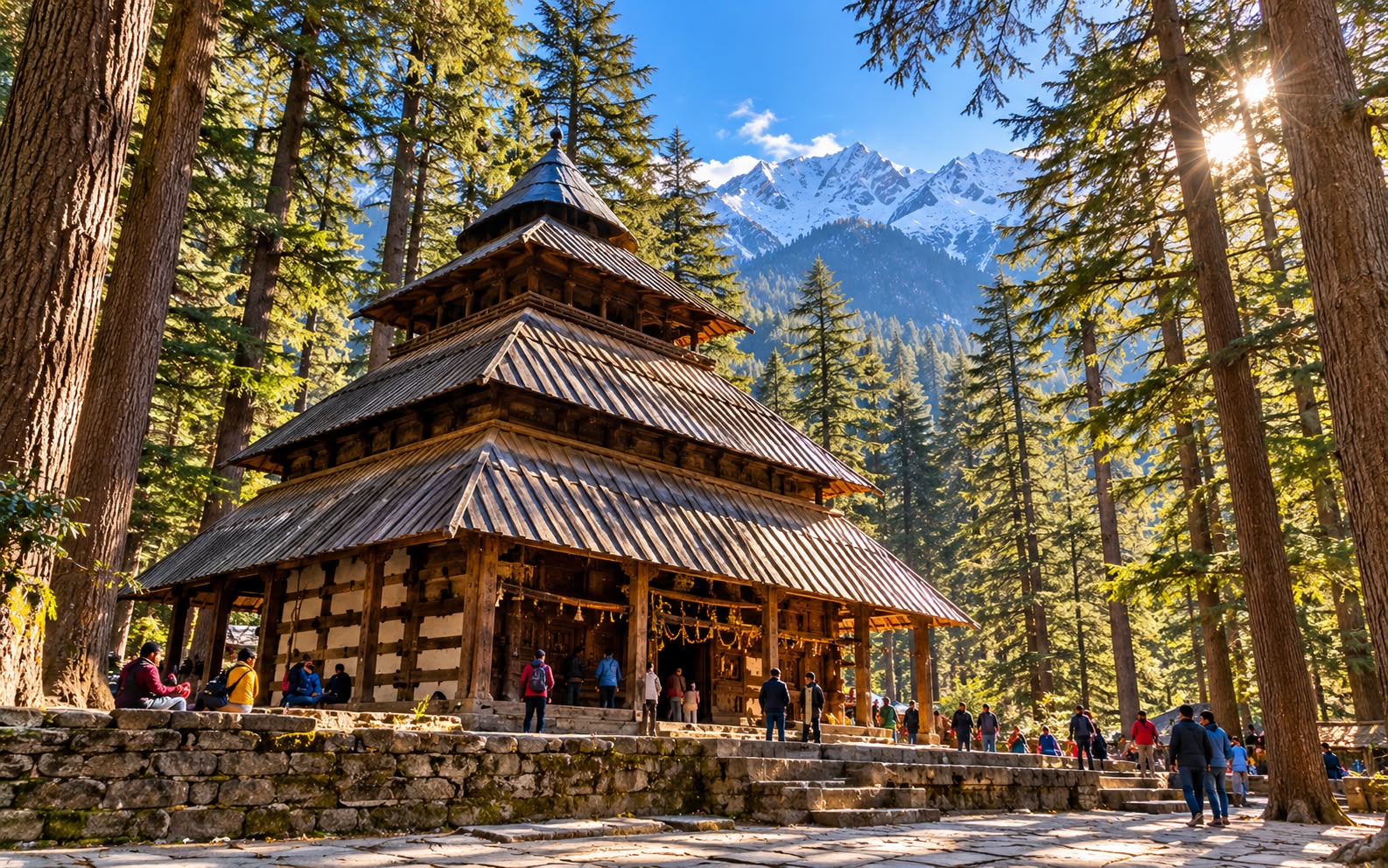
- 07:30 — Hadimba Devi Temple, 1553: a four-tiered wooden pagoda in a deodar grove, built around a rock bearing a goddess’s footprint. Go now — it is the busiest thing in Manali by ten.
- 09:00 — Manu Temple in Old Manali, and the village lanes above it.
- 10:30 — Vashisht across the river for the hot sulphur springs, free, public and very hot.
- 11:30 — Jogini Falls, a 45-minute walk up from Vashisht and the best short hike in Manali.
- 14:30 — Naggar Castle, 20km south: 500-year-old timber and stone, with the Roerich Art Gallery in the house where Nicholas Roerich spent his last years painting the Himalaya.
- 17:30 — Old Manali’s cafés, which are an institution.
Day 5 — Solang, and over the tunnel
- 09:00 — Solang Valley, 13km up: paragliding, zorbing, a ropeway, and in winter the skiing. A commercial activity park in a spectacular setting — treat it as that and it is a good morning.
- 12:00 — The Atal Tunnel to Lahaul. Nine kilometres under Rohtang, and on the far side the landscape changes completely: dry, bare and high, the beginning of the trans-Himalaya. No permit needed, and it takes about ten minutes.
- 13:00 — Sissu and its waterfall, and Koksar, both just beyond the tunnel mouth. An easy half-day.
- Or Rohtang Pass itself if you have the permit and the day is clear — the older, slower, more dramatic route over the top. Closed Tuesdays for maintenance, and the online permit has a daily vehicle cap.
- 18:00 — Back in Manali.
Day 6 — Down, or out
- 16:00 — The overnight Volvo to Delhi leaves late afternoon and arrives in the morning, which saves a hotel night and a day.
- Or fly from Bhuntar, if the weather is cooperating — which is not guaranteed.
- Build a buffer before an international connection. The Manali road is long and landslides are routine outside winter.
Costs and practicalities
Best time to visit
- March to June — the main season. Rhododendron in spring, everything open, and Rohtang usually opens in May. May and June are extremely busy with Indian holidaymakers.
- October to mid-November — the best of the year, honestly: clear air after the monsoon, autumn colour, apple harvest just finished, and far fewer people.
- July to September — the monsoon, and Himachal is the state worst affected by landslides in India. The Kullu valley road closes regularly and the 2023 floods destroyed sections of it. It is cheap and green and it is a genuine risk.
- December to February — snow in both towns, Rohtang closed, the Atal Tunnel usually open. Solang has skiing. Cold, pretty, and the roads can close for days.
Avoid the monsoon on this route specifically. The Chandigarh– Manali highway runs along rivers for most of its length and it is the section that fails.
Travel tips
- Book the toy train weeks ahead. It is the best part of reaching Shimla.
- Use the Atal Tunnel rather than chasing a Rohtang permit, unless the pass itself is the point.
- Rohtang is closed on Tuesdays.
- Go to Hadimba before 9am.
- Shimla’s monkeys will take your glasses. This is not a joke and the vendors selling sticks are not either.
- Stay in Old Manali or Vashisht.
- May, June and the New Year week are peak domestic holiday season — hotels double and the roads jam.
- The Manali–Delhi overnight coach is a good use of a night.
- Check road status before travel days between June and September.
What this trip actually costs
Two people, 5 nights, mid-range comfort, international flights excluded:
| Item | Cost |
|---|---|
| Hotels, 5 nights (2 Shimla + 3 Manali) | INR 24,000 (≈ AED 937) |
| Toy train, car and driver, Delhi coach or transfers | INR 20,000 (≈ AED 781) |
| Rohtang or tunnel trip, Solang activities, temples, Viceregal Lodge | INR 8,000 (≈ AED 312) |
| Food and drink, 6 days | INR 5,000 (≈ AED 195) |
| SIM, tips, extras | INR 3,000 (≈ AED 117) |
| Total for two | INR 60,000 (≈ AED 2,343) |
- Roughly INR 30,000 (≈ AED 1,171) per person, which makes this one of the cheaper weeks on the site. Himachal is a domestic holiday market and priced accordingly.
- The food line is very low because the food here is simple and inexpensive — dhabas, cafés and hotel meals.
- Solang’s activities are individually priced and add up quickly; paragliding alone can be ₹3,000–5,000 a person.
- Peak season doubles the hotel line. May, June and the week around New Year are the ones to avoid if budget matters.
- Hotel picks here are chosen on location, not on commission — always check prices and recent reviews before booking.
What to pack
- Layers. Both towns are 2,000m+, and evenings are cold even in June.
- A warm jacket if you are crossing to Lahaul — it is markedly colder on the far side of the tunnel.
- Walking shoes for Jogini Falls and the Jakhoo climb.
- Waterproofs, outside winter.
- Nothing loose or shiny in Shimla — see monkeys, above.
- Sun cream. Hill-station sun at altitude burns through cloud.
FAQ
Is six days enough for Himachal? For Shimla and Manali, comfortably — most of the driving is the one long day between them. It is not enough for Spiti or Dharamshala.
Shimla or Manali? Manali, for most people. It is a better base, has more to do around it, and the Atal Tunnel puts a genuinely different landscape half an hour away. Shimla is the more interesting town historically.
Do I need a Rohtang permit? Only for the pass itself. The Atal Tunnel needs none and reaches the same valley in ten minutes.
Is this good with children? Yes — the toy train, Solang’s activities and short walks make it one of the easier family trips in the Indian Himalaya.
Can I add Spiti? Not in six days. Spiti is its own eight-day route and the passes behind Manali are only open June to October.
Prices and entry rules change, and what you need depends on your passport; last checked 26 October 2026, so confirm with the embassy or your airline before booking.


