 The Itinerary
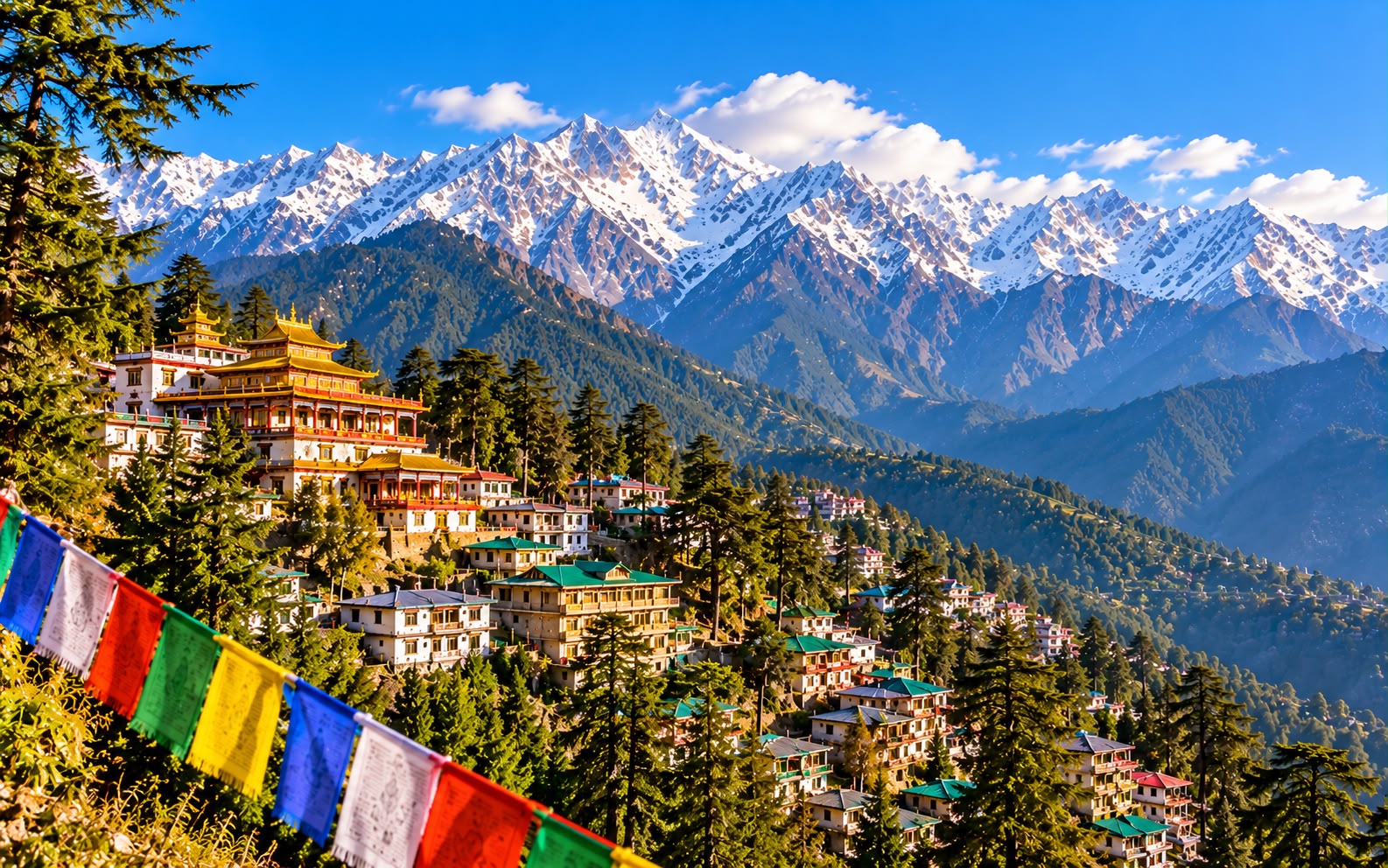
Himachal in 8 days: Manali, the Parvati valley and Dharamshala
Eight days through the other Himachal — Manali and the Atal Tunnel, the Parvati valley at Kasol and the hot springs at Manikaran, then across to Dharamshala and McLeod Ganj, where the Dalai Lama has lived since 1959. More interesting than the Shimla circuit and barely harder.
- South Asia
- 8 days
- ≈ AED 1,500 / person
- Skipping Shimla for the Parvati valley and the Tibetan exile capital
Before you go
Eight days is Himachal without Shimla, which for most people is the better trip.
Manali for the Kullu valley and the tunnel through to Lahaul. The Parvati valley at Kasol, which is a different world entirely — Israeli cafés, pine forest and a Sikh pilgrimage town built over boiling springs. And McLeod Ganj, where the Dalai Lama has lived since 1959 and where Tibetan exile government, monasteries and institutes sit in a ridge-top village above Dharamshala.
Six days does the classic Shimla–Manali pair if it is your first time in the Indian hills. This route assumes it is not.
Figure INR 38,000 (≈ AED 1,484) per person. March to June and October; avoid July to September, when Himachal’s roads fail.
Before you go: the short version of the admin
Visas
- e-Visa at the official indianvisaonline.gov.in/evisa and nowhere else. Arrive through Delhi.
- No permits needed on this route except Rohtang Pass, which the Atal Tunnel makes optional.
Getting there from the Gulf
- Fly to Delhi, then overland.
- Delhi → Manali is 12–14 hours; the overnight Volvo coach is the standard way and saves a hotel night.
- Dharamshala → Delhi is about 10 hours, or an hour from Gaggal airport (DHM), which has daily domestic flights and is weather-dependent.
- Fly out of Gaggal if you can — it turns a ten-hour road day into a morning.
Money
- UPI QR payments work throughout.
- ₹6,000 in small notes. Kasol and the upper Parvati villages are cash economies.
The Parvati valley, honestly
- Cannabis grows wild here and the valley has had a drug tourism problem for decades. Possession and trafficking are criminal offences in India with severe penalties, and enforcement is real.
- People have gone missing in this valley — a documented series of disappearances of foreign travellers over the past thirty years, some never resolved.
- The practical advice is ordinary: do not trek alone, tell someone your route, do not accept invitations from strangers to remote villages, and stay off the drugs.
- The valley itself is beautiful and the vast majority of visits are uneventful. It is worth going; it is also worth going with your eyes open, which most write-ups do not say.
Day by day
Day 1 — Arrive in Manali
- 08:00 — Off the overnight coach, and take it easy.
- 09:00 — Hadimba Devi Temple, 1553: a four-tiered wooden pagoda in a deodar grove, built around a rock bearing a goddess’s footprint. Go before 09:00 if you can — it is mobbed by ten.
- 11:00 — Check in and sleep for an hour. The coach does not count as a night.
- 16:00 — Old Manali above the town, and the cafés that have been there since the seventies.
Day 2 — Vashisht, Jogini and Naggar
- 08:30 — Vashisht across the river for the hot sulphur springs, free, public and very hot.
- 09:30 — Jogini Falls, a 45-minute walk up from Vashisht and the best short hike here.
- 14:00 — Naggar Castle, 20km south: 500-year-old timber and stone, with the Roerich Art Gallery in the house where Nicholas Roerich painted the Himalaya until his death.
- 18:00 — Back in Manali.
Day 3 — Over the tunnel to Lahaul
- 09:00 — The Atal Tunnel to Lahaul. Nine kilometres under Rohtang, about ten minutes, and no permit needed. On the far side the landscape turns dry, bare and high — the beginning of the trans-Himalaya.
- 10:00 — Sissu and its waterfall, and Koksar, both just beyond the tunnel mouth. An easy half-day.
- Or Rohtang Pass itself, which needs an online permit with a daily vehicle cap and is closed on Tuesdays.
- Or Solang Valley instead, if you want paragliding and the ropeway.
- 17:00 — Back in Manali.
Day 4 — Into the Parvati valley
- 09:00 — Two to three hours south, turning east at Bhuntar into a steep forested side valley.
- 12:00 — Kasol, the centre of it: a small town of cafés, guesthouses and trekking shops, with so much Israeli backcountry tourism that menus and signs are in Hebrew.
- 15:00 — Manikaran, 4km up: a Sikh gurudwara and Hindu temple built over boiling sulphur springs. The langar is cooked in the spring water — rice in cloth bundles lowered into the pool — and everyone is fed free, as at any gurudwara. The communal baths are extremely hot. Heads covered, shoes off.
- 17:00 — Tosh or Kalga, an hour further and on foot for the last stretch, if you want a village night instead of a town one.
- The Kheerganga trek — 12km up to hot springs at 3,000m — is the classic two-day walk from here, and needs a day this route does not have.
- Do not trek alone in this valley, and leave your route with someone.
Day 5 — Across to Dharamshala
- 07:30 — A long day west, six to eight hours over the Mandi road.
- 10:00 — Mandi for the old temples, or Bir–Billing if you want one of the best paragliding sites in the world — the world championships have been held there. A tandem flight is about fifteen minutes and needs booking ahead.
- 17:00 — Into McLeod Ganj. Stay in McLeod Ganj or Dharamkot, not lower Dharamshala: the two are 10km and 500 vertical metres apart, and the upper one is the point.
Day 6 — The Tsuglagkhang complex
- 08:30 — The Tsuglagkhang Complex: the Dalai Lama’s temple, Namgyal Monastery, and the Tibet Museum, which documents the 1959 exodus and what followed. Give the museum a proper hour — it is the most important thing here.
- If the Dalai Lama is in residence and teaching, public teachings are announced in advance on the official site and are free. Registration is at the Branch Security Office with passport photographs. Check before you travel; he is often away.
- 11:00 — The Kora, the pilgrim circuit around the complex, walked clockwise past prayer wheels and flags.
- 14:00 — Bhagsu Falls and Bhagsunag Temple, a short walk out.
- 16:00 — Dharamkot above, where the yoga and meditation schools are, including Tushita and the ten-day Vipassana centre.
- Early night if you are walking tomorrow.
Day 7 — Triund, or Norbulingka
- 07:00 — The Triund trek: 9km up and back, 2,850m at the ridge, five to six hours round trip, with the Dhauladhar range rising straight behind you. The best day walk in Himachal and accessible to any reasonably fit walker. Start early and carry water — there are tea shops on the way but the ridge is exposed.
- Or 10:00 — Norbulingka Institute down the hill: Tibetan arts, thangka painting, woodcarving and metalwork, in beautiful gardens. The best-run place in the valley.
- 16:00 — The Dharamshala cricket stadium, with the Himalaya behind the pavilion, is worth ten minutes even if you dislike cricket.
Day 8 — Out
- Fly from Gaggal (DHM) to Delhi, an hour, weather permitting — it cancels in poor visibility.
- Or the overnight coach, ten hours, which is the reliable option.
- Build a buffer before an international connection.
Costs and practicalities
Best time to visit
- March to June — the main season. Rhododendron in spring, everything open, and the Dhauladhar still holding snow behind McLeod Ganj. May and June are very busy.
- October to mid-November — the best window. Clear air after the monsoon, autumn colour, and the mountains visible every day.
- July to September — the monsoon. Himachal suffers worse landslides than any other Indian state; the 2023 floods destroyed long sections of the Kullu valley road. McLeod Ganj gets very heavy rain and the Triund path becomes a stream.
- December to February — snow in Manali and on the Dhauladhar, McLeod Ganj cold and quiet. The Parvati valley is very cold and many Kasol guesthouses shut.
Travel tips
- Use the Atal Tunnel, not a Rohtang permit, unless the pass is the point.
- Hadimba before 9am.
- Stay in McLeod Ganj or Dharamkot, never lower Dharamshala.
- Check the Dalai Lama’s schedule before planning around a teaching.
- Start the Triund walk early and carry water; there are tea shops on the way but the ridge is exposed.
- Do not trek alone in the Parvati valley, and leave your route with someone.
- Stay off the drugs. Indian narcotics law is severe and enforced.
- Fly out of Gaggal if the schedule allows; it saves a day.
- Check road status between June and September before any travel day.
What this trip actually costs
Two people, 7 nights, mid-range comfort, international flights excluded:
| Item | Cost |
|---|---|
| Hotels, 7 nights (3 Manali + 1 Kasol + 3 McLeod Ganj) | INR 32,000 (≈ AED 1,250) |
| Coaches, car and driver, Gaggal transfer or flight to Delhi | INR 26,000 (≈ AED 1,015) |
| Tunnel trip, Solang or paragliding, museum and institute entries | INR 7,000 (≈ AED 273) |
| Food and drink, 8 days | INR 8,000 (≈ AED 312) |
| SIM, tips, extras | INR 3,000 (≈ AED 117) |
| Total for two | INR 76,000 (≈ AED 2,968) |
- Roughly INR 38,000 (≈ AED 1,484) per person. Himachal is inexpensive and this route is mostly road time plus cheap, pleasant towns.
- McLeod Ganj and Kasol are both backpacker economies — you can halve the hotel line easily, and the good guesthouses are not expensive.
- Bir–Billing paragliding is around ₹3,000–4,000 each for the long flight, and is not in the figures above.
- May, June and New Year push the hotel line up sharply.
- Hotel picks here are chosen on location, not on commission — always check prices and recent reviews before booking.
What to pack
- Layers and a warm jacket. McLeod Ganj at 2,000m is cold at night year-round, and Triund’s ridge is colder.
- Proper walking shoes for Triund and Jogini.
- Waterproofs outside winter — the Dhauladhar makes its own weather.
- A head torch if you intend to stay overnight at Triund.
- Modest clothing for the gurudwara at Manikaran and the Tsuglagkhang complex, and a head covering for the gurudwara.
- Sun cream — hill sun at altitude is stronger than it feels.
FAQ
Is this better than the Shimla circuit? For most people, yes. Dharamshala is more interesting than Shimla and the Parvati valley has nothing like it on the standard route. The six-day version is the gentler introduction.
Will I see the Dalai Lama? Only at a scheduled public teaching, announced in advance, and he travels frequently. Check the official site before building a trip around it.
Is the Parvati valley safe? Ordinarily, yes, and it is beautiful. There is a documented history of travellers disappearing there, and a persistent drug scene. Do not trek alone, leave your route with someone, and stay off the drugs.
How hard is the Triund trek? 9km return, about 1,100m of ascent, five to six hours. Steep in places and well-trodden throughout. Any reasonably fit walker manages it; you can also sleep at the top.
Can I add Spiti? Not in eight days. Spiti needs its own eight, and the passes are only open June to October.
Prices and entry rules change, and what you need depends on your passport; last checked 26 October 2026, so confirm with the embassy or your airline before booking.


