 The Itinerary
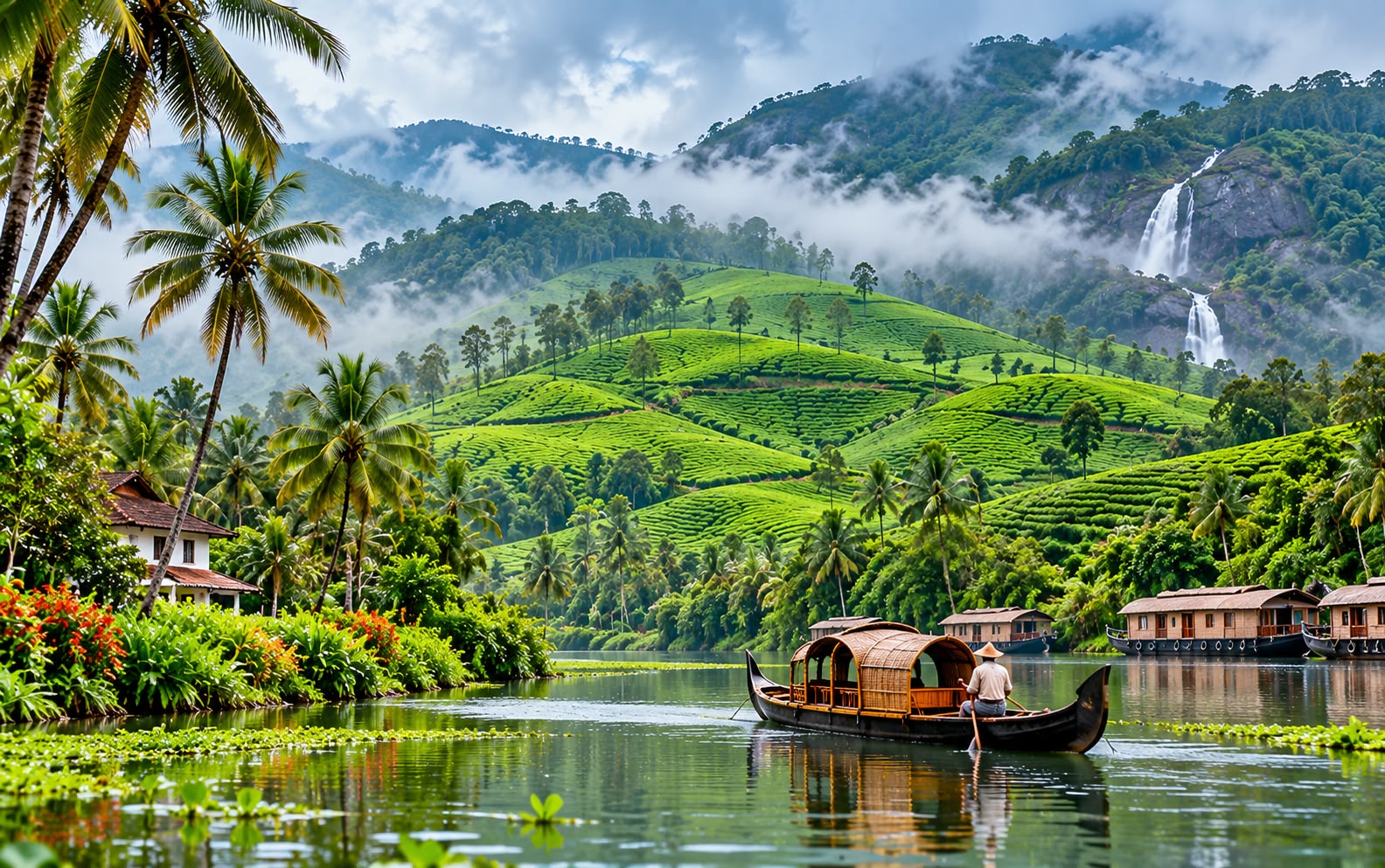
Kerala in the monsoon: Ayurveda season, green Munnar and low rates
Monsoon is the traditional Ayurveda season here, not an off-season to be endured — the humidity is held to open the pores and the treatment calendar is built around it. Munnar at its greenest, half-price rooms, and an honest account of what the rain actually does to a backwater day.
- South Asia
- 6 days
- ≈ AED 1,650 / person
- The season Kerala is cheapest, greenest and the one locals book treatments in
Before you go
Kerala in the monsoon is cheap because visitors avoid it, not because it is bad. The tradition here runs the other way: Karkidakam, the Malayalam month falling roughly mid-July to mid-August, is the classical season for Ayurvedic treatment, and Keralan families book panchakarma courses in it.
The reasoning is that humidity and cool air open the pores and make the body receptive, which is why the serious clinics run their main courses now and why rooms cost roughly half what they do in December.
The seven-day Kerala route is the dry-season circuit with Thekkady in it. This one drops the wildlife — you will not see much through rain — and puts the time into treatment, Munnar and the water.
Figure INR 42,000 (≈ AED 1,640) per person. June to August, and read the honest account below.
Before you go: what the rain actually does
- The southwest monsoon arrives in Kerala first, usually around the start of June, and it is the heaviest rainfall in India.
- It does not rain continuously. It rains hard, often for an hour or three, and then it stops — frequently with sun after. Mornings are often clear.
- What it ruins: wildlife spotting (Thekkady and Periyar are a poor bet), hill views on a bad day, and some beach swimming — the Arabian Sea gets rough and red flags go up.
- What it improves: the hills are extraordinarily green, the waterfalls run, the backwaters are full, the crowds are gone, and the light after a storm is the best of the year.
- August 2018 saw catastrophic flooding in Kerala and serious flooding has recurred. Check current conditions and warnings before and during travel, and take landslide advisories in the hills seriously.
- Build flexibility in. This is not a season for a tight schedule.
Before you go: the admin
Entry
- A domestic trip for Indian nationals.
- Foreign nationals need an Indian visa; an e-visa covers tourism for most nationalities.
- Last checked: 30 October 2026.
Choosing an Ayurveda centre, which matters more than the hotel
- “Ayurvedic spa” and “Ayurvedic hospital” are different things. A massage at a resort is a massage. A genuine panchakarma course involves consultation, a prescribed diet and a programme of days.
- Look for: a resident doctor with a BAMS qualification, a written consultation before any treatment, a Kerala government Green Leaf or Olive Leaf classification, and a stated programme length.
- A real course is a week or more. Three days is a massage holiday, which is fine — just know which you are buying.
- Treatment is not a spa day. The diet is restricted and parts of it are not relaxing.
Getting around
- A car and driver for the whole trip. Roads are fine but wet, and hill driving in heavy rain is slow.
- Kochi to Munnar is about four hours, Munnar to Alleppey about four and a half.
- Leeches are present on hill walks in the wet. Salt, and tuck your trousers in.
Day by day
Day 1 — Kochi
- Arrive and stay in Fort Kochi.
- 15:00 — The Chinese fishing nets on the point — cantilever nets worked by teams, best in the late afternoon, and they will invite you to haul. Agree whether that costs anything first.
- 16:30 — St Francis Church, where Vasco da Gama was originally buried, and the Dutch Cemetery.
- 18:00 — A Kathakali performance. Arrive an hour early to watch the make-up being applied — the painting is the better half.
- Monsoon is Kochi’s quietest season and the Fort area is genuinely pleasant in it.
Day 2 — Up to Munnar
- 09:00 — Four hours east and up, through rubber, then spice, then tea.
- The road climbs past waterfalls that only exist in this season. Cheeyappara and Valara are both roadside, and in June they are running hard.
- 14:00 — Munnar. Tea estates to the horizon at 1,600m, and in monsoon the green is a different colour entirely.
- 16:00 — A tea factory and museum, which is an indoor afternoon and genuinely interesting.
- Evening — it is cool here. 15–20°C, and a jumper is not optional.
Day 3 — Munnar, around the weather
- 07:00 — Early is clear more often than not. Top Station or Kolukkumalai for the viewpoint — cloud sits in the valleys below and the light is extraordinary.
- If it is socked in, do not force it. The view will not appear.
- 10:00 — Mattupetty dam and the tea estate roads, which are good in any weather.
- 13:00 — Eravikulam National Park for the Nilgiri tahr — check whether it is open, as the park closes for the calving season for several weeks in late winter and access can change in heavy rain.
- 16:00 — A spice plantation walk. Cardamom, pepper, nutmeg and clove in the wet smell like nothing else, and monsoon is when the estates are at their most aromatic.
Day 4 — Down to the water, and the first treatment
- 09:00 — Four and a half hours down to Alleppey or the Marari coast.
- 14:00 — Consultation at the Ayurveda centre. A proper one begins here, with pulse, history and a prescribed plan.
- 16:00 — The first treatment. Abhyanga — two therapists, warm medicated oil, synchronised — is the usual starting point.
- Expect to be oily and to be told what to eat. Both are the point.
- Evening — early, and light.
Day 5 — The backwaters, and the second treatment
- 08:00 — A backwater day. In monsoon the channels are full and the paddy is flooded.
- Take a small country boat, not a big houseboat, in this season — the narrow canals are where it is beautiful and the large boats cannot enter them. A punted canoe through the village channels for three hours is the best thing in Kerala.
- Houseboats still run in monsoon; some operators suspend overnight stays in the worst weather. Confirm.
- 14:00 — Back for the afternoon treatment.
- 17:00 — The beach at Marari if the sea is calm enough to walk beside. Swimming is often not advisable — red flags are there for a reason and the undertow in monsoon is serious.
Day 6 — A last treatment, and out
- 08:00 — The final treatment of the short course.
- 11:00 — Back toward Kochi, about an hour and a half.
- If there is time, Mattancherry — the Paradesi Synagogue and the Dutch Palace, both indoor, both short.
- Kochi airport is about an hour from Fort Kochi and is the first fully solar-powered airport in the world.
Costs and practicalities
Best time to visit
June to August for this version of Kerala.
- June — the monsoon breaks. The heaviest and most dramatic month, the greenest hills, and the lowest rates.
- July and mid-July to mid-August — Karkidakam, the classical Ayurveda month. Clinics are at their busiest with domestic patients, which is the strongest signal about when treatment is taken seriously here. Book the centre ahead.
- August — rain easing toward the end, and Onam, Kerala’s great harvest festival, falls in August or September — snake-boat races, feasts and flower carpets. Dates move with the Malayalam calendar.
- September to November — the retreating monsoon brings a second, lighter wet season.
- December to March — the dry season, which is what the seven-day route covers, at roughly double the room rates.
Travel tips
- Buy the right thing. A resort massage and a panchakarma course are not the same purchase.
- Check for a resident BAMS doctor and a written consultation.
- Mornings are clearer than afternoons. Front-load the views.
- Take a small country boat, not a big houseboat, for the backwaters in this season.
- Do not swim against a red flag. The monsoon undertow is serious.
- Take landslide and flood warnings in the hills seriously, and keep the schedule loose.
- Leeches on hill walks. Salt, and tuck your trousers in.
- Quick-dry clothes and two pairs of shoes, because one will always be wet.
- A dry bag for cameras and phones.
What this trip actually costs
Two people, 5 nights, Ayurveda centre and mid-range hotels, flights excluded:
| Item | Cost |
|---|---|
| Ayurveda centre, 3 nights with treatments, two people | INR 36,000 (≈ AED 1,406) |
| Munnar hotel, 2 nights | INR 12,000 (≈ AED 469) |
| Car and driver, 6 days | INR 14,000 (≈ AED 547) |
| Backwater boat, plantation and entries | INR 12,000 (≈ AED 469) |
| Food and everything else | INR 10,000 (≈ AED 390) |
| Total for two | INR 84,000 (≈ AED 3,280) |
- Roughly INR 42,000 (≈ AED 1,640) per person, and the same trip in December costs substantially more — monsoon rates are commonly around half.
- The Ayurveda line is the one that varies most. A genuine multi-week panchakarma course costs far more than this and is a different trip; this budgets a short course.
- A country boat costs a fraction of a houseboat and in this season is the better experience.
- Hotel picks here are chosen on location, not on commission — always check prices and recent reviews before booking.
What to pack
- A proper rain jacket, not an umbrella — the rain here comes sideways.
- Two pairs of shoes, and quick-dry clothes.
- A warm layer for Munnar. 15°C at 1,600m feels cold after the coast.
- A dry bag for electronics.
- Mosquito repellent. Standing water, and dengue is present.
- Loose cotton for treatment days — the oil does not come out of clothes.
- A Type D/M adapter, 230V.
Part of a bigger trip?
- Kerala in 7 days is the dry-season circuit with Thekkady.
- Kerala in 5 days is the short version.
- Kochi in 2 days if the city is the trip.
- Goa in the monsoon is the same season up the coast.
- South India in 14 days is the long run.
FAQ
Is monsoon really a good time for Ayurveda? It is the traditional season, and that is not marketing. Karkidakam — roughly mid-July to mid-August — is when Keralan families book treatment, on the reasoning that humidity and cool air make the body receptive. The serious clinics run their main courses then.
How much does the rain actually interfere? Less than people expect. It rains hard for an hour or three and stops, often with sun afterwards, and mornings are frequently clear. What it genuinely spoils is wildlife spotting and sea swimming, which is why this route drops Thekkady and treats the beach as scenery.
Is it safe, given the flooding? Kerala saw catastrophic flooding in 2018 and serious flooding has recurred since. Check current warnings before and during travel, take landslide advisories in the hills seriously, and keep the schedule loose. Most monsoon seasons pass without incident.
Houseboat or country boat? Country boat in this season, decisively. The narrow village canals are where the backwaters are beautiful and the large houseboats cannot enter them. A punted canoe for three hours beats an overnight on a wide channel.
How much cheaper is it? Roughly half on rooms compared with December to March, and substantially quieter everywhere. The Ayurveda centres are the exception — they are busy in Karkidakam with domestic patients, so book ahead.
Prices and entry rules change, and what you need depends on your passport; last checked 30 October 2026, so confirm with the embassy or your airline before booking.


