 The Itinerary
Kochi in 2 days: Fort Kochi, Mattancherry and Kathakali
Portuguese, Dutch, British and Jewish layers inside one square mile, fishing nets that need six men, and a Kathakali performance where the make-up is the first hour. Plus the ferry that is the best transport in the city.
- South Asia
- 2 days
- ≈ AED 250 / person
- Two slow days in a port that has been trading for six hundred years
Before you go
Kochi is the gentlest Indian city to arrive in, and that is not faint praise. Fort Kochi is walkable, shaded, quiet by Indian standards, and holds Portuguese, Dutch, British, Jewish and Chinese layers inside about a square mile.
Two days: one in Fort Kochi on foot, one in Mattancherry and Jew Town, with a Kathakali performance in the evening — where the make-up is applied in front of you for an hour before anything happens, and that is the better half.
Part of a Kerala trip? See Kerala in 7 days, which runs from here to the backwaters and the hills.
Figure the budget below. October to March.
Before you go: the short version
Getting there and around
- Cochin International (COK) is 90 minutes from Fort Kochi and is the world’s first fully solar-powered airport.
- Fort Kochi is on a peninsula, Ernakulam is the mainland city across the water, and the ferry between them is the best transport in Kochi — INR 10, twenty minutes, and far better than the long road round.
- Fort Kochi is entirely walkable. Autos for the rest, agreed first.
- Kerala has its own water metro now, an electric ferry network across the backwaters around the city.
What to book
- A Kathakali performance. Several venues run daily shows with the make-up session beforehand; the small ones are better than the large.
Day by day
Day 1 — Fort Kochi on foot
Walking order: Chinese nets → St Francis Church (5 min) → Santa Cruz Basilica (5 min) → Parade Ground → Princess Street and the Dutch Cemetery (10 min) → back to the nets for sunset. About 3km, flat, shaded by rain trees.
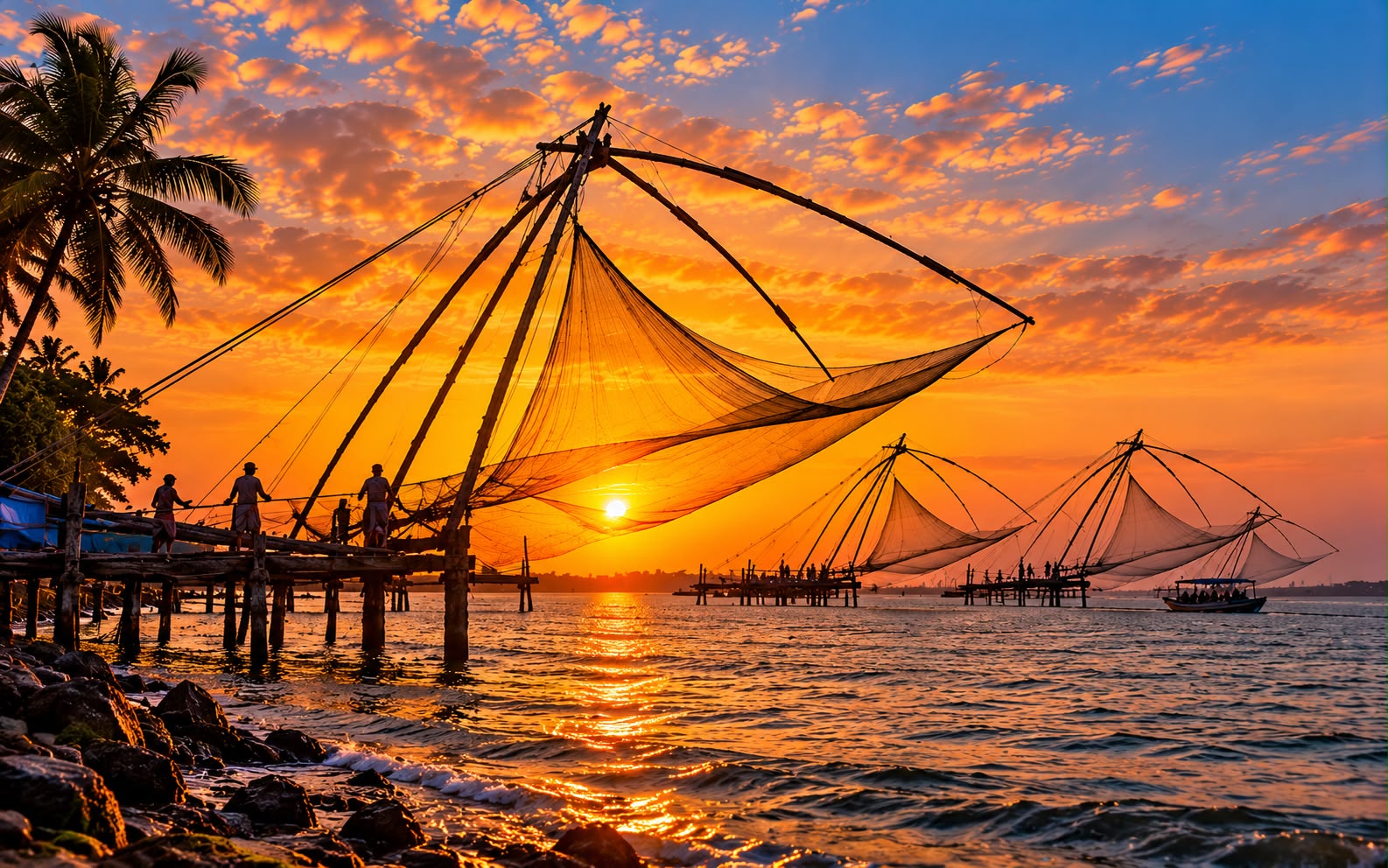
- 08:00 — The Chinese fishing nets at the northern tip — cantilevered shore-operated lift nets, said to have arrived with traders from Kublai Khan’s court. Each needs four to six men to work and they are lowered and raised every few minutes.
- They are a working fishery and a photo opportunity simultaneously — the operators will invite you to help pull, and will expect a tip for it. Fine, if you know that going in.
- 09:30 — St Francis Church, the oldest European church in India, built 1503. Vasco da Gama was buried here in 1524 before his remains were moved to Lisbon — the gravestone is still in the floor.
- 10:30 — Santa Cruz Basilica, Portuguese in origin, rebuilt by the British, and painted inside in a style that is entirely its own.
- 12:00 — Lunch, and a Kerala fish curry with rice or a meen pollichathu, fish wrapped in banana leaf.
- 15:00 — The Dutch Cemetery and the quiet lanes behind Princess Street — the Indo-Portuguese Museum if the layers interest you.
- 17:00 — Back at the nets for sunset, which is when they photograph properly and the harbour fills with traffic.
- 19:00 — A Kathakali performance. Arrive an hour early for the make-up — the actors apply it themselves, in front of the audience, and the green face takes most of an hour. The performance uses no speech at all — the story is told in eye movement, hand gestures and drumming.
Day 2 — Mattancherry and Jew Town
Walking order: Mattancherry Palace → Paradesi Synagogue (5 min along Jew Town Road) → the spice warehouses (on the same street) → the ferry back. About 2km, flat.
- 09:00 — Mattancherry Palace, built by the Portuguese in 1555 and given to the Raja of Kochi, then remodelled by the Dutch — which is why it is universally called the Dutch Palace.
- The murals are the reason to go — some of the finest in India, covering the Ramayana across several rooms, and photography inside is not permitted.
- 10:30 — The Paradesi Synagogue, built 1568, the oldest active synagogue in the Commonwealth. The floor is 1,100 hand-painted Chinese tiles, no two identical, laid in the eighteenth century.
- It is closed on Fridays and Saturdays and on Jewish holidays. The Jewish community here has dwindled to a handful of people, which the synagogue does not hide.
- 12:00 — Jew Town Road — spice warehouses, antique shops, and the smell of cardamom, pepper and ginger on the street, which is the genuine article; this is still a working spice trade.
- 14:00 — Lunch in Mattancherry, or back across.
- 16:00 — The ferry to Ernakulam for the mainland city, or Vypin and Cherai beach if you would rather have sand.
- 17:30 — A sunset cruise on the harbour from the Fort Kochi jetty — you may see dolphins, and the Chinese nets from the water are better than from the shore.
- 19:30 — Dinner on the waterfront, and toddy — fermented palm sap — from a licensed toddy shop is the local drink if you want the authentic version.
If you have a third day
- The backwaters. Alleppey is 90 minutes south and a houseboat night is the thing Kerala is known for — but a day trip from Kochi by shikara canoe through the narrower canals is better than a rushed houseboat, and it is the version that fits a short trip.
Costs and practicalities
Getting around, and what it costs
| Ferry, Fort Kochi to Ernakulam | INR 10 |
| Auto within Fort Kochi | INR 50–150 |
| Airport taxi | INR 1,200–1,800 |
| Mattancherry Palace | INR 200 |
| Paradesi Synagogue | INR 50 |
| Kathakali performance | INR 400–600 |
| Harbour sunset cruise | INR 400–600 |
| Backwater day trip by canoe | INR 1,500–2,500 |
- The ferry is the best ten rupees in India and the way locals cross.
Best time to visit
- October to March — 23–32°C, dry, and the season. December and January are the best of it.
- April and May — hot and very humid before the rains.
- June to September — the southwest monsoon arrives in Kerala first, and it is heavy. It is also when Ayurvedic treatment is traditionally done, and the state is at its greenest and cheapest.
- Onam, in August or September, is Kerala’s great festival — boat races, feasts and flower carpets.
Travel tips
- Take the ferry, not the road, between Fort Kochi and Ernakulam.
- Arrive an hour early for Kathakali — the make-up is the better half.
- The synagogue is closed Fridays and Saturdays.
- No photography inside Mattancherry Palace.
- Fort Kochi is walkable; do not take an auto within it.
- Tip the net operators if you pull, and decide before you grab the rope.
What this trip actually costs
Two people, 1 night, mid-range comfort, excluding travel to Kochi:
| Item | Cost |
|---|---|
| Hotel, 1 night in a Fort Kochi homestay | INR 4,000 (≈ AED 156) |
| Food and drink, 2 days | INR 2,400 (≈ AED 93.72) |
| Palace, synagogue, Kathakali, cruise, two people | INR 2,600 (≈ AED 102) |
| Ferries, autos and the airport both ways | INR 3,000 (≈ AED 117) |
| Total for two | INR 12,000 (≈ AED 469) |
- The heritage homestays in Fort Kochi are the thing to book — old Dutch and Portuguese houses, often cheaper than a hotel, and the reason people remember this city.
- Hotel picks here are chosen on location, not on commission — always check prices and recent reviews before booking.
What to pack
- Light cotton; it is humid year-round.
- Modest clothing for the churches and the synagogue.
- An umbrella between June and September, and a good one.
- A Type C/D/M adapter, 230V.
Part of a bigger trip?
- Kerala in 7 days runs from here to Alleppey, Munnar and Thekkady.
- Kerala in 5 days is the shorter version.
- South India in 14 days adds Tamil Nadu and Karnataka.
- Tamil Nadu in 7 days is the neighbouring route.
FAQ
Is two days enough for Kochi? For Fort Kochi and Mattancherry, comfortably. A third day is best spent on the backwaters rather than in the city.
Is Kathakali worth seeing? Yes, and arrive early for the make-up, which is applied in front of you and takes about an hour. The performance uses no speech at all — eyes, hands and drums.
When is the synagogue open? Closed Fridays, Saturdays and Jewish holidays. Check locally; the hours are short.
Houseboat or day trip on the backwaters? On a short trip, a canoe day trip through the narrow canals beats a rushed houseboat on the wide channels. Houseboats are worth it with a night to spare.
Is Kochi a good first stop in India? Among the best. It is small, walkable, relatively calm and genuinely interesting, which makes it a gentler landing than Delhi or Mumbai.
Prices and entry rules change, and what you need depends on your passport; last checked 29 October 2026, so confirm with the embassy or your airline before booking.


