 The Itinerary
Lisbon in 3 days: Alfama, Belém and a day in Sintra
Tram 28, the Jerónimos cloister and the original pastéis de Belém — plus the earthquake that explains the street plan, which hills to avoid walking up, and why Sintra needs a timed ticket.
- Southern Europe
- 3 days
- ≈ AED 1,300 / person
- Three days of hills, tiles and custard tarts, with Sintra booked ahead
Before you go
Lisbon is built on seven hills and faces the sea, and the two facts between them explain the whole city: the viewpoints, the funiculars, the tiles that keep the damp out, and the light.
Three days: Alfama and the viewpoints on day one, Belém and the river on day two, Sintra on day three.
One thing to book before you fly: Pena Palace in Sintra sells timed entry and it sells out. Everything else here can be decided on the morning.
Figure the budget below. March–June and September–October.
Before you go: the short version
Entry and visas
- Portugal is in the Schengen area — around 60 nationalities enter visa-free for 90 days in any 180; everyone else needs a short-stay (Type C) Schengen visa in advance.
- ETIAS is being phased in — check whether it applies by your dates.
- Our full guide: how Schengen visas actually work.
Getting in and around
- Humberto Delgado (LIS) is inside the city — metro red line, about 20 minutes to the centre.
- Get a Viva Viagem card — €0.50 for the card, then about €1.80 a journey, or €6.80 for 24 hours covering metro, bus, tram and the funiculars.
- A single bought on the tram is €3. The card pays for itself on day one.
- The hills are not a joke. The funiculars and the Santa Justa lift are public transport, not attractions, and the card covers them.
Day by day
Day 1 — Alfama, the castle and the viewpoints
Walking order: Castle → Alfama downhill (1.5km of lanes) → Sé → Baixa (10 min) → Santa Justa → Bairro Alto by funicular. About 4km, mostly downhill if you start at the top.
- 09:00 — Start at the top. Take tram 28 or a taxi up to the Castelo de São Jorge and walk down. Doing it the other way round is the single most common mistake in Lisbon.
- The castle is Moorish, taken in 1147, and the walls give you the whole city and the river at once.
- 10:30 — Alfama on foot, downhill. The oldest quarter, and the only one that largely survived the 1755 earthquake — which is why the lanes are medieval tangle while the Baixa below is a grid.
- The earthquake, the fire and the tsunami that followed killed tens of thousands on All Saints’ Day and rebuilt the city’s plan from scratch.
- 12:00 — The Sé cathedral, fortress-like and Romanesque, and the Miradouro de Santa Luzia beside it with its tiled terrace.
- 13:00 — Lunch in Alfama, then the Baixa grid — the Pombaline rebuild, among the first earthquake-resistant buildings in Europe, tested with troops marching on scale models.
- 15:30 — The Elevador de Santa Justa, a 45m wrought-iron lift of 1902 connecting the low town to the high. The queue is long and pointless — walk round to the Carmo side and reach the top walkway for free.
- 16:30 — The Carmo Convent, left roofless since 1755 and deliberately never rebuilt.
- 18:30 — Bairro Alto by the Glória funicular, and the Miradouro de São Pedro de Alcântara for sunset over the castle.
- 21:00 — Dinner, and fado if you want it. Book a small house in Alfama rather than a dinner-show; the good ones stop the room to listen.
Day 2 — Belém and the river
Walking order: Jerónimos → Pastéis de Belém (3 min) → Monument to the Discoveries (10 min) → Torre de Belém (15 min). About 3km, flat. Tram 15 from Praça da Figueira, 25 minutes.
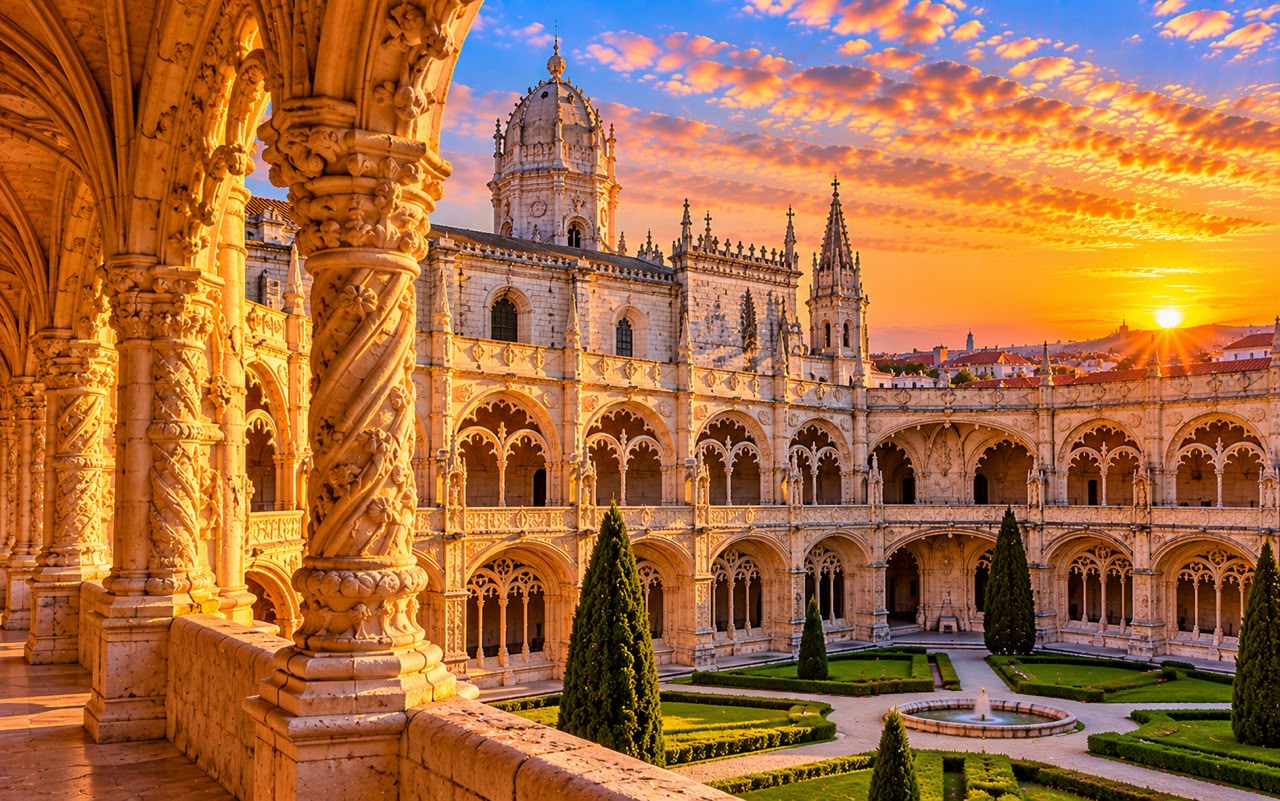
- 09:00 — The Jerónimos Monastery at opening, which is the one unmissable building in Lisbon. Manueline Gothic — stone carved into rope, coral, anchors and knots, paid for with the pepper trade.
- The cloister is the point. Vasco da Gama is buried in the church, which is free to enter; the cloister is ticketed.
- 11:00 — Pastéis de Belém, the original, baking to a recipe from the monastery since 1837. The takeaway queue moves fast; the seated rooms at the back are large and usually have space. Cinnamon and icing sugar are on the table.
- 12:30 — The Monument to the Discoveries, and the compass rose in the pavement, a gift from South Africa, with the dates of the voyages.
- 13:30 — The Torre de Belém, 1519, which guarded the harbour mouth and is now stranded at the edge of a changed river. The inside is small and the stair is a single-file bottleneck — many people are content to photograph it.
- 15:00 — The MAAT along the waterfront, or the Coach Museum, which is far more interesting than it sounds — the largest collection of royal carriages in the world.
- 17:30 — Back into town. LX Factory under the bridge for the bookshop and the bars, or Time Out Market at Cais do Sodré, which is a food hall with the city’s good kitchens in stalls.
- 20:00 — The Ponte 25 de Abril overhead — built by the company that built the Bay Bridge in San Francisco, which is why it looks like that.
Day 3 — Sintra
- 08:30 — Forty minutes by train from Rossio, and go early. Sintra by 10:00 is pleasant; Sintra at 13:00 is a queue.
- Pena Palace needs a timed ticket bought in advance — a 19th-century romantic fantasy in yellow and red on a crag, built by a king who had read too much. The terraces and the views are the best part; the interiors are crowded.
- 11:30 — Quinta da Regaleira, which is the better site and the one people underestimate: gardens full of grottoes, tunnels and the Initiation Well — a spiral stair nine turns deep into the ground, built for Masonic ritual.
- 14:00 — Lunch in Sintra village, and a travesseiro from Piriquita.
- 15:30 — The Moorish Castle along the ridge, or Cabo da Roca, the westernmost point of mainland Europe, by bus — it is a cliff, a lighthouse and a lot of wind, and whether that is worth two hours is a matter of taste.
- Two sites is the honest maximum. Three is a forced march and the buses between them are slow and full.
- 19:00 — Back to Lisbon.
Costs and practicalities
Getting around, and what it costs
| Viva Viagem card | €0.50 |
| Single journey on the card | about €1.80 |
| 24-hour transport pass | €6.80 |
| Single bought on the tram | €3 |
| Castelo de São Jorge | €15 |
| Jerónimos cloister | €12 |
| Torre de Belém | €8 |
| Train to Sintra, return | about €5 |
| Pena Palace | €20 |
| Quinta da Regaleira | €15 |
- The Lisboa Card (€27/44/54 for 24/48/72 hours) covers transport, the Sintra train and most of these sites. On a three-day plan like this one it is close to break-even — add up your own list before buying.
Best time to visit
- March–June and September–October — 18–26°C, clear, and the city is at its best.
- July–August — hot and very full; Sintra becomes genuinely unpleasant in the middle of the day.
- November–February — mild, 10–16°C, and the rainiest months. Quiet, cheap, and the tiles look better wet.
- Santo António on 12–13 June is the city’s night — sardines grilled in every street in Alfama, and nobody sleeps.
Travel tips
- Start at the top of every hill and walk down.
- Book Pena Palace before you fly, and get the earliest slot.
- Tram 28 is a working tram and a pickpocket’s favourite. Ride it early or ride tram 12 instead; keep your bag in front.
- Skip the Santa Justa queue and reach the top from the Carmo side.
- The pavement is polished limestone — it is slippery in the rain and lethal in smooth soles.
- Book fado in a small house, not a dinner-show.
What this trip actually costs
Two people, 2 nights, mid-range comfort, international flights excluded:
| Item | Cost |
|---|---|
| Hotel, 2 nights | EUR 240 (≈ AED 983) |
| Food and drink, 3 days | EUR 200 (≈ AED 819) |
| Sites in Lisbon, two people | EUR 70 (≈ AED 287) |
| Sintra: train, Pena and Regaleira, two people | EUR 80 (≈ AED 328) |
| Transport and incidentals | EUR 50 (≈ AED 205) |
| Total for two | EUR 640 (≈ AED 2,621) |
- Lisbon is the cheapest capital in Western Europe and this shows it. Sintra is the one day that costs real money.
- Hotel picks here are chosen on location, not on commission — always check prices and recent reviews before booking.
What to pack
- Shoes with grip for polished limestone on a slope.
- A light rain layer from November to March.
- A bag that closes, for tram 28.
- A Type C/F adapter, 230V.
Part of a bigger trip?
- Portugal in 8 days adds Porto, the Douro and the Algarve.
- Spain and Portugal in 12 days runs Lisbon with Madrid, Seville and Barcelona.
- Madrid in 3 days is a short hop east.
FAQ
Is the Lisboa Card worth it? On this plan it is close to break-even. It wins if you add more ticketed sites or lean on transport heavily; it loses if you walk most of the city, which is easy to do.
Do I have to book Sintra? Pena Palace, yes — timed entry and it sells out. Quinta da Regaleira usually has tickets on the door, but the earliest slot at Pena sets your whole day.
Is tram 28 worth riding? Early in the morning, yes, as a tram rather than an attraction. By midday it is full and it is where pickpockets work. Tram 12 covers a similar loop with a fraction of the crowd.
Which pastéis de nata? Pastéis de Belém is the original and the queue moves faster than it looks. Manteigaria in town is the one locals argue for, and it is open late.
How hard are the hills? Harder than photographs suggest. Use the funiculars and the Santa Justa lift — they are covered by the transport card — and plan every walk downhill.
Prices and entry rules change, and what you need depends on your passport; last checked 29 October 2026, so confirm with the embassy or your airline before booking.


