 The Itinerary
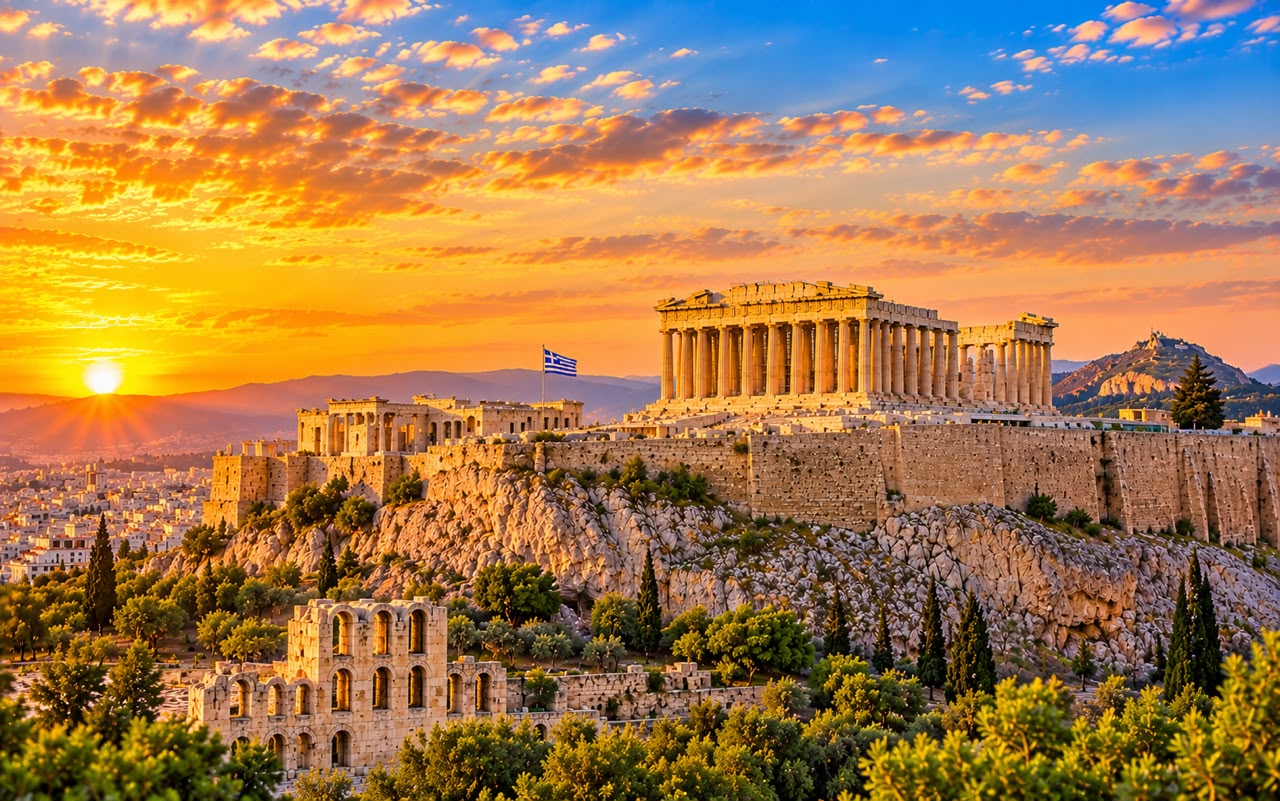
Athens in 2 days: the Acropolis, the Agora and the museum
The Acropolis caps its hourly slots and the rock has no shade — so the hour you go decides the day. Plus the combined ticket that pays for itself, and the museum most visitors skip.
- Southern Europe
- 2 days
- ≈ AED 900 / person
- Two days before an island ferry, done in the right order and the right hour
Before you go
Most people give Athens two days on the way to an island, and two days is genuinely enough for the essentials — if you go up the rock at the right hour.
The Acropolis now sells timed hourly slots with a daily cap, and the site has almost no shade. In summer 08:00 is the only civilised slot, and the authorities close the site during afternoon heatwaves. Book ahead and book early.
Two days: the Acropolis and its museum on day one, the Agora, Plaka and the National Archaeological Museum on day two.
Figure the budget below. April–June and September–October.
Before you go: the short version
Entry and visas
- Greece is in the Schengen area — around 60 nationalities enter visa-free for 90 days in any 180; everyone else needs a short-stay (Type C) Schengen visa in advance.
- ETIAS is being phased in — check whether it applies by your dates.
- Our full guide: how Schengen visas actually work.
Getting in and around
- Eleftherios Venizelos (ATH) — metro line 3 to Syntagma, €9, about 40 minutes. The X95 bus is €5.50 and runs all night.
- A 90-minute metro ticket is €1.20; a 24-hour pass is €4.10, neither valid to the airport.
- The centre is small. The Acropolis, the Agora, Plaka, Monastiraki and Syntagma are all within 20 minutes on foot.
- The combined ticket is €30 and covers the Acropolis, the Ancient Agora, the Roman Agora, Hadrian’s Library, the Temple of Olympian Zeus, Kerameikos and the Lyceum, valid five days. If you do the Acropolis and two others, it has paid for itself.
Day by day
Day 1 — The Acropolis and the museum
Walking order: Acropolis main gate → the rock (1km on uneven marble) → Areopagus (5 min) → Acropolis Museum (10 min) → Plaka. About 3km, with one climb.
- 08:00 — The Acropolis at opening, on a pre-booked slot. Enter by the main west gate — the south-east gate near the museum is quieter but puts the climb at the wrong end.
- The Propylaea is the monumental gateway; the Temple of Athena Nike sits on the bastion to the right.
- The Parthenon, 447–432 BC, has no straight lines in it — the columns bulge slightly and lean inward, and the floor is curved, all so that it should look straight. Extended, the columns would meet about 1.5km above the building.
- It survived nearly intact until 1687, when the Venetians shelled an Ottoman powder store inside it.
- The Erechtheion’s Caryatids are copies; five originals are in the museum below and one is in London.
- 10:30 — The Areopagus rock below the entrance — free, slippery, and the best view of the Acropolis from outside it.
- 11:30 — The Acropolis Museum. The glass floor over the excavated neighbourhood, and the top floor built at the exact size and orientation of the Parthenon, with the surviving sculptures arranged as they stood. The gaps are deliberate — they mark what is in the British Museum.
- 14:00 — Lunch in Plaka or Koukaki.
- 16:00 — The Temple of Olympian Zeus and Hadrian’s Arch — 15 columns standing of 104, and the temple took about 638 years to finish. On the combined ticket.
- 18:00 — Lycabettus Hill by funicular for sunset — the highest point in Athens, with the Acropolis lit below and the sea beyond.
- 21:00 — Dinner.
Day 2 — The Agora, Plaka and the big museum
Walking order: Ancient Agora → Monastiraki (5 min) → Roman Agora (5 min) → Anafiotika (10 min) → metro → National Archaeological Museum. About 4km.
- 08:30 — The Ancient Agora, which was the actual city — the market, the courts and the place Socrates argued and was condemned.
- The Temple of Hephaestus here is the best-preserved Doric temple anywhere, and almost nobody photographs it. The Stoa of Attalos has been fully rebuilt and holds the site museum, including the ostraka — potsherds scratched with the names of men being voted into exile.
- 10:30 — Monastiraki for the flea market and the mixed layers: a mosque, a church, a Roman wall and a metro station in one square.
- 11:30 — The Roman Agora and the Tower of the Winds, a 1st-century BC octagonal water clock and weather vane, with a carved wind god on each of its eight faces.
- 12:30 — Anafiotika, the pocket of whitewashed island houses built into the Acropolis slope by masons from Anafi brought in to build the king’s palace in the 1840s. It is the quietest corner in central Athens.
- 14:00 — Lunch, then Syntagma for the Evzones — the guard changes on the hour, with the full ceremony and the band on Sunday at 11:00.
- 16:00 — The National Archaeological Museum, which most two-day visitors skip and should not. The Mask of Agamemnon and the Mycenaean gold, the Antikythera Mechanism — a geared bronze computer for predicting eclipses, 2,000 years early — and the Artemision Bronze. Two hours minimum.
- 19:00 — The Panathenaic Stadium if there is light — all marble, rebuilt for the first modern Olympics in 1896.
Costs and practicalities
Getting around, and what it costs
| Metro, 90 minutes | €1.20 |
| 24-hour transport pass | €4.10 |
| Airport metro, one way | €9 |
| Combined archaeological ticket, 5 days | €30 |
| Acropolis only | €20 summer, €10 winter |
| Acropolis Museum | €15 summer, €10 winter |
| National Archaeological Museum | €12 summer, €6 winter |
| Lycabettus funicular, return | €10 |
- Winter prices are roughly half across the state sites, from 1 November to 31 March.
Best time to visit
- April–June and September–October — 20–30°C, and the rock is bearable.
- July–August — 35–40°C with no shade on the Acropolis, and the site closes during the worst afternoon heat. Go at 08:00 or not at all.
- November–March — 10–16°C, often bright, half-price tickets and no queues. The best-value time to see Athens, and most island ferries are reduced.
- Free entry on the first Sunday of the month from November to March, and on a handful of national holidays.
Travel tips
- Book the Acropolis slot ahead and take the earliest one.
- Buy the combined ticket if you will see three sites or more.
- The marble on the Acropolis is polished slick by millions of feet — grip matters more than support.
- Carry water up; there is one fountain and no shade.
- Eat in Koukaki or Psyri, not on the Plaka tourist strip.
- Watch your pockets on the green line and at Monastiraki.
What this trip actually costs
Two people, 1 night, mid-range comfort, international flights excluded:
| Item | Cost |
|---|---|
| Hotel, 1 night | EUR 120 (≈ AED 491) |
| Food and drink, 2 days | EUR 140 (≈ AED 573) |
| Combined ticket and museums, two people | EUR 114 (≈ AED 467) |
| Metro, airport transfer and the funicular | EUR 56 (≈ AED 229) |
| Total for two | EUR 430 (≈ AED 1,761) |
- In winter the tickets line roughly halves, which takes about €55 off the total for two.
- Hotel picks here are chosen on location, not on commission — always check prices and recent reviews before booking.
What to pack
- Shoes with grip for polished marble.
- A hat, sunglasses and water from May to September.
- A light layer for the evenings year-round.
- A Type C/F adapter, 230V.
Part of a bigger trip?
- Greece in 7 days adds Santorini and one more island.
- Greece in 10 days adds the mainland — Delphi and Meteora.
- Santorini in 3 days is 45 minutes by air or 5–8 hours by ferry.
FAQ
Is two days enough for Athens? For the Acropolis, the Agora, Plaka and the National Archaeological Museum, yes. A third day buys Delphi or Cape Sounion as a day trip, and both are worth it if you have the time.
What time should I go up the Acropolis? The 08:00 slot, especially between May and September. By 11:00 the rock is full and in high summer it is dangerously hot, and the site is sometimes closed in the afternoon.
Is the combined ticket worth €30? If you visit the Acropolis plus two of the other sites, yes. If you only want the Acropolis, the single ticket is cheaper.
Which museum, if only one? The Acropolis Museum pairs with the rock and explains what you have just walked around. The National Archaeological Museum is the greater collection. If you can, two hours each.
Is Athens safe? Ordinarily yes, with normal pickpocket caution on the metro and at Monastiraki. Omonia and parts of Exarchia are scruffier at night without being dangerous.
Prices and entry rules change, and what you need depends on your passport; last checked 29 October 2026, so confirm with the embassy or your airline before booking.


