 The Itinerary
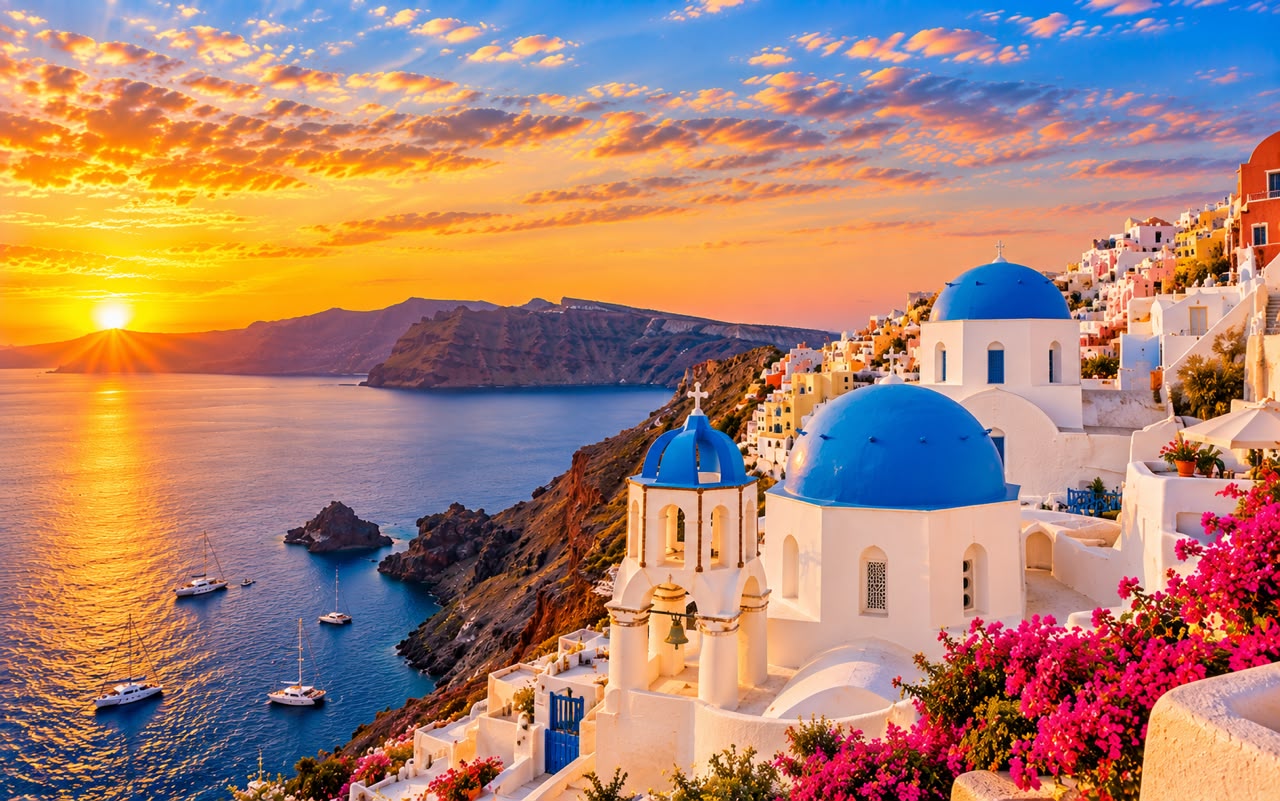
Santorini in 3 days: the caldera, Oia and Akrotiri
A caldera left by one of the largest eruptions in human history, a Bronze Age town buried under it, and the clifftop walk that beats the bus. Plus how to see the Oia sunset without standing in a crowd of four thousand.
- Southern Europe
- 3 days
- ≈ AED 1,850 / person
- Three days on the rim, with the sunset crush planned around
Before you go
Santorini is the rim of a volcano that blew its centre out around 1600 BC — one of the largest eruptions in human history, and the reason the island is a crescent of cliff looking down 300m into flooded crater.
Three days: Fira and the rim, the clifftop walk to Oia and the sunset, Akrotiri, the wine and a black beach.
Two warnings. Cruise-ship days put several thousand extra people on a rim path two metres wide — check the port schedule and plan around it. And the Oia sunset draws a crowd of thousands; there are better places to stand, listed below.
Figure the budget below. May–June and September–October.
Before you go: the short version
Entry and visas
- Greece is in the Schengen area — around 60 nationalities enter visa-free for 90 days in any 180; everyone else needs a short-stay (Type C) Schengen visa in advance.
- ETIAS is being phased in — check whether it applies by your dates.
- Our full guide: how Schengen visas actually work.
Getting there and around
- 45 minutes by air from Athens, or 5–8 hours by ferry depending on whether it is the fast boat or the slow one.
- Ferries dock at Athinios, a working port on a cliff with a switchback road and no shade. Arrange your transfer in advance — the bus scrum at arrival is unpleasant with luggage.
- Buses run from Fira to everywhere and are cheap, €1.80–2.50, but everything routes through Fira — there is no ring road.
- Where you sleep decides your trip. Fira is central and has the buses; Imerovigli is the quietest rim village and has the best views; Oia is the prettiest and the most expensive; Perissa and Kamari are the beach side and half the price, with no caldera view at all.
- The tap water is desalinated and brackish. Drink bottled.
Day by day
Day 1 — Fira and the rim
Walking order: Fira centre → the rim path north to Firostefani (20 min) → Imerovigli (25 min further). About 3km, with steps.
- 10:00 — Fira, and the first look down into the caldera, which is the moment the island earns its reputation.
- 11:00 — The Museum of Prehistoric Thera, small and essential: the frescoes from Akrotiri, including the boxing boys and the blue monkeys, and a gold ibex figurine found in 2000. See this before Akrotiri on day three — the site is bare without it.
- 13:00 — Lunch off the rim, where the prices halve.
- 15:00 — The rim path north to Firostefani and Imerovigli, which is paved, easy, and progressively quieter.
- 16:30 — Skaros Rock from Imerovigli — a headland that held the island’s medieval capital until earthquakes took it, and a 30-minute scramble out onto it.
- 19:00 — Sunset from Imerovigli, which looks at the same sun as Oia does, with a hundredth of the people.
- The cable car down to the old port is €6 and the donkeys are not an attraction — the welfare record is poor and the Greek authorities have had to impose weight limits. Walk or take the car.
Day 2 — The walk to Oia, and the sunset
Walking order: Fira → Firostefani → Imerovigli → Skaros → the ridge → Oia. 10km, 3–4 hours, with real ascent and loose ground in the middle section.
- 08:00 — Start early. The middle third has no shade, no water and no café, and in July it is brutal by 11:00.
- The first 3km are paved rim path. After Imerovigli it becomes a dirt trail over two headlands, with the caldera on your left the whole way and the open Aegean on your right.
- 11:30 — Arrive in Oia, hot, and take the rest of the day slowly. The bus back to Fira is 25 minutes if you would rather walk one way.
- 12:30 — Oia itself — the blue domes are Agios Spyridonas and Anastaseos, seen from the path on the north side, and the castle ruin at the end of the village.
- 14:00 — Lunch, then down the 300 steps to Ammoudi Bay for a swim off the rocks and the best fish on the island. Remember the 300 steps back up in the afternoon heat.
- 19:30 — Sunset. The castle ruin is where four thousand people stand, shoulder to shoulder, from an hour beforehand. The alternatives are better: the Ammoudi Bay rocks from below, the path on the north side of the village, or a restaurant terrace booked a week ahead.
- Afterwards the entire village walks to the bus stop at once. Wait twenty minutes and have a drink instead.
Day 3 — Akrotiri, the wine and a black beach
Order: Akrotiri (bus, 25 min from Fira) → Red Beach (10 min) → a winery → Perissa or Kamari. A car or an ATV makes this day; the buses all route back through Fira.
- 09:00 — Akrotiri, a Bronze Age Minoan town buried by the eruption and preserved under ash — two-storey houses, streets, drainage and plumbing, under a modern roof.
- No bodies and no gold have been found, which suggests the town was evacuated after warning quakes. The frescoes you saw on day one came out of these rooms.
- It has a fair claim to being the source of the Atlantis story, and only a fraction is excavated.
- 11:00 — The Red Beach nearby, under iron-red cliffs. Check the access notice — rockfall has closed it repeatedly and the viewpoint above is sometimes as far as you are allowed.
- 12:30 — A winery. Santorini grows Assyrtiko in kouloura — vines woven into low baskets on the ground, so the fruit sits inside sheltered from the wind, which is a technique found nowhere else.
- The vines are ungrafted and some are centuries old — the island’s volcanic soil kept phylloxera out. Try the dry Assyrtiko and the sweet Vinsanto.
- 15:00 — Perissa or Kamari, long black volcanic beaches on the flat side of the island. The sand gets painfully hot — sandals to the water.
- 17:00 — Ancient Thera above Kamari if you have the car and the legs, on a ridge 365m up.
- 20:00 — Dinner away from the rim, where you eat better for half as much.
Costs and practicalities
Getting around, and what it costs
| Bus, any single route | €1.80–2.50 |
| Fira cable car, one way | €6 |
| ATV hire, per day | €30–40 |
| Small car hire, per day | €45–60 |
| Akrotiri | €12 |
| Museum of Prehistoric Thera | €6 |
| Ancient Thera | €6 |
| Winery tasting | €15–25 |
| Caldera boat trip with the volcano | €35–50 |
- Everything on the rim costs roughly double what the same thing costs 500m inland. That is the whole economics of the island.
Best time to visit
- May–June and September–October — warm, swimmable from June, and the walk is comfortable.
- July–August — 30°C+, every bed at peak rate, and the rim path is a queue. The meltemi wind can also cancel ferries.
- November–March — most of the island closes. Hotels, restaurants and boats shut; it is quiet and cheap, and there is little to do but look at the view.
- Check the cruise schedule for your dates. Two large ships in port adds thousands of people to Fira and Oia between 10:00 and 17:00.
Travel tips
- Do the Fira–Oia walk at 08:00, with water, and not in July.
- Watch the sunset from Imerovigli or Ammoudi, not from the Oia castle.
- Book your port transfer before you arrive. Athinios is chaos.
- Don’t ride the donkeys.
- Drink bottled water — the tap is desalinated.
- Sleep in Perissa or Kamari if the budget is tight; the bus to the rim is 20 minutes and you will eat better.
- Book ferries ahead in summer and leave a day’s margin before an international flight — the meltemi cancels sailings.
What this trip actually costs
Two people, 2 nights, mid-range comfort, international flights excluded:
| Item | Cost |
|---|---|
| Hotel, 2 nights, caldera view | EUR 440 (≈ AED 1,802) |
| Food and drink, 3 days | EUR 260 (≈ AED 1,065) |
| Sites, museum and a tasting, two people | EUR 90 (≈ AED 369) |
| ATV for a day, buses and the cable car | EUR 60 (≈ AED 246) |
| Port transfers | EUR 50 (≈ AED 205) |
| Total for two | EUR 900 (≈ AED 3,685) |
- The hotel line is the whole decision. A caldera-view room is €220 a night in shoulder season and €400+ in August; the same standard in Perissa is €80.
- Add EUR 90 (≈ AED 369) for the caldera boat trip if you want the volcano and the hot springs, which is a good half-day.
- Hotel picks here are chosen on location, not on commission — always check prices and recent reviews before booking.
What to pack
- Proper shoes for the Fira–Oia walk — it is not a promenade.
- Water, a hat and sun cream; the island has no shade.
- Swimwear and sandals for hot black sand.
- A windproof layer — the meltemi blows hard even in August.
- A Type C/F adapter, 230V.
Part of a bigger trip?
- Greece in 7 days pairs Santorini with Athens and one more island.
- Greece in 14 days adds Crete and the mainland.
- Athens in 2 days is the stop before the ferry.
FAQ
Is three days enough for Santorini? Yes. Three days covers the rim, the walk, Akrotiri, a winery and a beach without rushing. A fourth day is for a boat trip or doing nothing, which the island is also good for.
Where should I stay? Imerovigli for the view and the quiet, Fira for the buses and the price, Oia if the budget is open, Perissa or Kamari if it is not. The rim costs roughly triple the beach side.
Is the Fira–Oia walk hard? 10km with real ascent, loose footing on two headlands and no shade in the middle. Easy at 08:00 in May; genuinely risky at midday in July. Carry more water than you think.
How do I see the Oia sunset without the crowd? Watch it from Imerovigli instead, or from the rocks at Ammoudi Bay, or book a terrace table a week ahead. The castle ruin holds thousands and they start arriving an hour early.
Is Akrotiri worth it? It is the most interesting site on the island — a Bronze Age town with streets and plumbing, buried under ash. See the frescoes in Fira first, or the site reads as bare walls.
Prices and entry rules change, and what you need depends on your passport; last checked 29 October 2026, so confirm with the embassy or your airline before booking.


