 The Itinerary
Jaipur in 2 days: Amber Fort, the City Palace and the bazaars
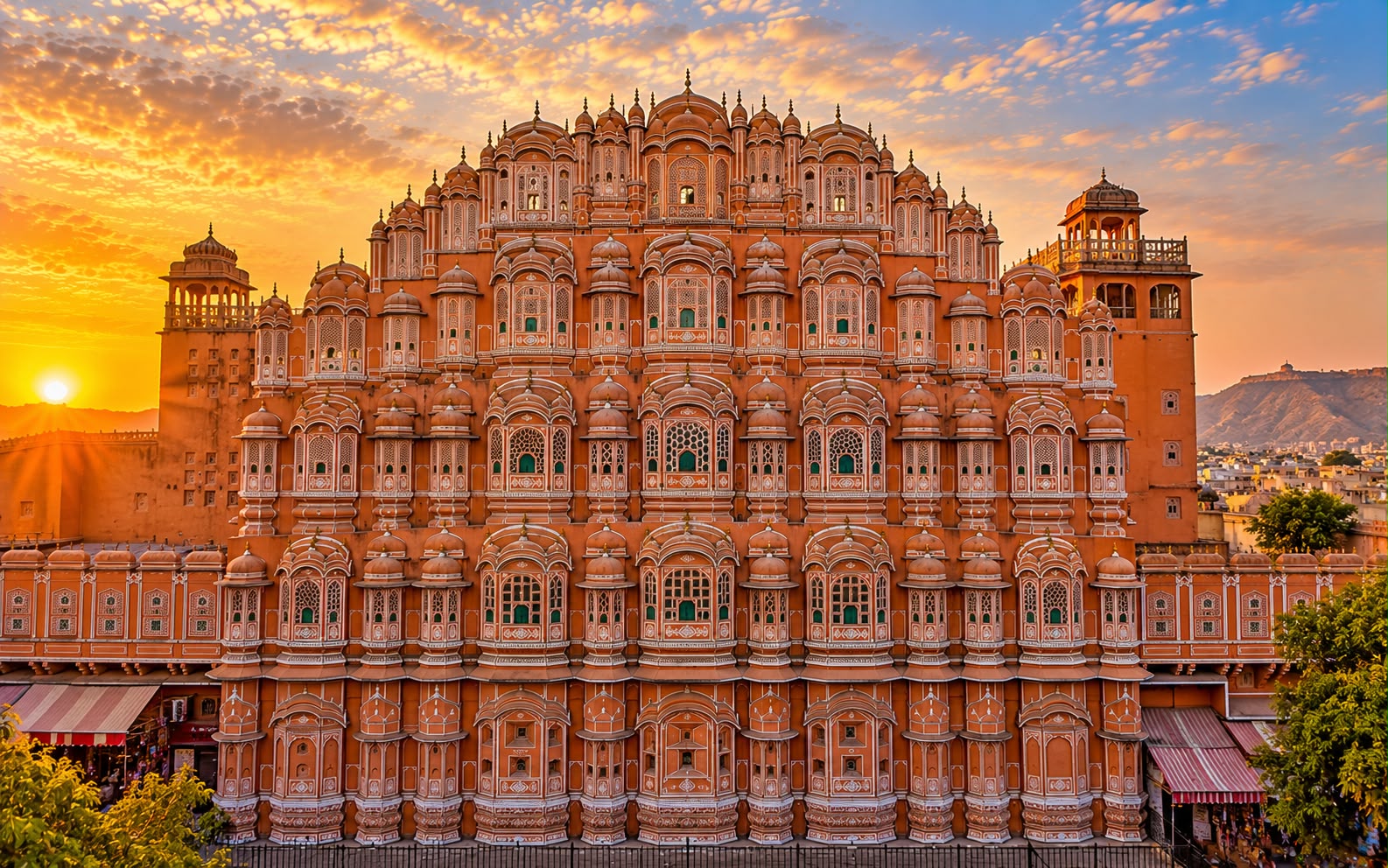
Amber Fort at opening and why to take the jeep, the stepwell nobody stops at, and the gem scam that is specific to this city. Plus where the Hawa Mahal photograph is actually taken from.
- South Asia
- 2 days
- ≈ AED 300 / person
- Two days, the elephant ride declined, and an observatory whose instruments still work
Before you go
Jaipur is a planned city from 1727, laid out on a grid by a Rajput king who was also an astronomer, painted pink in 1876 to welcome the Prince of Wales, and still painted pink by municipal by-law.
Two days: one out at Amber, the hill fort above the city, and one inside the walls — the City Palace, the observatory, the Hawa Mahal and the bazaars.
Two things to know before you arrive. Decline the elephant ride at Amber — the welfare record is poor and the jeep goes to the same gate. And the gem-export scam is specific to Jaipur; it is described below because it is persistent and costs people real money.
Part of a Rajasthan trip? See Rajasthan in 7 days.
Figure the budget below. October to March.
Before you go: the short version
Getting there and around
- Four to five hours from Delhi by road, or five by train — the Shatabdi and the Vande Bharat both run the route.
- Jaipur International (JAI) is 20 minutes from the centre.
- Use Uber or Ola. Autos are everywhere and the fare should be agreed before you get in — INR 100–200 within the old city.
- The old city is walkable, and the bazaars are best on foot.
The gem scam
- It works like this. A friendly local — often met “by chance”, sometimes a driver or a shopkeeper — explains that you can buy gemstones here and sell them at a large profit at home, or that you can carry stones for a dealer and be paid a commission. You are shown certificates and a convincing workshop.
- The stones are worthless or near-worthless, the certificates are meaningless, and the credit-card charge is irreversible.
- It is a long-running, well-organised confidence trick and it specifically targets visitors to this city. Decline entirely. There is no version of it that works out.
- Buying jewellery you simply like, at a fixed-price shop, is fine. The scam is always framed around resale or commission.
Day by day
Day 1 — Amber, and the north
Walking order: Amber Fort courtyards (1.5km, with steps) → Panna Meena ka Kund (10 min walk below) → car → Jal Mahal viewpoint → Nahargarh at sunset. About 3km on foot, with real climbing inside the fort.
- 08:00 — Amber Fort at opening, 11km north, before the heat and the coaches.
- Decline the elephant ride. The welfare record is poor — overwork, heat and hard surfaces — and the jeep goes to the same gate for a similar price. Walking up takes 15 minutes.
- The Sheesh Mahal, the mirror hall, where a single candle is said to have lit the whole room through thousands of convex mirror fragments.
- The Ganesh Pol, the painted gate to the private quarters, and the Sukh Niwas with its water channel for cooling.
- 11:00 — Panna Meena ka Kund, the stepwell ten minutes below the fort — a perfect symmetrical staircase well that takes ten minutes and that almost every coach drives past. You may not walk on the steps, and the rule is enforced.
- 12:30 — Jal Mahal, the palace standing in the middle of Man Sagar lake — you view it from the road; there is no access.
- 14:00 — Lunch, and out of the sun.
- 16:30 — Nahargarh Fort on the ridge, for the whole pink city laid out below at sunset. It is the best view in Jaipur and the café at the top knows it.
Day 2 — The walled city
Walking order: City Palace → Jantar Mantar (next door) → Hawa Mahal (5 min) → Johari and Bapu bazaars (10 min, and the old city grid is walkable). About 4km, flat.
- 09:00 — The City Palace, still partly the residence of the royal family. The Chandra Mahal is a separate, much pricier ticket; the main courtyards, the textile museum and the two enormous silver urns — the largest silver objects in the world, made to carry Ganges water to England in 1902 — are on the standard one.
- 10:30 — Jantar Mantar, UNESCO-listed, an eighteenth-century observatory of nineteen masonry instruments that still work. The Samrat Yantra is a 27-metre sundial accurate to two seconds — a guide here is genuinely worth it, because without one it is a courtyard of abstract shapes.
- 12:30 — The Hawa Mahal, the five-storey screen of 953 windows built so royal women could watch the street unseen. The famous photograph is taken from the rooftop cafés across the road, not from inside — though the inside is worth the small ticket for the ramps and the light through the lattice.
- 14:00 — Lunch, and laal maas — a fierce red Rajasthani mutton curry — or dal baati churma if you want the vegetarian classic.
- 16:00 — Johari Bazaar for jewellery, Bapu Bazaar for textiles and juttis, Tripolia for lac bangles. Haggle; start around half.
- 18:00 — Albert Hall Museum at dusk, lit, with the pigeons, or Patrika Gate at Jawahar Circle, which is the most photographed modern thing in the city.
If you have a third day
- Chand Baori at Abhaneri, 90 minutes toward Agra — 3,500 steps in thirteen storeys, and one of the deepest stepwells in India.
- Or Ranthambore, three hours away, for tigers.
Costs and practicalities
Getting around, and what it costs
| Uber or Ola across the city | INR 100–300 |
| Auto within the old city | INR 100–200 |
| Car and driver for the Amber day | INR 1,500–2,500 |
| Amber Fort | INR 600 |
| City Palace | INR 1,000 |
| Jantar Mantar | INR 300 |
| Hawa Mahal | INR 200 |
| Composite ticket (several sites) | INR 1,000 |
- The composite ticket covers Amber, Jantar Mantar, Hawa Mahal, Nahargarh and more for two days — if you are doing three or more sites it is clearly worth it.
Best time to visit
- October to March — 10–28°C, and the season.
- The Jaipur Literature Festival in January is the largest free literary festival in the world and fills every hotel.
- Holi in March is the one to plan around or avoid, depending on temperament.
- April to June — 40–45°C, and Amber Fort in May is genuinely punishing.
- July to September — the monsoon, which greens the hills and halves the prices.
Travel tips
- Decline the elephant ride.
- Buy the composite ticket if doing three or more sites.
- Take a guide at Jantar Mantar; it is unintelligible without one.
- The Hawa Mahal photograph is from the café opposite.
- Panna Meena ka Kund takes ten minutes and is the best ten minutes in Jaipur.
- Never buy gemstones for resale. See above.
What this trip actually costs
Two people, 1 night, mid-range comfort, excluding travel to Jaipur:
| Item | Cost |
|---|---|
| Hotel, 1 night | INR 5,000 (≈ AED 195) |
| Food and drink, 2 days | INR 3,000 (≈ AED 117) |
| Composite tickets and City Palace, two people | INR 4,000 (≈ AED 156) |
| Car for the Amber day, autos, airport | INR 3,000 (≈ AED 117) |
| Total for two | INR 15,000 (≈ AED 586) |
- Jaipur is good value and the composite ticket is most of why.
- A heritage haveli hotel costs little more than a chain and is the better experience here.
- Hotel picks here are chosen on location, not on commission — always check prices and recent reviews before booking.
What to pack
- Shoes for fort steps and cobbles.
- Sun protection. Amber has very little shade.
- Modest clothing for the palace and temples.
- A Type C/D/M adapter, 230V.
Part of a bigger trip?
- Rajasthan in 7 days adds Udaipur and Jodhpur.
- Rajasthan in 14 days adds Jaisalmer and the desert.
- The Golden Triangle in 5 days runs Delhi, Agra and Jaipur.
- Udaipur in 2 days is six hours south and the obvious pairing.
FAQ
Is two days enough for Jaipur? Yes — one day at Amber and the north, one inside the walls. A third day buys Chand Baori or Ranthambore.
Should I ride an elephant at Amber Fort? No. The welfare record is poor and a jeep covers the same ground for a similar price. The walk up takes fifteen minutes.
Is the composite ticket worth it? If you are seeing three or more sites, clearly. It covers Amber, Jantar Mantar, Hawa Mahal and Nahargarh among others, over two days.
What is the gem scam? An offer to buy stones for resale at home, or to carry them for commission. The stones are worthless and the charge is irreversible. Decline any conversation framed around resale.
Where is the Hawa Mahal photo taken from? The rooftop cafés directly across the road, not from inside the building. Inside is still worth the small entry fee.
Prices and entry rules change, and what you need depends on your passport; last checked 29 October 2026, so confirm with the embassy or your airline before booking.


