 The Itinerary
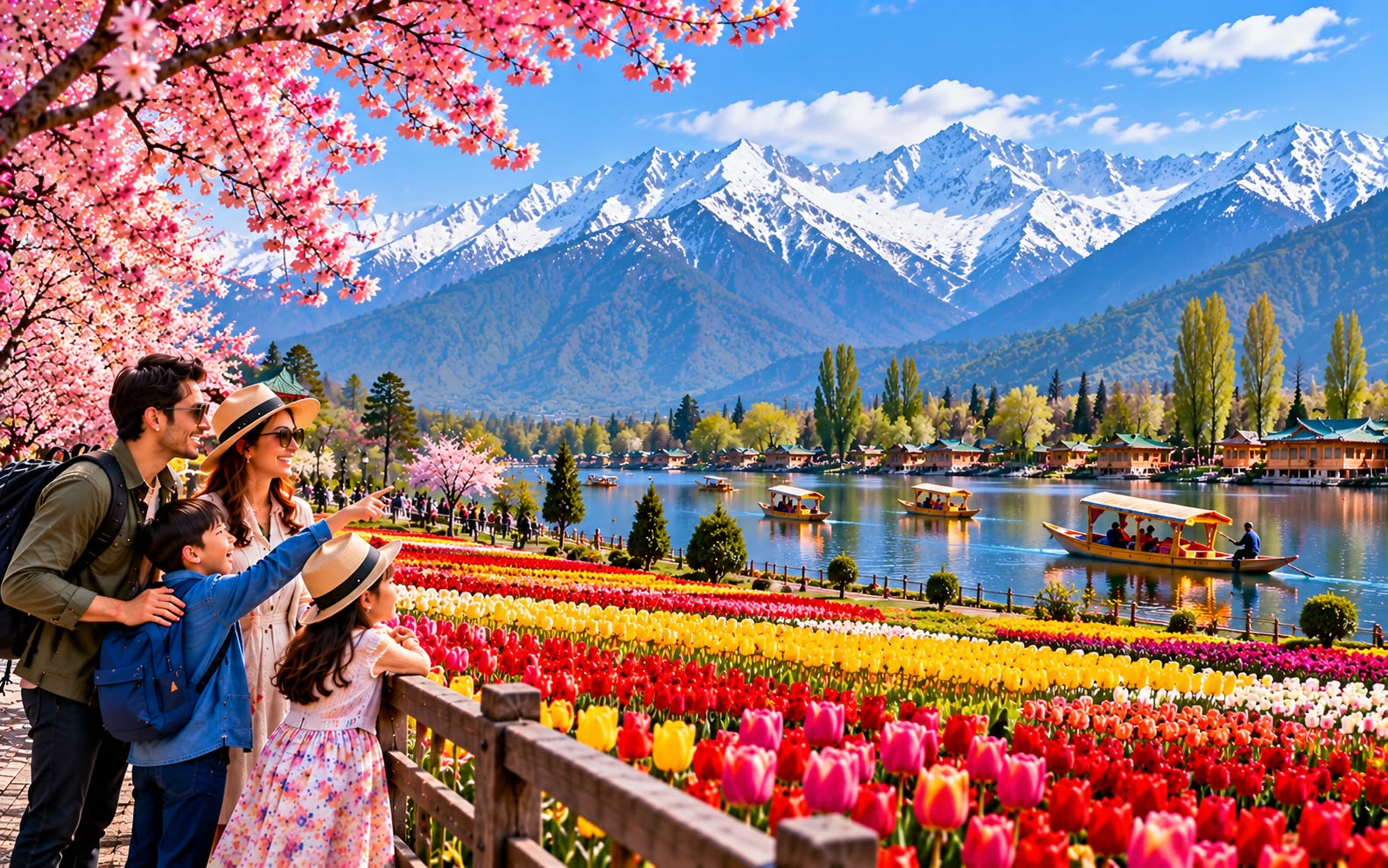
Kashmir tulip season in 5 days: the garden, the blossom and the valley
The Indira Gandhi Memorial Tulip Garden opens for about three weeks each spring and the dates move with the winter. Almond and cherry blossom either side of it, the valley at its greenest, and the standard circuit underneath. Several governments maintain travel advisories for Jammu and Kashmir, and this guide opens with that.
- South Asia
- 5 days
- ≈ AED 1,300 / person
- A three-week window in April when the valley does the thing it is famous for
Before you go
The tulip garden below the Zaberwan hills is the largest in Asia and it is open for roughly three weeks. The dates move with the winter — a cold March pushes it late, a warm one pulls it forward — and the exact opening is announced only days in advance.
That is the whole planning problem, and it is softer than it sounds: April in the valley is worth the trip whether or not you hit peak bloom. Almond blossom comes first, cherry and the tulips together, and the valley is as green as it gets.
The five-day valley route is this circuit without the season. The winter version is the snow trip. This one is built around three weeks in April.
Figure INR 33,000 (≈ AED 1,289) per person. April, with the detail below.
Read this first
Several governments advise against all, or all but essential, travel to parts of Jammu and Kashmir, including the Kashmir valley. The wording differs between countries and changes with conditions, so check your own government’s current advice before you book anything — not a blog, and not this page.
What sits behind those advisories:
- A long-running security situation. The valley has seen insurgency, heavy security deployment and periodic unrest for over three decades. Armed forces are highly visible and checkpoints are routine.
- Attacks have targeted tourists. In April 2025, gunmen killed civilians at Baisaran meadow above Pahalgam, a site on most visitor itineraries including this one. It was followed by a serious military exchange between India and Pakistan.
- Communications have been cut before. The region has experienced extended internet and mobile shutdowns, most notably through 2019–2020. Assume connectivity can be withdrawn.
- Border proximity. The Line of Control is close, and areas near it carry separate and stronger warnings everywhere.
- Conditions change quickly. A quiet season can end abruptly, and roads, flights and permits close with it.
Travel insurance will usually not cover you for a region your government advises against travelling to. Check the policy wording specifically; this catches people out and it is expensive.
April carries a particular version of this, because the tulip window is short and non-refundable bookings get made months ahead for dates nobody can confirm. Book flexibly.
Before you go: the admin
Entry
- A domestic trip for Indian nationals, no permit for the valley itself.
- Foreign nationals need an Indian visa as anywhere else; the valley is not a restricted area, though some border districts are.
- Last checked: 30 October 2026. Rules and advisories change — confirm against your own government and the Indian authorities.
The garden, and the dates
- The Indira Gandhi Memorial Tulip Garden sits on terraced slopes below the Zabarwan range, above Dal Lake, with more than a million bulbs in a long series of beds.
- It opens for roughly three weeks, typically from late March into the second half of April, and the opening date is announced shortly beforehand once the buds are judged ready.
- Peak is a narrower window inside that — perhaps ten days.
- Book refundable, and treat the garden as the best thing rather than the only thing.
- Go at opening. It is extremely busy by mid-morning, particularly at weekends and during the tulip festival days.
- There is an entry fee and the garden is laid out to be walked in about an hour.
Getting around
- A car with a driver for the whole trip. The circuit is Srinagar, Gulmarg, Pahalgam and back.
- The Srinagar–Gulmarg road is 50km and around two hours; Pahalgam about two and a half.
- April roads are open, unlike midwinter — though the Srinagar–Jammu highway can still close after late snow.
Money and practicalities
- Indian rupees. Cards work in Srinagar hotels and almost nowhere else on this circuit.
- April is cool, not warm — 5–20°C, colder at Gulmarg, and rain is common.
- Houseboats are heated by a bukhari, a wood or kerosene stove. Confirm the boat has one; April nights on the water are cold.
Day by day
Day 1 — Srinagar, and onto the water
- Arrive on a morning flight. Afternoon arrivals catch the weather diversions.
- 12:00 — To the houseboat on Dal or Nigeen.
- 15:00 — A shikara across the lake. In April the floating gardens are green again, the willows are in leaf, and the mountains behind still carry snow — which is the combination people come for.
- 17:00 — The old city — Jamia Masjid with its 378 deodar pillars, and the walnut and papier-mâché workshops.
- 19:30 — Wazwan on the boat. Order it in advance.
Day 2 — The tulip garden, early, then the Mughal gardens
- 08:00 — At the tulip garden gate for opening. This is not negotiable — by eleven it is a slow-moving crowd and the photographs are of other people.
- The beds run in bands up the terraces with Dal Lake below, and the Zabarwan ridge behind. An hour is enough.
- 10:00 — Siraj Bagh’s almond orchard nearby if the blossom is still on — it comes earlier than the tulips and some years the two overlap.
- 11:30 — Nishat Bagh and Shalimar Bagh, the Mughal terraced gardens along the lake. In April the chinars are in new leaf and the water channels are running — this is the month they were designed for.
- 15:00 — Pari Mahal above them for the view down the lake.
- 18:00 — Back to the boat.
Day 3 — Gulmarg
- 09:00 — Two hours west, climbing to 2,650m.
- 11:00 — The Gulmarg Gondola. Phase 1 to Kongdoori at 3,080m; Phase 2 to Apharwat at 3,979m. In April there is still snow up top and green below, which is the best of both.
- Phase 2 closes often for wind. Go up on the clear window.
- 14:00 — The meadow. Gulmarg means “meadow of flowers” and in late April the first of them appear as the snow line retreats.
- Ponies are everywhere and the handlers negotiate hard — agree the price and the route before mounting.
- 17:00 — Stay in Gulmarg rather than driving back. The early morning is the reason.
Day 4 — Pahalgam and the Lidder
- 08:00 — Down and east, about four hours via Srinagar.
- Note the advisory section above regarding Baisaran meadow, and check your own government’s current advice before planning any excursion above the town.
- 13:00 — Pahalgam. The Lidder runs through it and the valley above is pine and meadow.
- 14:30 — Aru and Betaab valleys — short drives up the river. Betaab is the manicured one; Aru is where you walk.
- In April the river is high with snowmelt and the meadows are just greening.
- 17:00 — Back toward Srinagar, or stay and drive in the morning.
Day 5 — Out
- A spare morning by design. Srinagar flights move in bad weather.
- 09:00 — Hazratbal shrine on the north shore, white marble against the water.
- 11:00 — A last shikara, or the Government Arts Emporium for fixed-price pashmina and papier-mâché, which removes the haggling.
- The airport has slow, layered security. Three hours, and nothing in a cabin bag you mind losing.
Costs and practicalities
Best time to visit
April, and the weeks inside it matter.
- Mid-to-late March — almond blossom in Srinagar, and the valley waking up. The tulip garden may open at the end of the month in a warm year.
- The first three weeks of April — the tulip window in most years, with cherry and apple blossom alongside it. This is the target.
- Late April and May — the garden is over, the valley is fully green, and Gulmarg’s meadow is coming into flower. Still an excellent trip and much cheaper.
- June to September — the summer valley, which is what the standard route covers.
- December to February — snow, and the winter route is that trip.
Travel tips
- Book flexibly. The garden’s opening is announced days ahead and the window is three weeks.
- Be at the tulip garden when it opens. By eleven you are photographing a crowd.
- Treat the garden as the best thing, not the only thing. April in the valley stands up without it.
- Check your own government’s advisory, and your insurance wording, before paying a deposit.
- Confirm the houseboat has a working bukhari. April nights are cold on the water.
- Stay the night in Gulmarg, not a day trip.
- Agree pony prices and the route before mounting.
- Build a spare morning. Srinagar flights cancel for weather.
- Do not photograph security installations or personnel.
What this trip actually costs
Two people, 4 nights, mid-range, flights to Srinagar excluded:
| Item | Cost |
|---|---|
| Houseboat on the lake, 2 nights with meals | INR 16,000 (≈ AED 625) |
| Gulmarg and Pahalgam hotels, 2 nights | INR 18,000 (≈ AED 703) |
| Car and driver, 5 days | INR 12,000 (≈ AED 469) |
| Tulip garden, gondola, Mughal gardens and shikara | INR 8,000 (≈ AED 312) |
| Food and everything else | INR 12,000 (≈ AED 469) |
| Total for two | INR 66,000 (≈ AED 2,577) |
- Roughly INR 33,000 (≈ AED 1,289) per person, and April is cheaper than the May–June peak even with the festival weeks in it.
- The tulip garden entry itself is a few hundred rupees. The season’s cost is in the beds and the flights, not the ticket.
- Gulmarg rates rise sharply from May. April is good value there.
- Shopping is the line that runs away and is not in this budget.
- Hotel picks here are chosen on location, not on commission — always check prices and recent reviews before booking.
What to pack
- Warm layers and a waterproof. April is 5–20°C and wet, and Gulmarg is colder again.
- Walking shoes for the gardens and the Lidder.
- Sunscreen — the valley is high and the light is strong even when it is cool.
- Modest clothing for Jamia Masjid and Hazratbal; a headscarf for women at the shrines.
- Cash in rupees for Gulmarg and Pahalgam.
- A power bank. Outages happen.
Part of a bigger trip?
- Kashmir in 5 days is this circuit without the season.
- Kashmir in 7 days adds Sonmarg and Doodhpathri.
- Kashmir in winter is Gulmarg under snow.
- Kashmir honeymoon is the slower version.
- Himachal in 6 days is the Himalayan alternative with no advisory attached.
FAQ
When exactly does the tulip garden open? There is no fixed date. It opens for roughly three weeks, usually from late March into the second half of April, and the opening is announced only shortly beforehand once the buds are ready. A cold March pushes it later. Book flexible rates.
What if we miss the tulips? April in the valley is worth the trip regardless — almond and cherry blossom, the Mughal gardens in new leaf with the water running, snow still on the peaks above a green valley, and Gulmarg’s gondola with snow at the top. The garden is the best thing, not the only one.
How crowded is the garden? Very, from mid-morning, and more so at weekends and during the festival days. It is genuinely calm at opening. That single hour is the difference between the photographs you wanted and photographs of a crowd.
Is April a good time for Gulmarg? Yes, and an unusual one — snow still at the top of the gondola, green coming up through the meadow below, and rates well under the May and June peak. Phase 2 still closes for wind, as it does all year.
Is it safe? Several governments maintain advisories for the region and attacks have targeted tourists, most recently at Baisaran in April 2025. Many thousands travel here each season without incident. Make the decision on your own government’s current advice, and check whether your insurance covers a region it warns against — usually it does not.
Prices and entry rules change, and what you need depends on your passport; last checked 30 October 2026, so confirm with the embassy or your airline before booking.


