 The Itinerary
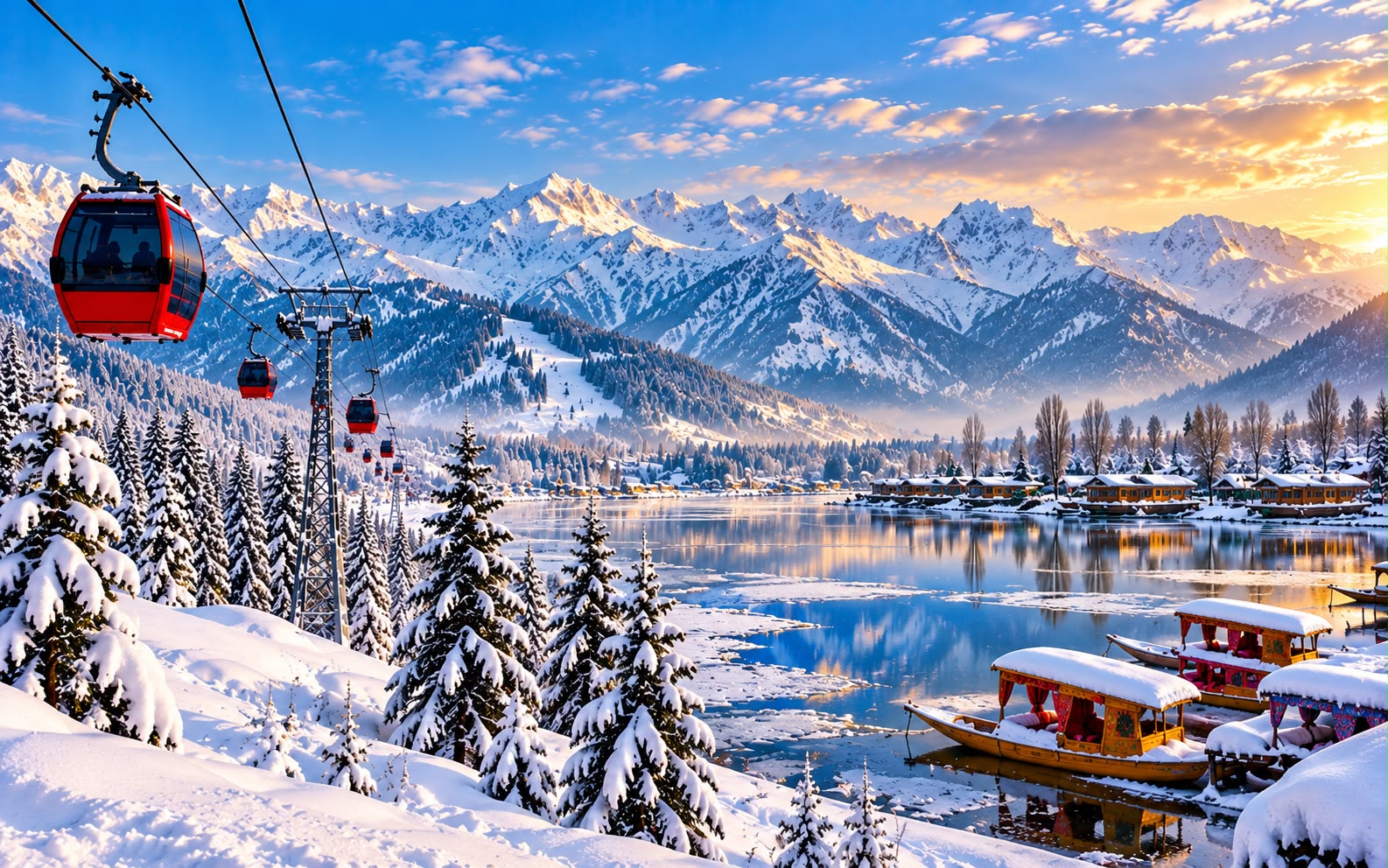
Kashmir in winter: Gulmarg, the gondola and a frozen Dal Lake
The winter version of the Kashmir valley: two nights at Gulmarg for the gondola and the snow, a houseboat on a half-frozen Dal Lake, and the Mughal gardens under a metre of it. Pahalgam comes out of the plan because the road is the problem. Several governments maintain travel advisories for Jammu and Kashmir, and this guide opens with that.
- South Asia
- 5 days
- ≈ AED 1,500 / person
- Deep snow at 4,000m and a houseboat with a bukhari going — behind a live travel advisory
Before you go
Kashmir in winter is a different trip from Kashmir in spring, and the difference is not atmosphere — it is the road map. Gulmarg goes from a day trip to the reason you came, and Pahalgam comes out of the plan entirely, because the Srinagar–Pahalgam road in January is a gamble nobody needs on a five-day trip.
Two nights in Gulmarg, two on the water in Srinagar, and the Mughal gardens seen under snow rather than in bloom. That is the shape. The five-day valley route is the spring and summer version with Pahalgam in it; the seven-day route adds Sonamarg and the Lidder properly.
Gulmarg sits at 2,650m and the gondola’s upper stage reaches 3,979m on Apharwat — one of the highest cable cars anywhere, and in February it is sitting in several metres of snow. Dal Lake freezes at the edges most winters and occasionally much further.
Figure INR 38,000 (≈ AED 1,484) per person. December to February, with late January and February the deepest snow.
Read this first
Several governments advise against all, or all but essential, travel to parts of Jammu and Kashmir, including the Kashmir valley. The wording differs between countries and changes with conditions, so check your own government’s current advice before you book anything — not a blog, and not this page.
What sits behind those advisories:
- A long-running security situation. The valley has seen insurgency, heavy security deployment and periodic unrest for over three decades. Armed forces are highly visible and checkpoints are routine.
- Attacks have targeted tourists. In April 2025, gunmen killed civilians at Baisaran meadow above Pahalgam, a site on most visitor itineraries. It was followed by a serious military exchange between India and Pakistan.
- Communications have been cut before. The region has experienced extended internet and mobile shutdowns, most notably through 2019–2020. Assume connectivity can be withdrawn.
- Border proximity. The Line of Control is close, and areas near it carry separate and stronger warnings everywhere.
- Conditions change quickly. A quiet season can end abruptly, and roads, flights and permits close with it.
Travel insurance will usually not cover you for a region your government advises against travelling to. Check the policy wording specifically; this catches people out and it is expensive.
Winter adds a second layer of risk that has nothing to do with security. The Jawahar Tunnel and the Srinagar–Jammu highway close in heavy snow, sometimes for days. Flights into Srinagar cancel in fog and snow with little notice. Build a spare day at the end, and do not book a tight onward connection.
Before you go: the winter admin
Entry
- Domestic trip for Indian nationals, no permit for the valley itself.
- Foreign nationals need an Indian visa like anywhere else; the valley is not a restricted area, though some border districts are.
- Last checked: 30 October 2026. Rules and advisories change — confirm against your own government and the Indian authorities before booking.
Getting there, in winter specifically
- Fly to Srinagar. In winter this is the only sensible way in. The road from Jammu closes in snow and the rail link stops short of the valley.
- Morning flights. Srinagar fog clears through the morning and afternoon arrivals are the ones that divert.
- A cancelled flight is a normal winter event, not a disaster. Hotels expect it.
Getting around
- A car with a driver for the whole trip, not per leg. In snow you want the same person who knows whether the Gulmarg road is open.
- The Srinagar–Gulmarg road is 50km and takes two hours in winter, sometimes more. Chains or a 4x4 are normal above Tangmarg, and the last stretch is occasionally shut until a plough has been through.
- At Tangmarg you may be made to change into a local vehicle. This is routine.
Money and the cold
- Indian rupees. Cards work in Srinagar hotels and almost nowhere in Gulmarg. Carry cash.
- ATMs in Gulmarg are unreliable in winter. Draw in Srinagar.
- Houseboats are heated by a bukhari, a wood or kerosene stove. Confirm the boat has one and that it is lit, because an unheated houseboat in January is genuinely unpleasant.
- A kangri — the wicker-cased charcoal pot people carry under a pheran — is not a souvenir, it is how the valley stays warm.
Day by day
Day 1 — Srinagar, and onto the water
- Arrive on a morning flight, which is the one that lands.
- 12:00 — To the houseboat on Dal or Nigeen. Nigeen is quieter and colder; Dal is livelier and closer to everything.
- 14:00 — A shikara out across the lake. In winter the water steams in the morning and the edges ice over, and the floating gardens are brown stubble rather than green. It is a better hour than it sounds.
- 16:00 — The old city — Jamia Masjid with its 378 deodar pillars, and the papier-mâché and walnut-wood workshops around it.
- 18:00 — Back to the boat before dark. The valley gets dark early and cold fast.
- Eat on the houseboat on night one. Rogan josh, haak, and rice.
Day 2 — The Mughal gardens under snow, then up to Gulmarg
- 09:00 — Shalimar Bagh and Nishat Bagh. Under snow the terraces and the water channels read as architecture rather than as planting, which is arguably the better version — the chinars are bare and the structure is all there is.
- 11:00 — Pari Mahal above them for the view down the lake, if the road up is clear.
- 12:30 — Leave for Gulmarg. Two hours, and you want to be up before the afternoon light goes.
- 15:00 — Arrive and do nothing. Gulmarg is 2,650m and you have come from 1,585m; the first afternoon is for walking slowly around the bowl and letting the altitude settle.
- 17:00 — St Mary’s Church in the snow, and the frozen golf course, which in summer is the highest in the world and in winter is a white field with flags in it.
Day 3 — The gondola, and Apharwat
- 08:30 — Gondola Phase 1 to Kongdoori at 3,080m. Go early: the queue is the single biggest time cost of this trip and it builds through the morning.
- 10:00 — Phase 2 to Apharwat at 3,979m, weather permitting. This stage closes often — wind, not snow, is usually the reason. If it is open, go up immediately rather than after lunch.
- At the top it is a different climate. Wind chill well below −15°C is ordinary. Goggles, not sunglasses.
- 12:30 — Down to Kongdoori for lunch, which is tea and Maggi in a hut, and perfectly good.
- 14:00 — Snow play, a sledge, or a ski lesson. Hire is available in the village and the quality varies enormously — look at the gear before you pay.
- 16:30 — Off the mountain before the light goes.
Day 4 — A second mountain day, or down early
- This is the flexible day, and that is deliberate. If Phase 2 was shut yesterday, today is the retry.
- 09:00 — Either back up the gondola, or the Khilanmarg walk — about an hour up through the trees from the top of Phase 1, with the Pir Panjal in front of you.
- For skiers, Gulmarg’s reputation is off-piste and it is earned. It is also a serious mountain with real avalanche terrain and limited patrol — take a local guide, not a friend’s recommendation.
- 14:00 — Down to Srinagar, two hours, arriving in the afternoon.
- 17:00 — Lal Chowk and the covered markets for pashmina and saffron. Both are heavily faked; buy from a shop that will write what it sold you on the bill.
Day 5 — Out
- A spare morning by design, because the flight out is the one most likely to move.
- 09:00 — Hazratbal shrine on the lake’s north shore, white marble against the water.
- 11:00 — A last shikara, or the Kashmir Government Arts Emporium for the fixed-price version of the shopping.
- The airport has slow, layered security. Three hours, not two, and no cabin bag you care about.
Costs and practicalities
Best time to visit
December to February, and they are not the same month.
- December — snow arrives, the gondola is running, and prices are lower than January. Phase 2 may not be open yet.
- January — Chillai Kalan, the forty harshest days of the valley winter, from roughly 21 December. Deep cold, the best chance of a frozen Dal, and the highest chance of a shut road.
- February — the best snow of the year and the most reliable gondola, with marginally longer days. The month to pick.
- March — thawing, slushy, and the almond blossom starts in Srinagar. A different and also lovely trip.
- April–October — the green valley, which is what the spring and summer route covers.
Travel tips
- Build a spare day. Srinagar flights cancel in winter and the Gulmarg road closes. A trip with no slack in it will eat the thing you came for.
- Go up the gondola on your first clear morning, not on the day you planned to. Weather decides this, not your itinerary.
- Confirm the houseboat has a working bukhari and ask what the heating costs — some charge for wood by the night.
- Hire gear in Srinagar if you are fussy, Gulmarg if you are not.
- Goggles and a balaclava. Apharwat is windburn territory.
- Take a guide for anything off-piste. The avalanche risk here is real and the infrastructure is thin.
- Phone signal is patchy above Tangmarg and postpaid Indian SIMs work where prepaid visitor SIMs sometimes do not.
- Do not photograph security installations or personnel.
What this trip actually costs
Two people, 4 nights, mid-range comfort, flights to Srinagar excluded:
| Item | Cost |
|---|---|
| Gulmarg hotel, 2 nights in high season | INR 24,000 (≈ AED 937) |
| Houseboat on the lake, 2 nights with meals | INR 12,000 (≈ AED 469) |
| Car and driver, 5 days including the Gulmarg run | INR 9,000 (≈ AED 351) |
| Gondola, both phases, two people | INR 4,000 (≈ AED 156) |
| Ski or snowboard hire, lessons and a guide | INR 18,000 (≈ AED 703) |
| Food, tea and everything else | INR 9,000 (≈ AED 351) |
| Total for two | INR 76,000 (≈ AED 2,968) |
- Roughly INR 38,000 (≈ AED 1,484) per person, and noticeably more than the green-season valley trip — Gulmarg beds in February are the most expensive in Kashmir.
- Drop the ski line entirely and this becomes a snow-and-gondola trip at about two-thirds the cost.
- Gulmarg hotel rates swing hard. January and February carry a premium that December does not.
- Hotel picks here are chosen on location, not on commission — always check prices and recent reviews before booking.
What to pack
- Proper insulated boots with grip. This is the one thing people get wrong, and the village is sheet ice in places.
- A real down jacket, not a city coat. −15°C with wind at the top of Phase 2.
- Goggles, thermal base layers, a balaclava and two pairs of gloves — one waterproof.
- Sunscreen. Snow at 4,000m burns faster than a beach.
- Cash in rupees, enough for Gulmarg.
- A power bank. Cold flattens phone batteries fast, and outages happen.
Part of a bigger trip?
- Kashmir in 5 days is this valley in spring and summer, with Pahalgam back in it.
- Kashmir in 7 days adds Sonamarg and a slower Lidder valley.
- Ladakh in 7 days is the other side of the same mountains, and a summer trip.
- Himachal in 6 days is the easier Indian snow option when the valley advisory is a problem for you.
FAQ
Is the Gulmarg gondola open in winter? Phase 1 runs through the season. Phase 2 to Apharwat is weather dependent and closes often, usually for wind rather than snow. Go up on your first clear morning rather than the day you planned to.
Is Gulmarg good for a beginner skier? The lower bowl at Kongdoori is fine for lessons and there is hire in the village. Gulmarg’s reputation, though, is off-piste terrain for experienced skiers, and that part needs a local guide rather than enthusiasm.
Does Dal Lake actually freeze? The shallows and the edges freeze most winters, and the shikara channels sometimes have to be broken open in the morning. A full freeze across the lake is rare and makes the news locally when it happens.
Why is Pahalgam not in this itinerary? The road is the reason. In deep winter the Pahalgam leg can strand you or simply be cancelled, and on a five-day trip that costs you Gulmarg as well. The spring route has it in.
What if my flight to Srinagar is cancelled? Assume it might be. Fog and snow close the airport through winter, hotels and drivers treat it as routine, and the fix is a spare day at the end of the trip rather than a tight onward connection.
Prices and entry rules change, and what you need depends on your passport; last checked 30 October 2026, so confirm with the embassy or your airline before booking.


