 The Itinerary
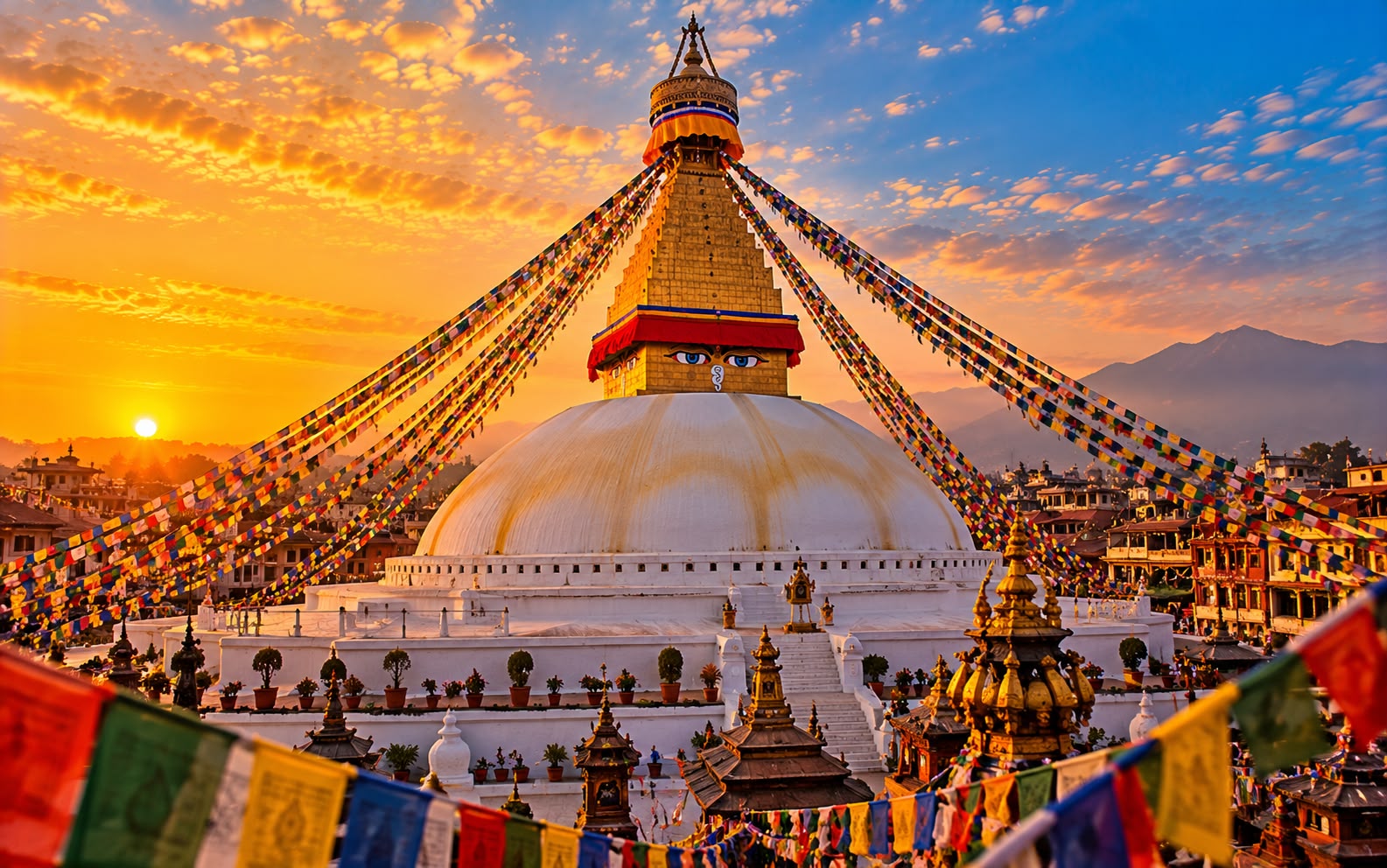
Kathmandu in 3 days: Durbar Square, Boudhanath and Bhaktapur
The Kathmandu valley holds seven UNESCO sites within an hour of each other. Which to see at dawn, what the 2015 earthquake took and what was rebuilt, and why Bhaktapur deserves a night rather than a morning.
- South Asia
- 3 days
- ≈ AED 550 / person
- Seven UNESCO monument zones inside one valley, and three of them are towns
Before you go
The Kathmandu valley is one UNESCO World Heritage Site made of seven separate monument zones — three royal squares, two Buddhist stupas, two Hindu temple complexes — all within an hour of each other.
Three days covers them, and the shape that works is the city first, the two great religious sites second, and Bhaktapur and Patan third — because those two are towns rather than monuments and reward the most time.
On the 2015 earthquake: it killed nearly 9,000 people and destroyed or damaged a great deal of what is on this page. Restoration has been extensive and is ongoing. Some of what you will see is rebuilt, some is still scaffolded, and the guides will tell you which — that honesty is part of visiting now.
Part of a Nepal trip? See Nepal in 10 days, which runs from here to Pokhara and Chitwan.
Figure the budget below. October–November and March–April.
Before you go: the short version
Entry
- Visa on arrival at Kathmandu airport for most nationalities — bring US dollars cash and a passport photo, and expect a queue. The online pre-application saves time but not the payment step.
- A few nationalities must apply in advance. Check your own case.
Getting in and around
- Tribhuvan International (KTM) is 20 minutes from Thamel in theory and an hour in traffic.
- Pathao and inDrive are the local ride apps and are far cheaper than hailing. A taxi across the city is NPR 400–800.
- The valley’s air quality is poor, particularly in winter. A mask is not an overreaction, and many residents wear one.
- Traffic is the main constraint. Everything on this page is within 14km and nothing takes less than 40 minutes.
Day by day
Day 1 — Durbar Square and Swayambhunath
Walking order: Thamel → Kathmandu Durbar Square (15 min on foot) → Freak Street (5 min) → taxi → Swayambhunath: 365 steps. About 3km plus the climb.
- 09:00 — Kathmandu Durbar Square, the old royal complex. Several temples here were destroyed in 2015 and the rebuilding is visible — the Kasthamandap, from which the city takes its name, has been reconstructed.
- The Kumari Ghar, where the living goddess — a young girl selected as the incarnation of Taleju — appears briefly at a window. Photography of her is forbidden.
- 11:00 — Freak Street, the 1960s hippie trail’s original address, now quiet and more interesting for it.
- 13:00 — Lunch, and dal bhat — lentils, rice, vegetables and pickle, with refills — is the national meal.
- 15:00 — Swayambhunath, the monkey temple. 365 steps up to a stupa with painted eyes on all four sides and the whole valley below. Nothing loose or shiny — the macaques are practised and fast.
- 17:30 — Sunset from the top, which is the hour to be there.
- 19:30 — Thamel for the trekking shops, the momos and the live music, which is touristy and is also where everyone starts.
Day 2 — Pashupatinath and Boudhanath
Walking order: Pashupatinath riverbank (1.5km around the complex) → taxi → Boudhanath kora (the circuit is 500m). About 3km.
- 06:30 — Pashupatinath at dawn — the most important Hindu temple in Nepal, on the Bagmati, with the cremation ghats running along the river.
- Non-Hindus cannot enter the main temple. The view is from the far bank, and you do not photograph the cremations. People will offer to let you; it is a scam and it is also a funeral.
- The sadhus on the terraces pose for a fee, agreed first. Several are performers; some are not.
- 09:30 — Breakfast, and a gap.
- 11:00 — Boudhanath, one of the largest stupas in the world, rebuilt after 2015 cracked its spire. Walk the kora clockwise, as everyone does, past the Tibetan monasteries that ring it.
- 13:00 — Lunch on a rooftop facing the stupa, which is the thing to do here.
- 16:00 — The Garden of Dreams back in the centre, a restored neo-classical garden that is the only quiet green space in Kathmandu.
- 18:00 — Boudhanath again at dusk if you have the energy — butter lamps lit around the base and the kora at its fullest. It is a different place from the morning.
Day 3 — Bhaktapur and Patan
Walking order: Bhaktapur Durbar Square → Taumadhi Square (5 min) → Pottery Square (5 min) → Dattatreya Square (10 min). About 3km, all on brick, no cars.
- 08:00 — Bhaktapur, 14km east and the best preserved of the three royal squares. Go early; it is empty before ten.
- The Nyatapola temple — five tiers on five plinths, each guarded by a pair of figures said to be ten times stronger than the pair below, from wrestlers up to goddesses. It survived both the 1934 and 2015 earthquakes intact.
- Pottery Square, where they still throw by hand and dry the pots in the open square.
- 12:00 — Juju dhau, the “king curd”, in a clay pot — it is a Bhaktapur speciality and genuinely worth seeking out.
- 14:00 — Patan, on the way back — the Krishna Mandir, carved entirely from stone rather than brick and timber, and the Patan Museum, which is the best in Nepal and is housed in a restored palace wing.
- 17:00 — Patan’s backstreet courtyards, where the metalworkers still beat statues by hand.
- Each square charges its own ticket, and the money funds the restoration.
Consider staying in Bhaktapur
- The square after the day visitors leave at four is the best hour in the valley, and there are guesthouses on it.
Costs and practicalities
Getting around, and what it costs
| Pathao or inDrive across the city | NPR 200–500 |
| Taxi, Thamel to Bhaktapur | NPR 1,200–1,800 |
| Kathmandu Durbar Square | NPR 1,000 |
| Bhaktapur Durbar Square | NPR 1,800 |
| Patan Durbar Square | NPR 1,000 |
| Swayambhunath | NPR 200 |
| Boudhanath | NPR 400 |
| Pashupatinath | NPR 1,000 |
| Dal bhat at a local place | NPR 350–600 |
- The site tickets are the main cost and they are the restoration funding, which is a reasonable thing to pay for.
Best time to visit
- October–November — the best of the year. Clear air after the monsoon, mountain views, and the Dashain and Tihar festivals.
- March–April — warm, rhododendron in the hills, and hazier.
- December–February — cold, 2–18°C, and the valley’s air quality is at its worst, with the mountains often invisible.
- June–September — the monsoon. Green, cheap, and the Himalaya stay hidden.
Travel tips
- Pashupatinath at dawn, and put the camera away at the ghats.
- Bhaktapur before ten, or stay the night.
- Boudhanath at dusk is better than Boudhanath at noon.
- Nothing loose at Swayambhunath. The monkeys take glasses.
- Use Pathao or inDrive, not street taxis.
- Carry a mask in winter, and cash — cards work in Thamel and almost nowhere else.
- Buy pashmina and singing bowls in Patan, not Thamel, where the workshops are and the prices are half.
What this trip actually costs
Two people, 2 nights, mid-range comfort, international flights excluded:
| Item | Cost |
|---|---|
| Hotel, 2 nights | NPR 14,000 (≈ AED 342) |
| Food and drink, 3 days | NPR 12,000 (≈ AED 293) |
| Site tickets, two people across all seven zones | NPR 11,000 (≈ AED 268) |
| Taxis and ride apps, including the airport | NPR 7,000 (≈ AED 171) |
| Incidentals | NPR 2,000 (≈ AED 48.81) |
| Total for two | NPR 46,000 (≈ AED 1,123) |
- Nepal is very cheap and the UNESCO site tickets are the largest single line — which is the restoration levy and is worth paying.
- Hotel picks here are chosen on location, not on commission — always check prices and recent reviews before booking.
What to pack
- Shoes for uneven brick and 365 steps.
- A warm layer — the valley is 1,400m and winter mornings are near freezing.
- A mask for winter air quality.
- Modest clothing for temples, and shoes that come off easily.
- A Type C/D/M adapter, 230V, and power cuts still happen.
Part of a bigger trip?
- Nepal in 10 days adds Pokhara, Chitwan and the Annapurna foothills.
- Nepal and Bhutan in 12 days crosses to Paro and Tiger’s Nest.
- India and Nepal in 13 days pairs this with Delhi, Agra and Varanasi.
FAQ
Is three days enough for Kathmandu? For the seven UNESCO zones, yes, if you accept that Bhaktapur and Patan get an afternoon each rather than a day. Four days lets you sleep in Bhaktapur, which is the better trip.
What did the 2015 earthquake destroy? A great deal across all three Durbar Squares, and it cracked Boudhanath’s spire. Restoration has been extensive; some buildings are faithful reconstructions and some are still scaffolded.
Can I enter Pashupatinath? Non-Hindus cannot enter the main temple. The complex and the far bank of the river are open, and that is where the view is.
Is Bhaktapur worth staying in? Yes, if you have the night. The square after four, once the day visitors have gone, is the best hour in the valley.
How bad is the air? Poor, and worst in winter when the valley traps it. The mountains often disappear entirely between December and February. October and November are clear.
Prices and entry rules change, and what you need depends on your passport; last checked 29 October 2026, so confirm with the embassy or your airline before booking.


