 The Itinerary
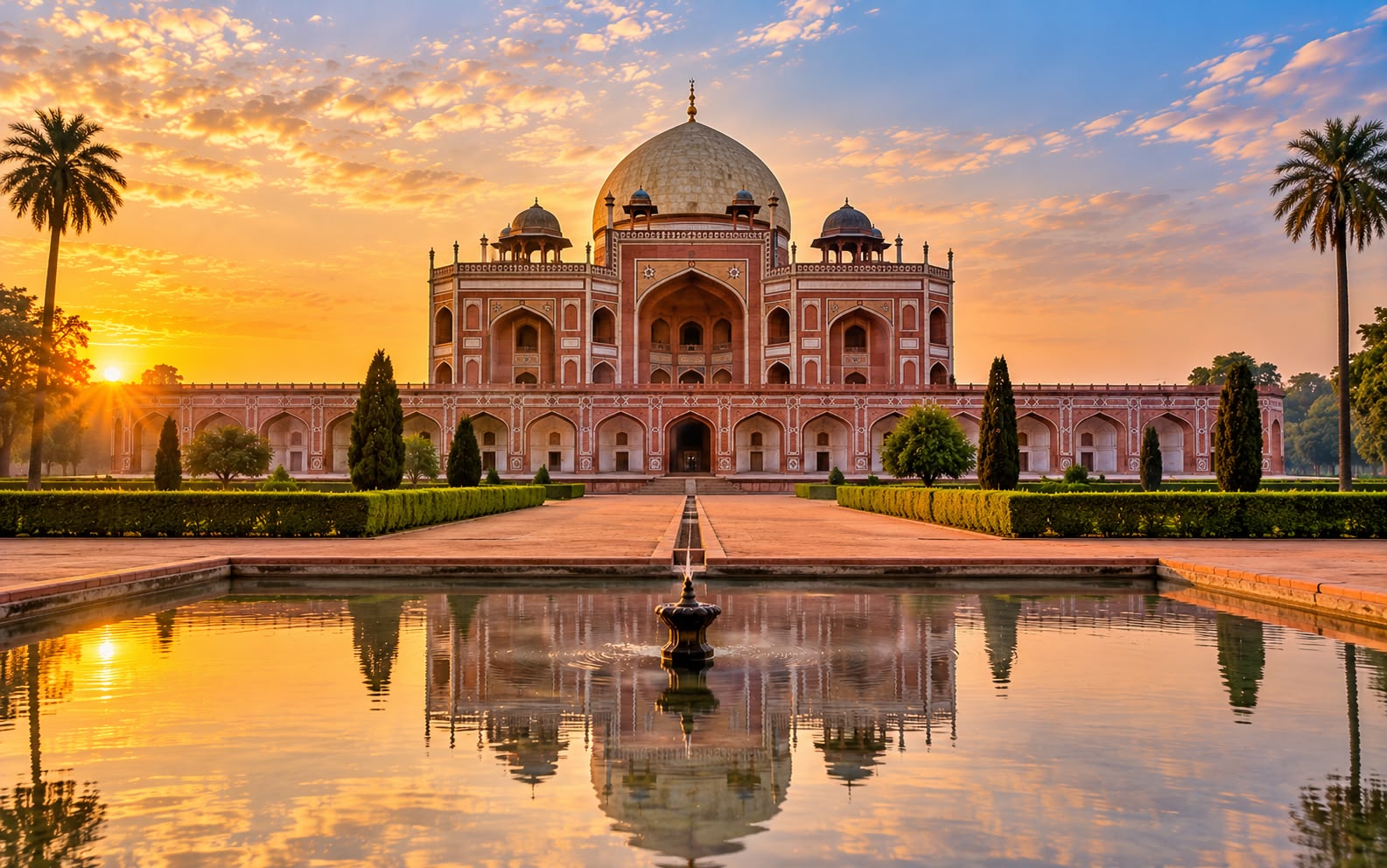
Delhi in 2 days: Old Delhi, the Mughal tombs and New Delhi
Old Delhi in the morning on a cycle rickshaw, the Mughal tombs in the afternoon light, and New Delhi's colonial grid on the second day. Plus the hotel scam that catches people on arrival, and the metro that avoids all of it.
- South Asia
- 2 days
- ≈ AED 300 / person
- Two days that split the city by era instead of fighting the traffic
Before you go
Delhi is several cities stacked on one site — at least seven capitals over a thousand years — and two days works if you take them in order rather than by postcode.
Day one is the Mughal city: Jama Masjid, Chandni Chowk, and Humayun’s Tomb, which is the building the Taj Mahal was designed from. Day two is the older ruins and the British one: Qutub Minar, Lutyens’ New Delhi, and the museums.
The metro is the thing that makes this possible. It is clean, air-conditioned, very cheap, and it is immune to the traffic that otherwise eats a short visit.
Part of an India trip? See the Golden Triangle in 5 days, which runs Delhi, Agra and Jaipur.
Figure the budget below. October to March.
Before you go: the short version
Entry
- The e-Visa is applied for at indianvisaonline.gov.in/evisa and nowhere else. The copycat sites charge several times the fee for the same document.
- Apply at least four days ahead, and the tourist e-Visa comes in 30-day, one-year and five-year versions.
Getting in and around
- Indira Gandhi International (DEL) is 45–60 minutes from the centre. The Airport Express metro is INR 60 and takes 20 minutes to New Delhi station — it is by far the best way in.
- Use Uber or Ola, which remove the fare negotiation entirely.
- The Delhi Metro is excellent — INR 10–60 a journey, and it has a women-only carriage at the front of every train.
- Cycle rickshaws are the right way through Chandni Chowk, where nothing else fits.
The scam that catches people on arrival
- “Your hotel is closed / has burned down / is in a riot area.” It is not. The driver or the “tourist office” is steering you to a commission hotel. It happens most often to people arriving late at New Delhi station or Connaught Place.
- Book your first transfer in advance, confirm your hotel directly, and ignore anyone who approaches you unsolicited with help.
Day by day
Day 1 — Old Delhi and the Mughal tombs
Walking order: Jama Masjid → Chandni Chowk by cycle rickshaw (the lanes are too narrow and crowded to enjoy on foot in the middle of the day) → Khari Baoli → metro → Humayun’s Tomb (1km within the gardens). About 3km on foot.
- 07:30 — Jama Masjid at opening, India’s largest mosque, built by Shah Jahan in 1656. It closes to visitors around prayer times and the courtyard holds 25,000 people.
- Cover shoulders and knees; robes are lent at the gate. There is a camera fee and shoes come off.
- 09:00 — Chandni Chowk by cycle rickshaw — the main spine of the old city, and Khari Baoli, which is the largest spice market in Asia and will make you cough.
- 10:30 — Paranthe Wali Gali for breakfast — a lane of paratha shops, several over a century old.
- 12:00 — The Red Fort, which is closed on Mondays. An hour is enough; the Diwan-i-Khas is the part worth it.
- 15:00 — Humayun’s Tomb, UNESCO-listed and the prototype the Taj Mahal was built from — the first great Mughal garden tomb, and far quieter than its famous descendant.
- 17:00 — Nizamuddin Dargah next door, and on a Thursday evening there is qawwali — a religious gathering, not a performance. Sit at the back, cover your head, and shoes off at the lane.
- 20:00 — Dinner in Nizamuddin or Lodhi Colony.
Day 2 — The old ruins and the British city
Walking order: Qutub Minar complex (1.5km of grounds) → metro → Lodhi Garden (2km loop) → India Gate and Rajpath (auto). About 4km.
- 08:30 — Qutub Minar, UNESCO-listed — a 73-metre victory tower begun in 1193, and the iron pillar in the courtyard that has not rusted in sixteen centuries, which metallurgists still write papers about.
- 11:00 — Lodhi Garden, free, with fifteenth-century tombs scattered through a park that Delhi actually uses. The best free hour in the city.
- 12:30 — Lunch in Khan Market or Lodhi Colony.
- 14:00 — The National Museum, which holds relics of the Buddha, the Harappan “Dancing Girl”, and a great deal that almost nobody sees.
- 16:30 — Rajpath and India Gate, Lutyens’ ceremonial axis, with the Rashtrapati Bhavan at the far end. It is best in the late afternoon, and the lawns fill with families.
- 18:30 — Connaught Place, the Georgian colonnade at the centre of New Delhi, and Janpath for the handicraft emporiums — the state-run ones have fixed prices and no haggling.
If you have a third day
- Agra and the Taj Mahal — see the day trip, which is 90 minutes each way on the Gatimaan Express.
Costs and practicalities
Getting around, and what it costs
| Metro, typical journey | INR 10–60 |
| Airport Express metro | INR 60 |
| Uber or Ola across the city | INR 150–350 |
| Cycle rickshaw in Chandni Chowk | INR 100–200 |
| Red Fort | INR 600 |
| Humayun’s Tomb | INR 600 |
| Qutub Minar | INR 600 |
| National Museum | INR 650 |
| Lodhi Garden | free |
- The metro is the single best decision in Delhi. It avoids the traffic and the negotiation at the same time.
Best time to visit
- October to March — 10–28°C and the only comfortable window. December and January are foggy, which delays flights and trains regularly.
- April to June — 40–45°C, and genuinely dangerous in the middle of the day.
- July to September — the monsoon, which breaks the heat and floods the streets.
- Air quality between late October and January is severe — Delhi regularly records among the worst in the world after Diwali and through the winter inversion. If you have respiratory issues, this matters more than the temperature.
Travel tips
- Nobody’s hotel has burned down. Ignore the approach.
- Use the metro, with the women-only carriage if preferred.
- Red Fort is closed Mondays; most other monuments are not.
- Cycle rickshaw through Chandni Chowk, not on foot at midday.
- Check the air quality index if you are visiting November to January.
- Carry small notes and expect to tip in small amounts constantly.
What this trip actually costs
Two people, 1 night, mid-range comfort, international flights excluded:
| Item | Cost |
|---|---|
| Hotel, 1 night | INR 6,000 (≈ AED 234) |
| Food and drink, 2 days | INR 3,000 (≈ AED 117) |
| Monument entries, two people | INR 5,000 (≈ AED 195) |
| Metro, Uber and the airport both ways | INR 1,600 (≈ AED 62.48) |
| Tips, rickshaws, incidentals | INR 400 (≈ AED 15.62) |
| Total for two | INR 16,000 (≈ AED 625) |
- The monument tickets are the biggest line — foreign-visitor rates are roughly ten times the Indian ones, which is standard across the country.
- Lodhi Garden, Chandni Chowk and Rajpath cost nothing.
- Hotel picks here are chosen on location, not on commission — always check prices and recent reviews before booking.
What to pack
- Shoulders and knees covered for the mosque and the dargah.
- Socks, for hot stone at the mosque.
- A mask if visiting between November and January.
- A Type C/D/M adapter, 230V.
Part of a bigger trip?
- The Golden Triangle in 5 days runs Delhi, Agra and Jaipur.
- India in 10 days and 14 days build out from here.
- The Taj Mahal as a day trip if you have one spare day.
- Jaipur in 2 days is four hours by road or five by train.
FAQ
Is two days enough for Delhi? For Old Delhi, the Mughal tombs and the New Delhi grid, yes. It is not enough to add Agra, which needs its own day.
Is Delhi safe? Ordinary big-city care, with more commercial pressure than most. Women travellers report persistent attention; the metro’s women-only carriage is genuinely useful and widely used.
What is the hotel scam? A driver or a “tourist office” tells you your hotel is closed, burned down or unreachable, and offers an alternative on commission. Book transfers ahead and confirm with your hotel directly.
How bad is the air? Between late October and January, severe — regularly among the worst readings in the world. It is a real consideration for anyone with asthma or a lung condition.
Old Delhi or New Delhi? Old Delhi for the market streets, the mosque and the food. New Delhi for the tombs, the gardens and the museums. Two days gives you both, which is the point of this plan.
Prices and entry rules change, and what you need depends on your passport; last checked 29 October 2026, so confirm with the embassy or your airline before booking.


