 The Itinerary
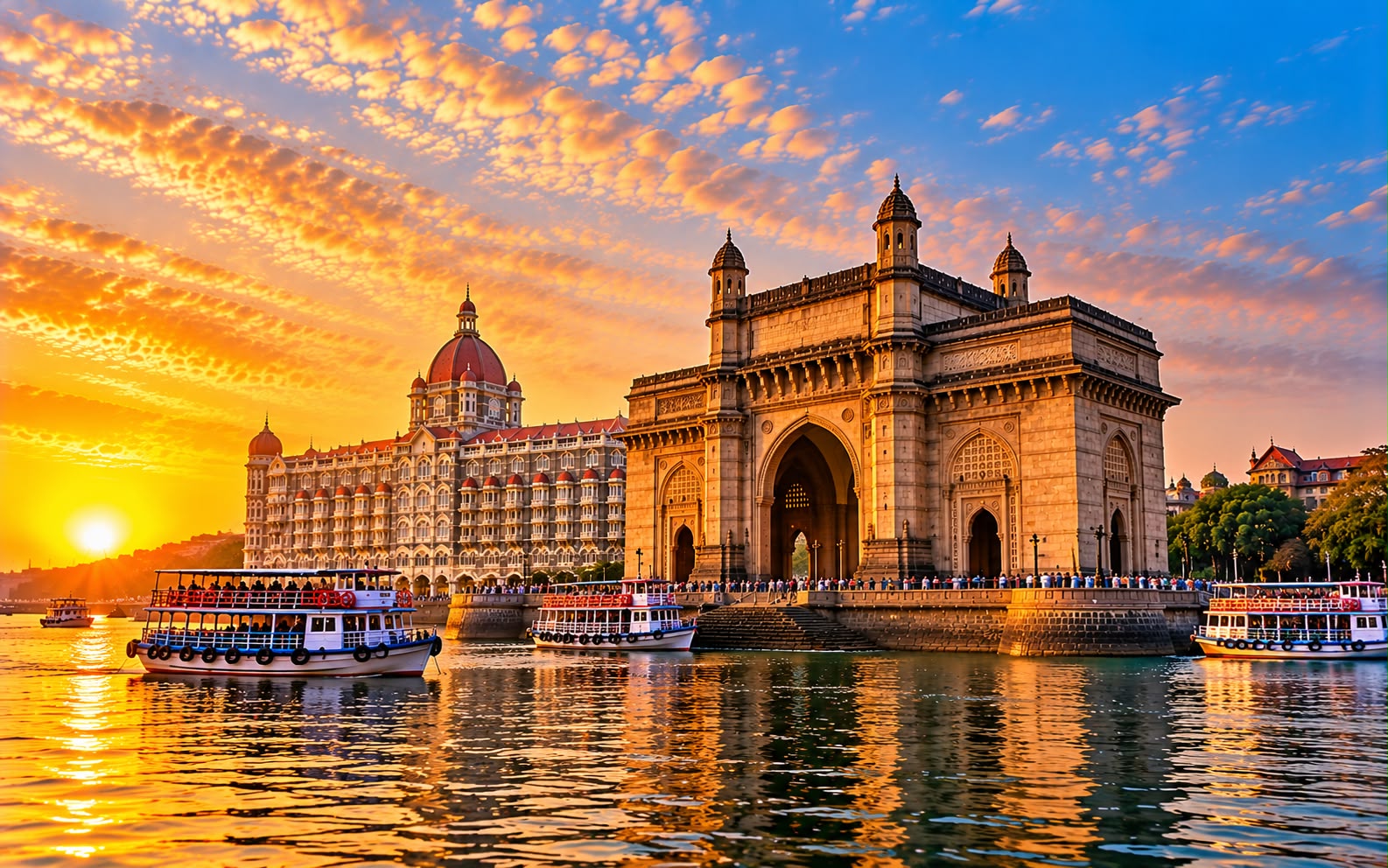
Mumbai in 3 days: the Gateway, Bandra and Elephanta
Colaba's colonial core on foot, the cave temples an hour across the harbour, and the suburbs where the city actually lives. Plus the dabbawalas, the local trains, and how to do Dharavi without it being a zoo.
- South Asia
- 3 days
- ≈ AED 600 / person
- Three days in a city of Victorian Gothic, Art Deco and twenty million people
Before you go
Mumbai is the densest, fastest and most self-confident city in India, and it is also the one most visitors give a day to on their way somewhere else. Three days is the minimum to see why people who live here are so attached to it.
The shape: day one on foot through Colaba and the Fort, which holds the second-largest collection of Art Deco buildings in the world after Miami, alongside the Victorian Gothic the British left. Day two across the harbour to Elephanta. Day three in the suburbs, which is where the city actually lives.
Part of an India trip? See India in 14 days.
Figure the budget below. November to February.
Before you go: the short version
Getting in and around
- Chhatrapati Shivaji Maharaj International (BOM) is 60–90 minutes from Colaba depending entirely on traffic.
- Use Uber or Ola. Metered black-and-yellow taxis also work and the meters are generally honest here, which is not true everywhere in India.
- The local trains carry around seven million people a day and are the fastest way north–south. Avoid the 08:00–11:00 and 17:00–21:00 peaks entirely — the crush is genuine and dangerous.
- There are women-only carriages on every train and they are widely used.
- The new metro lines are air-conditioned and far gentler than the locals.
Where to stay
- Colaba or Fort for the colonial core and walking.
- Bandra for restaurants and the suburbs, and a long commute to the sights.
Day by day
Day 1 — Colaba, the Fort and Marine Drive
Walking order: Gateway of India → Colaba Causeway (10 min) → Kala Ghoda (15 min) → CSMT (10 min) → taxi → Marine Drive. About 5km, flat, and shaded in parts by the arcades.
- 08:00 — The Gateway of India, built to welcome George V in 1911 and finished in 1924 — and the last British troops left India through it in 1948, which is a tidy piece of historical symmetry.
- 09:00 — The Taj Mahal Palace hotel opposite, which is worth walking into. It opened in 1903 and was one of the sites of the 2008 attacks; the memorial inside is quiet and unmissable.
- 10:00 — Colaba Causeway for the street shopping, then Kala Ghoda — the arts district, with the Jehangir Art Gallery and the Chhatrapati Shivaji Maharaj Vastu Sangrahalaya, which is the city museum and is excellent.
- 13:00 — Lunch at Britannia or a Parsi café — Kyani, Britannia, Yazdani. The Irani cafés are a disappearing institution — perhaps two dozen left from several hundred — and berry pulao is the dish.
- 15:00 — Chhatrapati Shivaji Maharaj Terminus, UNESCO-listed, Victorian Gothic with Indian detail and still a working commuter station carrying three million people a day. Look at it from across the road, and go inside at the quiet end of the afternoon.
- 17:00 — The Oval Maidan, with Gothic on one side and Art Deco on the other, which is the UNESCO listing in one view.
- 18:30 — Marine Drive at dusk — the “Queen’s Necklace” when the streetlights come on along the curve — and Chowpatty beach for bhelpuri.
Day 2 — Elephanta, and the evening city
Walking order: boat → 120 steps up to the caves → the five caves (flat inside). About 2km plus the climb.
- 09:00 — The boat from the Gateway of India, an hour each way. The last boat back is around 17:30 and you do not want to test it.
- Elephanta is closed on Mondays.
- 10:30 — The caves, UNESCO-listed, cut into the rock in the fifth to eighth centuries. The Trimurti — a three-headed Shiva, six metres tall — is the one to stand in front of, and the damage to several figures was done by Portuguese soldiers using them for target practice.
- The monkeys will take food from your hands. Carry nothing open.
- 14:00 — Back across, and the harbour view of the city from the water is the best one.
- 16:00 — Dhobi Ghat from the Mahalaxmi bridge — the open-air laundry where thousands of items are washed by hand daily, and the view from the bridge is free.
- 18:00 — Haji Ali Dargah, a tomb on an islet reached by a causeway that floods at high tide — check the tide times, or you will be waiting.
- 20:00 — Dinner in Lower Parel or Colaba.
Day 3 — Bandra, Dharavi and the suburbs
- 08:30 — A Dharavi tour, if you do one, with a community-based operator. Dharavi is one of the largest informal settlements in Asia and also a working industrial economy — leather, pottery, and a recycling industry turning over hundreds of millions of dollars a year.
- Choose the operator carefully. The good ones are run from within Dharavi, employ local guides, put money back, and ban photography of people. The bad ones are a bus with a window. If you are not comfortable with the idea, do not go — that is a reasonable position.
- 11:30 — Bandra — the sea-facing promenade at Bandstand, Mount Mary Church, and the street art on Chapel Road.
- 13:00 — Lunch in Bandra, which is the best eating in the city.
- 15:00 — The dabbawalas, if you time it — around 5,000 men deliver roughly 200,000 home-cooked lunches a day across the city by train and bicycle, with an error rate so low it has been studied by business schools. The handover at Churchgate around 11:30 is the one to watch, so this is a morning substitution rather than an afternoon one.
- 17:00 — Bandra–Worli Sea Link by taxi for the drive, and Worli Sea Face for sunset.
- 19:00 — Prithvi Theatre in Juhu for a play and the café, or Juhu beach for the stalls.
Costs and practicalities
Getting around, and what it costs
| Uber or Ola, typical ride | INR 150–400 |
| Black-and-yellow taxi, metered | INR 100–300 |
| Local train, second class | INR 10–30 |
| Metro | INR 10–60 |
| Elephanta boat, return | INR 260 |
| Elephanta caves entry | INR 600 |
| City museum (CSMVS) | INR 700 |
| Dharavi tour, community-run | INR 1,000–1,500 |
- Taxis are the practical choice and are cheap by any international standard. Use the trains off-peak only.
Best time to visit
- November to February — 18–32°C and dry. The season.
- March to May — hot and very humid, 35°C with coastal moisture.
- June to September — the monsoon, and Mumbai gets it properly — around 2,000mm, with flooding that stops the trains. It is atmospheric and it is genuinely disruptive.
- Ganesh Chaturthi in August or September fills the streets and ends with idols carried into the sea at Chowpatty.
Travel tips
- Elephanta is closed Mondays, and the last boat is 17:30.
- Avoid the local trains at peak. Off-peak they are the fastest thing in the city.
- Choose a Dharavi operator that is based in Dharavi, or skip it.
- Check the tide for Haji Ali.
- The Irani cafés are worth seeking out while they are still there.
- Mumbai meters are generally honest, unlike some Indian cities.
What this trip actually costs
Two people, 2 nights, mid-range comfort, international flights excluded:
| Item | Cost |
|---|---|
| Hotel, 2 nights in Colaba or Fort | INR 14,000 (≈ AED 547) |
| Food and drink, 3 days | INR 6,000 (≈ AED 234) |
| Elephanta, museums, Dharavi tour, two people | INR 5,000 (≈ AED 195) |
| Taxis, trains and the airport both ways | INR 4,000 (≈ AED 156) |
| Incidentals | INR 1,000 (≈ AED 39.05) |
| Total for two | INR 30,000 (≈ AED 1,171) |
- Mumbai is the most expensive city in India to sleep in — Colaba rooms cost roughly double Delhi’s equivalent.
- Everything else is cheap, and the Irani cafés are the best value meals in the country.
- Hotel picks here are chosen on location, not on commission — always check prices and recent reviews before booking.
What to pack
- Shoes for 5km a day on uneven pavements.
- Light clothing — it is humid even in winter.
- An umbrella between June and September, and it will not be enough.
- A Type C/D/M adapter, 230V.
Part of a bigger trip?
- India in 14 days places Mumbai in a wider route.
- Goa in 4 days is an hour by air or ten by train.
- Delhi in 2 days is the northern counterpart and a very different city.
- South India in 14 days runs south from here.
FAQ
Is three days enough for Mumbai? For Colaba, Elephanta and the suburbs, yes. The city rewards longer, but three days covers the colonial core, the caves and a sense of how people actually live.
Should I do a Dharavi tour? Only with a community-based operator that employs local guides and bans photography of residents. Those exist and are genuinely informative. If the idea makes you uncomfortable, that is a fair reason not to.
Are the local trains safe for visitors? Off-peak, yes, and they are the fastest way around. At rush hour the crush is dangerous and people are injured every year. Use the metro or a taxi instead.
Is Elephanta worth the day? It is a half day with the boat, and yes — the Trimurti is one of the great pieces of Indian sculpture. Remember it is closed on Mondays.
Mumbai or Delhi? Delhi for monuments and history; Mumbai for architecture, food and energy. Mumbai is the easier city to be a visitor in and the harder one to understand quickly.
Prices and entry rules change, and what you need depends on your passport; last checked 29 October 2026, so confirm with the embassy or your airline before booking.


