 The Itinerary
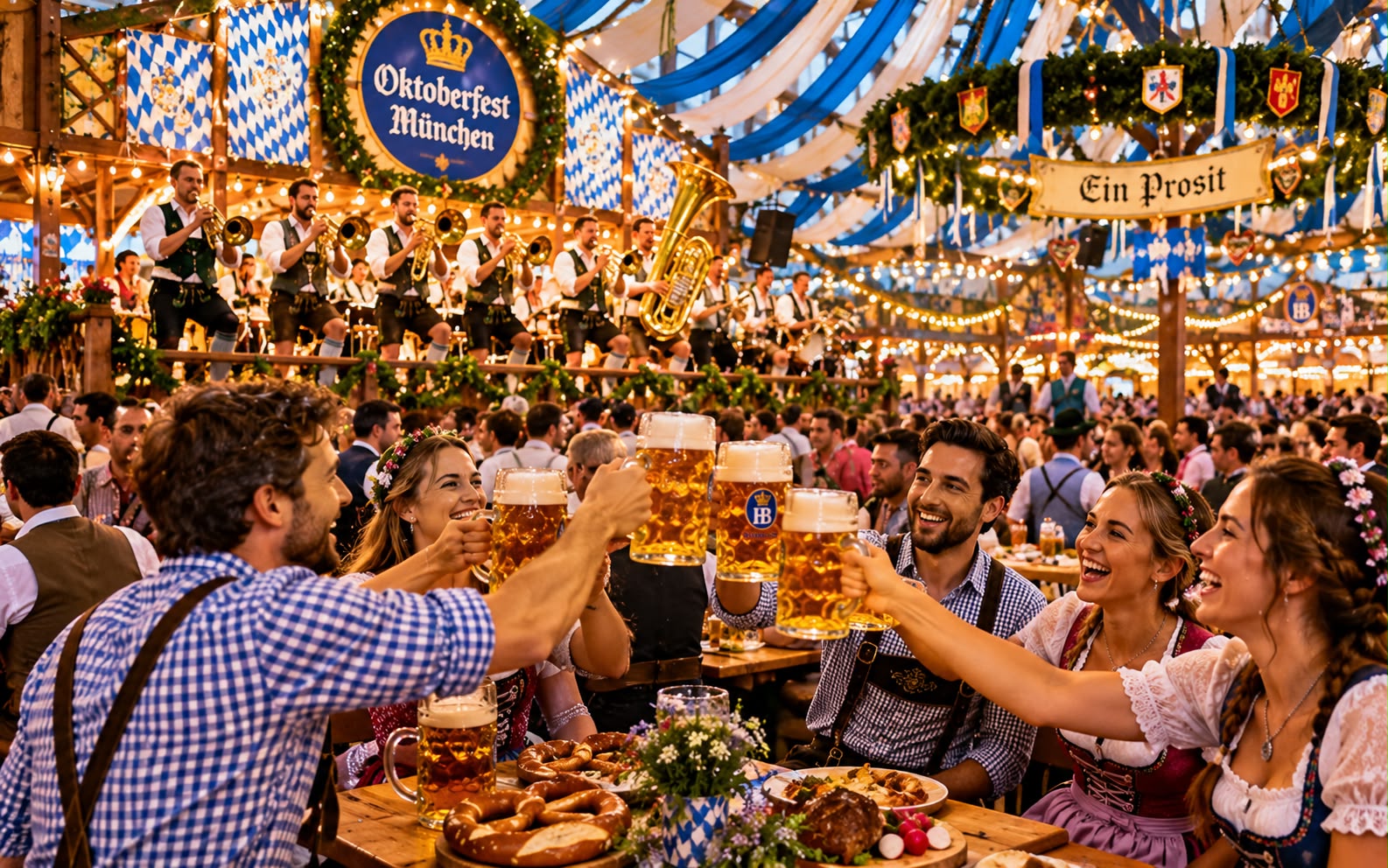
Oktoberfest in 4 days: tent strategy, and Bavaria on the other days
Mostly September, not October, and the reservation system is the whole game. Which tents suit which kind of day, how to get a table without one, what a Maß does to you at that strength, and two day trips for the mornings after.
- Western Europe
- 4 days
- ≈ AED 3,700 / person
- Getting into a tent, staying upright, and seeing Bavaria while you are there
Before you go
Oktoberfest is mostly in September. It runs about sixteen to eighteen days, traditionally opening on a Saturday in the second half of September and ending on the first Sunday of October — extended by a day or two when German Unity Day on 3 October falls just after. Check the exact dates for your year; they move.
It is not a beer festival in the craft sense. It is a Bavarian folk festival on the Theresienwiese, with fourteen large tents and around twenty small ones, a funfair, and roughly six million visitors.
The reservation system is the whole game, and this page is mostly about getting a seat. Two of the four days go to Bavaria instead, because four consecutive days in a tent is not a plan, it is a medical event.
Figure EUR 900 (≈ AED 3,685) per person. Late September.
Before you go: the admin
Entry
- Germany is in the Schengen area. Many nationalities enter visa-free for 90 days in any 180; others need a Schengen visa.
- See how the Schengen visa works for the rules and which country to apply to.
- Last checked: 30 October 2026.
Tables, which is the thing to understand
- Entry to the grounds and the tents is free. You pay for what you drink and eat.
- You cannot be served standing up. Beer is served to seated guests at a table. No seat, no beer.
- Reservations are free but come with a minimum spend — typically two Maß and half a chicken per person, paid for in advance as vouchers.
- Each tent runs its own reservations, usually opening in the spring for that autumn, through the tent’s own website. They go quickly, and most tents hold some capacity for walk-ins.
- Without a reservation: arrive early. Weekday mornings from about 10:00 you can usually find a table. Weekends by 09:00 or not at all. Tents close their doors when full, sometimes before noon on a Saturday.
- Beer is served from 10:00 on weekdays and 09:00 at weekends, with the first keg tapped at noon on the opening Saturday.
Which tent
- Hofbräu-Festzelt — the most international, the loudest, and the one with a standing area. Easiest for foreigners, least Bavarian.
- Augustiner-Festhalle — widely considered the best beer, served from wooden barrels, and the most family-friendly in the daytime.
- Schottenhamel — where the opening tapping happens, young crowd.
- Käfer Wiesn-Schänke — small, food-led, open later than the others, hardest to get into.
- Oide Wiesn — a separate, ticketed historic section with old rides, traditional music and no pressure. Small entry fee, and it is the calmest and best part of the whole festival. Go here if the tents sound like too much.
The beer, which is stronger than it looks
- A Maß is one litre. Festbier is brewed stronger than ordinary lager — typically around 6% rather than 5%.
- A litre at that strength is roughly three ordinary beers.
- Eat. Half a chicken, a pretzel the size of your head, Schweinshaxe. This is not optional.
- Water is sold and is not free. Drink it.
Practicalities
- Tracht — dirndl and lederhosen — is worn by most Germans there, and visitors are welcome to. Buy from a proper shop rather than a costume one if you want to avoid looking like a stag party.
- Cash. Many tents are cash-only for drinks, and tipping the server is expected — round up roughly a euro per Maß.
- Take the U-Bahn. Theresienwiese has its own station and driving is pointless.
- Lockers and a left-luggage office exist at the grounds. Large bags and rucksacks over three litres are not permitted in the tents.
Day by day
Day 1 — Munich, and the Wiesn in the evening
- Arrive and go into the city first.
- 14:00 — Marienplatz and the Glockenspiel — it chimes at 11:00 and 12:00, and 17:00 in summer.
- 15:00 — The Viktualienmarkt, and its beer garden under the maypole.
- 17:00 — Walk to the Theresienwiese. The evening of a weekday is the gentler introduction — go, look, find your bearings, and eat before you drink.
- Do not attempt a full session on arrival day.
Day 2 — The tent day
- 09:00 — Arrive at the grounds early, reservation or not. If you have one, it will be for a set slot — usually a daytime or an evening block.
- 10:00 — Beer service starts. Order food with the first Maß.
- The tent rhythm: brass band and folk music in the daytime, switching to pop and singalongs in the evening, at which point everyone stands on the benches. Benches, not tables. Standing on a table gets you removed.
- “Ein Prosit” plays every twenty minutes or so and everybody toasts. Look people in the eye when you clink.
- 14:00 — Go outside. The funfair, the Oide Wiesn, the air. A whole day inside one tent is how the afternoon goes wrong.
- 17:00 — Back in, or go home. Know which you are doing.
Day 3 — Neuschwanstein, or Salzburg
- The recovery day, and it should be a real one.
- Neuschwanstein — about two hours by train and bus to Hohenschwangau. Tickets must be bought in advance for a timed tour, and the walk up takes 30–40 minutes. The Marienbrücke gives the view from the postcards — it closes in bad weather and for maintenance.
- Or Salzburg — about 90 minutes by train, a different country, and an old town that is a UNESCO site.
- Or Dachau — a 40-minute journey, and a serious half-day. Entry is free. It is not a filler between beer days; treat it accordingly or leave it for another trip.
- Evening — a normal Munich beer garden. The Chinesischer Turm in the Englischer Garten is the classic, and far calmer than the Wiesn.
Day 4 — A last morning, and out
- 09:00 — The Englischer Garten — larger than Central Park, with surfers on the Eisbach standing wave by the southern entrance, year round.
- 11:00 — The Residenz or the Deutsches Museum if the weather is poor. The Deutsches Museum is one of the largest science museums in the world and absorbs half a day easily.
- Munich airport is about 45 minutes by S-Bahn.
Costs and practicalities
Best time to visit
The second half of September into the first days of October.
- The opening Saturday — the parade and the noon tapping. Spectacular and completely packed.
- Weekdays in the first week — the easiest time to get a table without a reservation, and the most relaxed tents.
- Both weekends — the busiest. Tents close their doors by late morning. Only come on a weekend with a reservation.
- The final days into early October — Italian Weekend, as the penultimate weekend is known locally, is one of the busiest of the whole run.
- The rest of the year — Munich is excellent and far cheaper, and Germany in 10 days covers it. The Christmas markets are the other seasonal trip, and that route has them.
Travel tips
- Check the dates for your year. It is mostly September and the dates move.
- Reserve in spring or plan to arrive early. Those are the two strategies; there is no third.
- Weekday mornings for a walk-in table. Weekends need a reservation.
- Eat with the first beer. A litre of 6% on an empty stomach is the mistake everyone sees someone else make.
- Benches, not tables. Standing on a table gets you thrown out.
- Carry cash and tip about a euro per Maß.
- Large bags are not allowed in the tents. Use the left-luggage office.
- The Oide Wiesn is the calm, cheap, genuinely traditional version and most visitors never go in.
- Book accommodation months ahead. Munich rates double or worse.
- Take the U-Bahn.
What this trip actually costs
Two people, 3 nights, mid-range hotel at festival rates, international flights excluded:
| Item | Cost |
|---|---|
| Munich hotel, 3 nights at Oktoberfest rates | EUR 900 (≈ AED 3,685) |
| Beer and food in the tents, two people | EUR 400 (≈ AED 1,638) |
| Neuschwanstein or Salzburg day trip, two people | EUR 180 (≈ AED 737) |
| Local transport, the Oide Wiesn and entries | EUR 120 (≈ AED 491) |
| Food outside the tents, 4 days | EUR 200 (≈ AED 819) |
| Total for two | EUR 1,800 (≈ AED 7,370) |
- Roughly EUR 900 (≈ AED 3,685) per person, and the hotel line is the festival — the same room in November costs a fraction.
- A Maß plus food is the unit of spending here, and a reservation’s minimum spend is usually two Maß and half a chicken each.
- Staying outside the centre — Munich’s S-Bahn reaches a long way — takes a serious amount off the room line.
- Entry to the grounds and the tents is free. The Oide Wiesn charges a small entry.
- Hotel picks here are chosen on location, not on commission — always check prices and recent reviews before booking.
What to pack
- Comfortable shoes you do not mind getting beer on.
- A warm layer and a rain jacket. Late September in Bavaria swings between 8°C and 22°C, and the tents are hot while the grounds are not.
- Cash.
- Tracht if you want it — or buy it there, which is cheaper than it looks and better made.
- A small bag. Anything over about three litres will not get into a tent.
- A Type C/F adapter, 230V.
Part of a bigger trip?
- Germany in 10 days is Munich, the Alps and Berlin outside the festival.
- Germany’s Christmas markets is the other seasonal trip.
- Austria in 9 days is next door and Salzburg is 90 minutes away.
- Germany and Austria in 12 days runs both.
FAQ
When is Oktoberfest actually held? Mostly in September. It runs about sixteen to eighteen days, traditionally opening on a Saturday in the second half of September and closing on the first Sunday of October, extended slightly when German Unity Day on 3 October falls just after. Check your year.
Do we need a table reservation? For a weekend, effectively yes — tents close their doors when full, often by late morning. On a weekday you can usually walk in and find a table from around 10:00. Reservations are free but carry a minimum spend, open in spring, and go through each tent’s own website.
Can we drink standing up? No. Beer is served to seated guests only, so no seat means no beer. The Hofbräu tent is the exception with a standing area, which is why it is the easiest tent for visitors without a reservation.
How strong is the beer? Festbier is brewed stronger than ordinary lager, typically around 6%, and a Maß is a full litre — roughly three normal beers in one glass. Order food with the first one.
What if the tents sound like too much? Go to the Oide Wiesn. It is a separate ticketed section with historic rides, traditional music and a calm, family atmosphere, it costs very little to enter, and most visitors never set foot in it.
Prices and entry rules change, and what you need depends on your passport; last checked 30 October 2026, so confirm with the embassy or your airline before booking.


