 The Itinerary
Japan on a budget in 7 days: the rail-pass maths and konbini meals
Japan stopped being expensive and nobody updated the advice. Business hotels for the price of a European hostel, konbini and gyudon meals that are genuinely good, and the rail-pass arithmetic that now usually says no — with the numbers to check it yourself.
- East Asia
- 7 days
- ≈ AED 1,850 / person
- Working out that the rail pass no longer pays, and eating extremely well for very little
Before you go
Japan’s reputation for being expensive is a decade out of date, and the single biggest budget mistake people still make is buying a rail pass they do not need.
The Japan Rail Pass rose sharply in 2023 and on a simple Tokyo–Kyoto–Osaka week it no longer pays for itself. Point-to- point tickets are cheaper for this route, and this page shows the arithmetic rather than asserting it.
The seven-day route costs this week at business-hotel-plus level. This one does the same three cities for a little over half — and the food is not a compromise.
Figure JPY 80,000 (≈ AED 1,856) per person. Any month, with the cheapest below.
Before you go: the admin
Entry
- Visa-free for around 70 nationalities for 90 days, including the GCC states, the EU, the UK and the US.
- Indian passport holders need a visa in advance; an e-visa is available for some applicants.
- Last checked: 30 October 2026.
The rail-pass arithmetic, done
- A 7-day national JR Pass costs around ¥50,000.
- Tokyo to Kyoto by shinkansen is about ¥14,000; Kyoto to Osaka about ¥1,500; Osaka to Kansai airport about ¥1,300. That is roughly ¥17,000 of travel.
- The pass costs about three times what this itinerary’s travel does. It does not pay.
- When it does pay: if you are going further — adding Hiroshima, Kanazawa or Tohoku — or doing several long legs in a week. Price your actual route before buying.
- Regional passes often do pay where the national one does not — the Kansai and Hokuriku area passes are much cheaper and cover the ground most first trips actually use.
- The night bus — Tokyo to Kyoto for around ¥5,000 — is the real budget option, and it saves a night’s accommodation.
Where to sleep
- Business hotels — APA, Toyoko Inn, Super Hotel and the like — are the budget traveller’s secret here. A small, spotless twin with a bathroom costs about what a European hostel dorm does.
- Hostels are good and barely cheaper. Capsule hotels are an experience and about the same price.
- Book early. Rates rise steeply closer to the date, unlike much of Asia.
- Stay near a station, not near a sight. Everything is a train ride anyway.
Where to eat
- Konbini food is genuinely good and very cheap — onigiri, katsu sando, egg sandwiches, oden in winter. This is not a compromise and Japanese commuters eat it daily.
- Gyudon chains — Yoshinoya, Sukiya, Matsuya — a beef bowl for a few hundred yen.
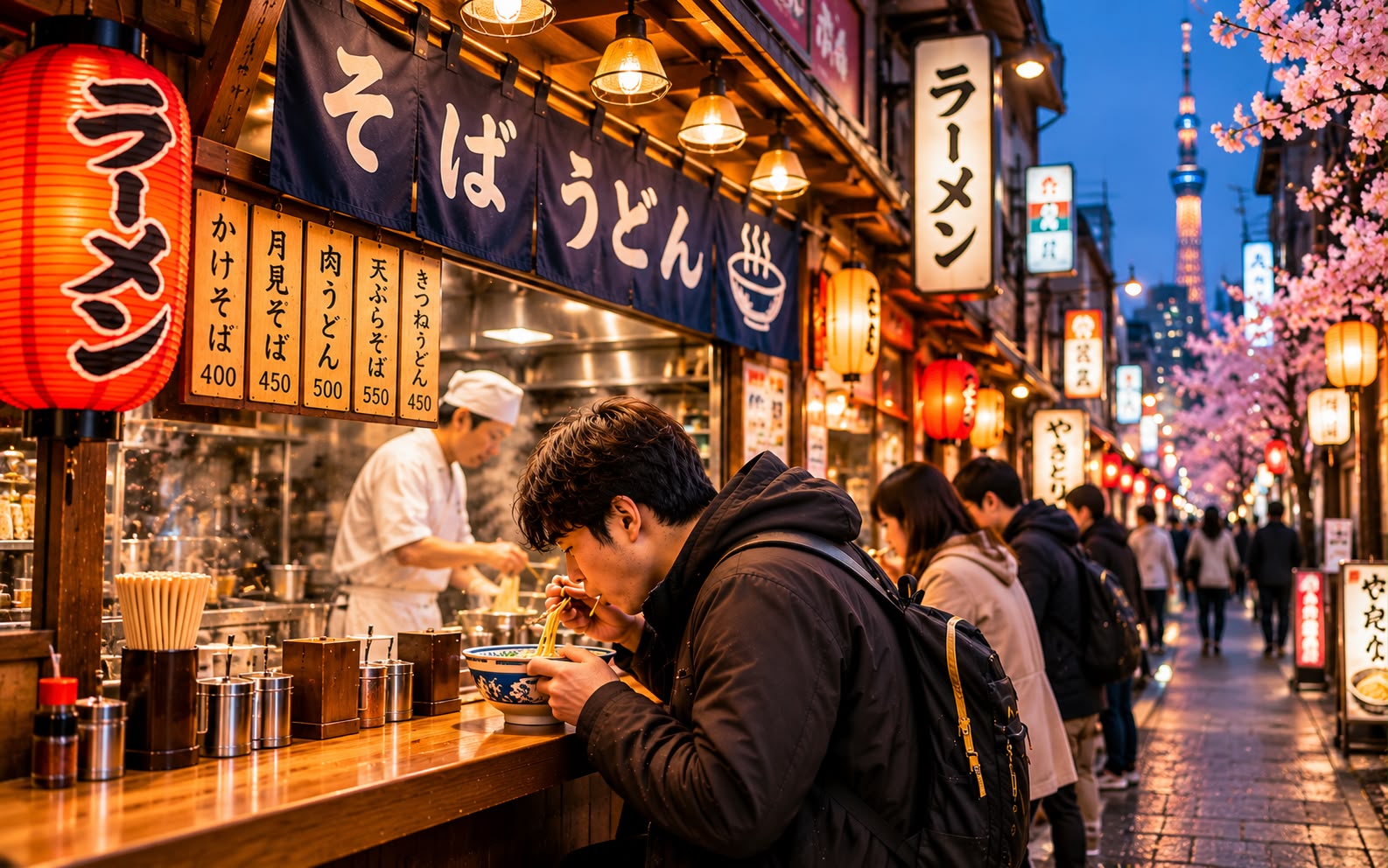
- Standing soba and udon bars in stations. Under ¥500 and under five minutes.
- Department store food halls — depachika — discount heavily in the last hour before closing.
- A ¥1,000 lunch set at a proper restaurant is often the same kitchen as the ¥4,000 dinner.
Day by day
Day 1 — Tokyo, free
- Arrive and take the cheap option in. The Keisei Access Express from Narita costs a fraction of the Skyliner; the Haneda monorail is cheap anyway.
- Get an IC card — Suica or Pasmo — which works on almost everything.
- Afternoon — Asakusa and Senso-ji, free, and the Nakamise approach.
- Evening — the Tokyo Metropolitan Government Building observatory — free, 202m, and the view people pay for at Shibuya Sky.
Day 2 — Tokyo for almost nothing
- 07:00 — Tsukiji outer market for a cheap breakfast.
- 09:00 — Meiji Shrine — free — and Yoyogi Park.
- 11:00 — Harajuku and Omotesando, which cost nothing to walk.
- 14:00 — The Imperial Palace East Gardens, free.
- 17:00 — Shibuya Crossing, free, and the view of it from the Starbucks for the price of a coffee.
- 19:00 — Omoide Yokocho or Ebisu Yokocho — tiny bars and grills, cheap if you order carefully.
- Tokyo’s great museums are modest; the free ones — the government building, the shrines, the parks — carry the day.
Day 3 — Night bus to Kyoto
- A last Tokyo morning — Ueno Park and its free grounds, or Yanaka’s old streets.
- Evening — the night bus to Kyoto. Around ¥5,000, eight hours, reclining seats, and it saves a night’s hotel.
- Book a three-across coach rather than four-across if the price gap is small; the difference in the night is not.
- Or take the shinkansen and accept the cost; the arithmetic is in the table below either way.
Day 4 — Kyoto, at opening
- 06:30 — Fushimi Inari. Free, open at all hours, and empty before eight. The torii tunnels are the best free sight in Japan.
- 09:00 — Tofuku-ji or Kiyomizu-dera — small entries, and both are crowded by mid-morning.
- 12:00 — Nishiki Market for a cheap lunch grazed from stalls.
- 15:00 — The Philosopher’s Path, free, and Nanzen-ji’s grounds and aqueduct, also free.
- 18:00 — Gion and the Shirakawa canal, free, and the best evening walk in the city.
Day 5 — Arashiyama and the west
- 07:30 — The bamboo grove before the crowds. Free.
- 09:00 — Tenryu-ji’s garden has a small entry; the grounds around it cost nothing.
- 11:00 — Walk the Hozugawa riverside rather than taking the scenic railway.
- 14:00 — Kinkaku-ji, the golden pavilion — a small entry and twenty minutes — or Ryoan-ji’s rock garden.
- Kyoto’s buses have a day pass that pays for itself in three rides.
Day 6 — Osaka
- The local rapid train from Kyoto, about 30 minutes, for a few hundred yen. Do not take the shinkansen for this leg.
- Osaka Castle park is free; the keep is ticketed.
- Shinsekai and Dotonbori — takoyaki and kushikatsu from stalls is the cheapest good eating in Japan.
- The Umeda Sky Building’s floating garden is cheaper than most observation decks and better.
- Stay in Namba or Shin-Imamiya, where the beds are cheapest in the city.
Day 7 — Out
- Kansai airport — the Nankai local train costs a fraction of the Rapi:t express and takes fifteen minutes longer.
- A last konbini breakfast, which will be better than the airport’s.
- Allow three hours.
Costs and practicalities
Best time to visit
Any month works; the cheap ones are specific.
- January to early March — the cheapest window of the year, cold and clear, and the cities are quiet.
- Late March to early April — cherry blossom. The most expensive fortnight of the year, and its own route.
- Late April to early May — Golden Week, the busiest domestic travel period. Avoid.
- June — the rainy season, and genuinely cheap.
- July and August — hot and humid, and expensive in August.
- September — typhoon season, and good value.
- November — autumn colour, busy but not sakura-busy, and the autumn route covers it.
Travel tips
- Price your route before buying a rail pass. On Tokyo–Kyoto–Osaka it does not pay.
- Check the regional passes. The Kansai-area ones often do pay where the national one does not.
- Take the night bus for one leg. It saves a fare and a bed.
- Business hotels, near a station. Cheaper than hostels in some cities and far more comfortable.
- Konbini and gyudon are not a compromise. They are what people here actually eat.
- Depachika food halls discount in the last hour.
- The ¥1,000 lunch set is often the same kitchen as the expensive dinner.
- Free sights carry Kyoto — Fushimi Inari, the Philosopher’s Path, Gion, the bamboo grove.
- The Tokyo government building observatory is free and the view is the one people pay for elsewhere.
- Get an IC card on day one.
What this trip actually costs
Two people, 6 nights, business hotels and a night bus, international flights excluded:
| Item | Cost |
|---|---|
| Business hotels and hostels, 6 nights | JPY 68,000 (≈ AED 1,577) |
| Konbini, gyudon and standing noodle bars, 7 days | JPY 44,000 (≈ AED 1,021) |
| Point-to-point tickets and one night bus, two people | JPY 29,000 (≈ AED 673) |
| Temples, gardens and one museum | JPY 11,000 (≈ AED 255) |
| IC cards, local transport and the airport train | JPY 8,000 (≈ AED 186) |
| Total for two | JPY 160,000 (≈ AED 3,711) |
- Roughly JPY 80,000 (≈ AED 1,856) per person for a week, against about 146,000 on the standard route.
- Two 7-day rail passes would cost about ¥100,000 against the ¥29,000 of travel this itinerary actually uses. That single decision is most of the difference between a cheap Japan trip and an expensive one.
- Food is the line people expect to be painful and it is not. Two people eat well here for about ¥6,000 a day.
- Entries are small. Japan’s best sights are shrines and streets and they are free.
- Travel insurance is not in this figure and should be.
- Hotel picks here are chosen on location, not on commission — always check prices and recent reviews before booking.
What to pack
- Comfortable shoes that come off easily. Temples, ryokan and some restaurants all require it.
- A hand towel. Many public toilets have no dryer or paper.
- A coin purse. Japan still runs on coins and you will accumulate them.
- Layers. Indoor heating and air conditioning are both aggressive.
- A small daypack — coin lockers at stations are cheap and let you walk unburdened.
- A Type A adapter, 100V.
Part of a bigger trip?
- Japan in 7 days is the same route at mid-range.
- Japan for vegetarians is the same route with the food problem solved.
- Japan in 10 days adds Hakone.
- Japan in 14 days adds Hiroshima and the Alps — and is where a rail pass starts to pay.
- Tokyo in 5 days if one city is the trip.
FAQ
Is the Japan Rail Pass worth it? Not on this route. It rose sharply in 2023 and a 7-day national pass now costs roughly three times the point-to-point fares for Tokyo–Kyoto–Osaka. Price your actual legs before buying. It starts to pay when you add Hiroshima, Kanazawa or Tohoku — and the regional passes often pay where the national one does not.
Is Japan actually expensive? Less than its reputation. Business hotels cost about what a European hostel dorm does, a beef bowl is a few hundred yen, and most of Kyoto’s best sights are free. The expensive parts are rail passes you did not need and restaurants you did not have to choose.
Is konbini food really fine? Yes. Onigiri, sandwiches, salads and hot food from 7-Eleven, Lawson and FamilyMart are fresh, cheap and eaten daily by everyone here. It is not a traveller’s compromise.
Where should I stay? A business hotel near a station — APA, Toyoko Inn, Super Hotel. Small rooms, spotless, private bathroom, and cheaper than many hostels once you compare a twin against two dorm beds.
What is the cheapest time to go? January to early March, and June’s rainy season. Avoid late March to early April for cherry blossom and the Golden Week holiday at the end of April, which are the two most expensive periods of the year.
Prices and entry rules change, and what you need depends on your passport; last checked 2 November 2026, so confirm with the embassy or your airline before booking.


