 The Itinerary
Pushkar Camel Fair in 4 days: the fair, the lake and Jaipur
The fair runs to the lunar calendar around Kartik Purnima, so the dates move each year. The trading happens early and thins as the tourist programme builds, which is the single most useful thing to know. Two nights in a tented camp, the ghats at dawn, and Jaipur on the way through.
- South Asia
- 4 days
- ≈ AED 1,100 / person
- A livestock market that became a spectacle, caught in the days before it tips over
Before you go
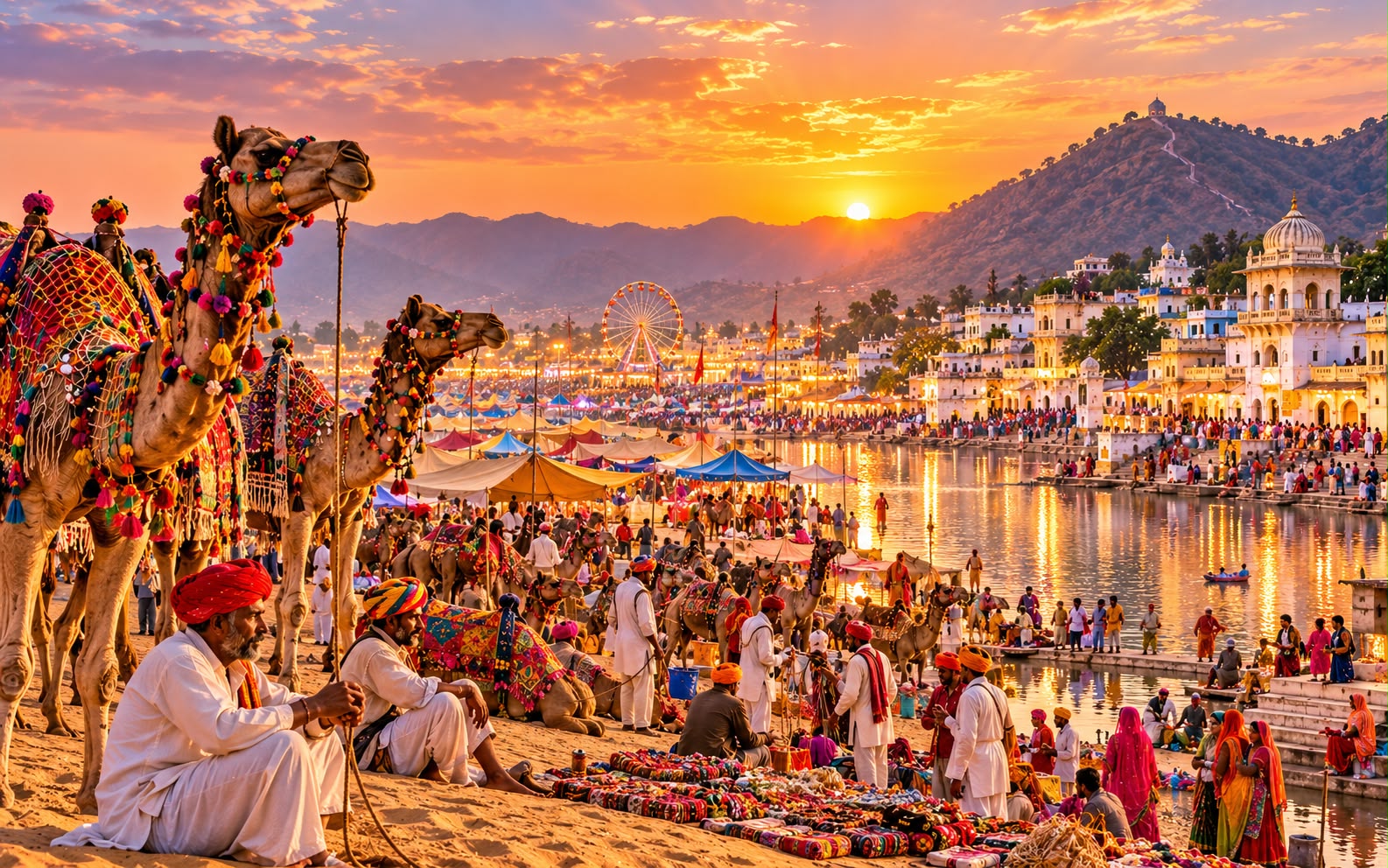
The Pushkar fair is two events wearing one name. It begins as a livestock market — camels, horses and cattle traded on the dunes outside town — and it ends as a cultural festival with competitions, a stadium programme and a great many photographers.
The trading is heaviest in the early days and thins out as the official programme builds. Most visitors arrive for the last few days and see the show rather than the fair. Arrive early instead.
The dates move. The fair is tied to the lunar calendar, running up to Kartik Purnima — the full moon of the month of Kartik — which falls in November most years. Confirm the dates before booking anything.
The seven-day Rajasthan route covers the state properly. This is four days built around the fair, with Jaipur either side because that is where you fly.
Figure INR 28,000 (≈ AED 1,093) per person. November, on the dates below.
Before you go: the admin
Entry
- A domestic trip for Indian nationals.
- Foreign nationals need an Indian visa; an e-visa covers tourism for most nationalities.
- Last checked: 30 October 2026.
The dates, and why they move
- The fair culminates on Kartik Purnima, the full-moon day of the Hindu month of Kartik, which falls in November in most years and can slip to very late October.
- The whole event runs roughly a week to ten days up to that full moon.
- The Rajasthan tourism department publishes the official programme each year. Check it rather than assuming last year’s dates.
- Camel trading dominates the first half; the stadium events, competitions and the crowd arrive for the second.
What Pushkar is the rest of the time
- A Hindu pilgrimage town around a sacred lake with 52 ghats.
- It has one of the very few temples to Brahma anywhere.
- Alcohol, meat and eggs are prohibited in the town. This is enforced and worth knowing before you book dinner.
- Shoes off near the ghats, and leather is not to be carried there.
- “Pushkar passport” — a persistent scam involves being given a flower at the ghats, led through a short puja and then asked for a very large donation, sometimes aggressively, with a red thread tied on as a receipt. Decline flowers politely at the lakeside, or set the amount before anything begins.
Where to stay
- Tented camps go up for the fair and range from basic to genuinely luxurious.
- Book months ahead. Pushkar is a small town and the fair fills it entirely.
- Rates during the fair are several times the ordinary ones.
- Staying in Ajmer, 15km away, is the cheaper fallback.
Day by day
Day 1 — Jaipur
- Arrive and stay in the old city.
- 15:00 — The City Palace and Jantar Mantar — the eighteenth-century observatory with the world’s largest stone sundial, UNESCO-listed.
- 17:00 — Hawa Mahal from the street opposite, which is where the photograph is taken from.
- 18:30 — Dinner. Eat meat tonight — Pushkar is vegetarian.
Day 2 — To Pushkar, and the dunes
- 08:00 — Two and a half to three hours west, past Ajmer.
- 11:00 — Check into the camp.
- 14:00 — The fairground. The livestock is on the sand flats and dunes beyond the town — camels in lines, traders squatting in groups, decorated animals, and a great deal of bargaining you cannot follow.
- Walk out beyond the main enclosure. The further from the stadium you get, the more it is a working market.
- Ask before photographing people. A camel trader is at work, not on display. Many will say yes; some will ask for money, which is a fair transaction either way.
- 17:30 — Sunset over the dunes, which is the hour everybody is there for.
Day 3 — Dawn at the ghats, and the fair proper
- 06:00 — The lake at dawn. Pilgrims bathing at the ghats, lamps on the water, and the hills behind. This is the best hour of the trip and the fairground is still asleep.
- 07:30 — The Brahma temple, one of very few dedicated to him anywhere.
- 09:00 — Back to the fairground for the morning trading, which is busier than the afternoon.
- 11:00 — The competitions if they are running — longest moustache, best-decorated camel, matka phod, and a camel-and-horse dance programme in the stadium. Cheerful, crowded and squarely for visitors.
- 16:00 — A camel cart or a short ride out to the dunes. Agree the price first.
- 19:00 — Back at camp. Folk music is usually part of the camp evening.
Day 4 — Back to Jaipur, and out
- 07:00 — A last hour at the ghats, or Savitri temple on the hill — a ropeway runs up it, and the view over the lake and the dunes at sunrise is the other good photograph here.
- 10:00 — Back to Jaipur.
- 14:00 — Amber Fort if there is time — go late afternoon, which is cooler and far less crowded than mid-day.
- Jaipur airport is about 20 minutes from the centre.
Costs and practicalities
Best time to visit
November, in the days up to Kartik Purnima.
- The first half of the fair — the livestock trading is at its height and the tourist programme has not started. Fewer people, more camels. This is when to come.
- The last three days — the stadium events, the cultural programme, the largest crowds and the highest rates.
- Kartik Purnima itself — the religious climax, when pilgrims bathe in the lake in very large numbers. The town is extremely full.
- The rest of November to February — Pushkar without the fair, which is a quiet pilgrimage town and pleasant. Rajasthan’s season runs October to March, and the seven-day route covers it.
- April to September — hot, then wet. Not the trip.
Travel tips
- Confirm the dates for your year. They follow the lunar calendar and move.
- Come for the first half. The trading is the thing, and it thins as the programme builds.
- Walk beyond the stadium. The working market is further out.
- Book camps months ahead and expect fair-week rates.
- No alcohol, meat or eggs in town. Plan dinner in Jaipur accordingly.
- Decline flowers at the ghats unless you intend to pay, and agree the amount beforehand.
- Shoes off near the lake, and leave leather behind.
- Ask before photographing people.
- Dawn is the best hour — the ghats are quiet and the light is the best of the day.
- It is cold at night in November. The desert drops sharply after dark.
What this trip actually costs
Two people, 3 nights, tented camp at fair rates, flights excluded:
| Item | Cost |
|---|---|
| Pushkar tented camp, 2 nights with meals | INR 24,000 (≈ AED 937) |
| Jaipur hotel, 1 night | INR 7,000 (≈ AED 273) |
| Car and driver, 4 days | INR 10,000 (≈ AED 390) |
| Camel cart, temple and fort entries, the ropeway | INR 6,000 (≈ AED 234) |
| Food and everything else | INR 9,000 (≈ AED 351) |
| Total for two | INR 56,000 (≈ AED 2,187) |
- Roughly INR 28,000 (≈ AED 1,093) per person, and the camp is most of it — fair-week rates run several times the ordinary ones.
- Staying in Ajmer 15km away takes a substantial amount off, at the cost of the dawn hour at the ghats.
- The fairground itself is free to walk around. The stadium events are ticketed in part.
- Hotel picks here are chosen on location, not on commission — always check prices and recent reviews before booking.
What to pack
- A warm layer. November nights in the desert are cold, and a tent is a tent.
- Shoes that come off easily for the ghats and temples.
- Dust protection — a scarf, and something for a camera. The fairground is sand and it gets into everything.
- Modest clothing; this is a pilgrimage town.
- Cash. Card acceptance at the fair is minimal.
- A Type D/M adapter, 230V.
Part of a bigger trip?
- Rajasthan in 7 days is Jaipur, Jodhpur and Udaipur.
- Rajasthan at Diwali is the other seasonal version, a few weeks earlier.
- Rajasthan in 14 days adds Jaisalmer and the desert.
- Jaipur in 2 days if the city is the trip.
- The Golden Triangle in 5 days runs Delhi, Agra and Jaipur.
FAQ
When is the Pushkar fair? It follows the lunar calendar, culminating on Kartik Purnima — the full moon of the month of Kartik — which falls in November most years. The whole event runs roughly a week to ten days up to it. Check the official programme for your year rather than assuming last year’s dates.
Should we come early or late in the fair? Early. The livestock trading dominates the first half and thins as the stadium programme and the crowds build. Most visitors arrive for the last few days and see a cultural show rather than a camel market.
Is it very touristy? The last days are, heavily. The first days are a working livestock market with visitors at the edges, and if you walk beyond the main enclosure it stays that way throughout.
Can we drink alcohol in Pushkar? No. Alcohol, meat and eggs are all prohibited in the town and it is enforced. Plan a meat dinner for your Jaipur nights if you want one.
What is the “Pushkar passport”? A persistent scam at the ghats. Someone presses a flower on you, leads you through a short puja, then asks for a very large donation and ties a red thread on as proof you have paid. Decline flowers politely, or fix the amount before anything starts.
Prices and entry rules change, and what you need depends on your passport; last checked 30 October 2026, so confirm with the embassy or your airline before booking.


