 The Itinerary
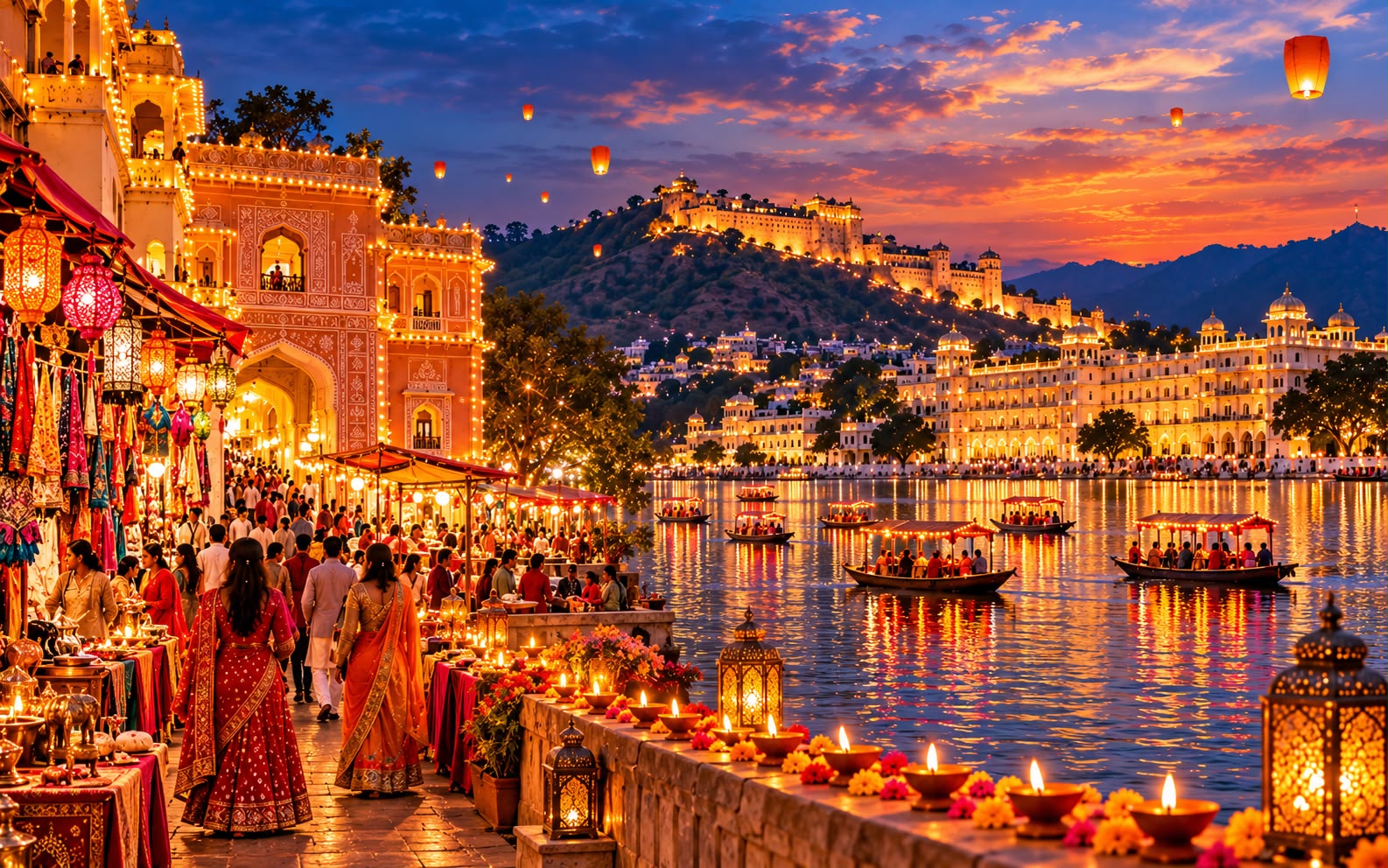
Rajasthan at Diwali in 6 days: Jaipur's lit bazaars and Udaipur's lakes
Diwali moves with the lunar calendar and runs five days, not one. Jaipur's markets are lit end to end and judged on it, Udaipur's lakes take the reflections, and the air quality afterwards is the thing nobody tells you. Which nights matter and what shuts.
- South Asia
- 6 days
- ≈ AED 1,950 / person
- The one week Jaipur lights every bazaar and competes with itself over it
Before you go
Jaipur at Diwali is the best version of an Indian city at festival. The old city’s bazaars are lit end to end — Johari, Bapu, Tripolia and the rest — and the city has long run a competition for the best-decorated market, which is why the effort is extraordinary and why it goes on for days rather than one night.
Diwali moves. It follows the lunar calendar, falling on the new moon of Kartik — October or November depending on the year — and it runs five days, not one. Confirm the dates before booking anything.
Three nights in Jaipur for the lights, two in Udaipur where the lakes take the reflections. The seven-day Rajasthan route adds Jodhpur and is the trip outside festival week.
Figure INR 50,000 (≈ AED 1,952) per person. October or November, on the dates below.
Before you go: the five days, and which ones matter
- Dhanteras — day one. Buying gold, silver and utensils is traditional, so the jewellery bazaars are heaving. Shops stay open very late.
- Choti Diwali (Naraka Chaturdashi) — day two. Lights go up, smaller fireworks.
- Diwali / Lakshmi Puja — day three, the main night. Families are at home performing puja in the evening, so the streets are quieter early, then the fireworks start and do not stop. Many restaurants close.
- Govardhan Puja / Annakut — day four.
- Bhai Dooj — day five.
- For the bazaars, the two or three days before the main night are the best. The lights are up, the markets are open and the city is not indoors.
- On the main night itself, book dinner in your hotel. Much else will be shut.
Before you go: the admin
Entry
- A domestic trip for Indian nationals.
- Foreign nationals need an Indian visa; an e-visa covers tourism for most nationalities.
- Last checked: 30 October 2026.
The air, which is the honest caveat
- Air quality across north India deteriorates sharply around Diwali, from fireworks combined with seasonal crop-residue burning and the onset of winter inversion.
- Rajasthan is better than Delhi, which is not saying a great deal. Jaipur can still record severe readings in the days after.
- Firecracker use is regulated — courts have restricted conventional crackers and permitted “green” ones within set hours — and enforcement is inconsistent.
- If anyone in your party has asthma or a respiratory condition, take this seriously. Check the AQI forecast, carry an N95, and consider arriving before the main night rather than after.
- Udaipur is generally better than Jaipur on this, being smaller and further south.
Booking
- Hotels book out months ahead and rates rise substantially for festival week.
- Heritage hotels and havelis decorate for it and are the right choice here.
- Trains and flights fill. This is one of the largest domestic travel periods of the Indian year.
- Many businesses close for two to three days. Confirm restaurant opening before relying on it.
Safety around fireworks
- Fireworks are set off in the street, at close range, by everyone. Rockets travel sideways.
- Keep your distance, wear closed shoes, and do not carry synthetic clothing that melts.
- With small children, watch from a rooftop rather than a street.
Day by day
Day 1 — Jaipur, and the bazaars
- Arrive and stay in or near the old city — the pink walled quarter is where everything happens.
- 16:00 — The bazaars as the lights come on. Johari for jewellery, Bapu for textiles and juttis, Tripolia for brassware, and Chandpole.
- Each market is strung and outlined, and the decoration is a competition between traders’ associations. It is genuinely spectacular and it is free.
- 19:00 — Walk the length of it. Expect crowds and traffic; the old city is best on foot.
- Watch for the Hawa Mahal lit from the street opposite.
Day 2 — Amber, and the rooftops
- 08:00 — Amber Fort early. Go at opening — it is the busiest site in the state in this season.
- The Sheesh Mahal, mirrored so that a single candle reflects across the ceiling, is the one to see.
- Do not take an elephant ride. The practice has been criticised for years on welfare grounds and there is a jeep alternative to the same gate.
- 11:00 — Panna Meena ka Kund, the stepwell below the fort, and Jal Mahal on the lake on the way back.
- 14:00 — Rest. The evening is the point.
- 17:00 — The City Palace or Jantar Mantar, then a rooftop at dusk. Nahargarh Fort above the city gives the whole lit grid at once, and is the single best Diwali view in Jaipur.
- 20:00 — Back into the bazaars.
Day 3 — The main night
- Morning — quiet. The city is preparing.
- 10:00 — Albert Hall Museum, or the Anokhi Museum of Hand Printing in Amber, which is small and excellent.
- 14:00 — Shops begin closing. Buy anything you want before mid-afternoon.
- Evening — Lakshmi Puja. Families are indoors, oil lamps go along every parapet and doorway, and the streets are briefly calm.
- If you are invited to a home, go. It is the whole festival.
- 21:00 onward — fireworks, everywhere, for hours.
- Book dinner in the hotel. Most restaurants will be shut.
Day 4 — To Udaipur
- 09:00 — Fly or drive south. The flight is about an hour; the road is six to seven.
- Book either well ahead — this is peak domestic travel.
- 15:00 — Udaipur. Smaller, calmer and cleaner air.
- 17:00 — A boat on Lake Pichola as the light goes. The City Palace, the Lake Palace and the ghats from the water — and in festival week the whole lakefront is lit and doubled in the reflection.
- 19:30 — A rooftop dinner.
Day 5 — Udaipur, slowly
- 09:00 — The City Palace — the largest in Rajasthan, built up over four centuries, with the Sheesh Mahal and the courtyards. Go at opening.
- 12:00 — Jagdish Temple, and the old city lanes.
- 15:00 — Saheliyon ki Bari, the garden of the maids of honour, with fountains that run on gravity.
- 17:00 — Sunset from Karni Mata — a cable car up the hill above the lake — or the Monsoon Palace further out, which is the bigger view.
- Evening — the ghats. Diyas on the water.
Day 6 — Out
- 08:00 — A last walk by the lake, which is the best hour in Udaipur.
- Or Shilpgram, the crafts village outside town.
- Udaipur airport is about 25 minutes from the centre and connects through Delhi and Mumbai.
Costs and practicalities
Best time to visit
October or November, on the Diwali dates for your year.
- The two or three days before the main night — lights up, markets open, the city outdoors. This is when to be here.
- The main night — extraordinary, and much is closed. Plan around it rather than through it.
- The days after — the air is at its worst, shops reopen gradually, and rates begin to fall.
- The rest of October to March — Rajasthan’s season, clear and cool, which is what the seven-day route covers. The Pushkar Camel Fair follows a few weeks later in November.
- April to September — 40°C and above, then the monsoon. Not the trip.
Travel tips
- Confirm the Diwali dates for your year. They move with the lunar calendar.
- Arrive two or three days before the main night. That is when the bazaars are at their best.
- Book hotels months ahead and expect festival rates.
- Book dinner in the hotel for the main night. Much else shuts.
- Nahargarh at dusk is the best view of a lit Jaipur.
- Do not ride the elephants at Amber. Take a jeep.
- Check the AQI, and carry an N95 if anyone is asthmatic.
- Closed shoes and no synthetics near street fireworks.
- Buy what you want before mid-afternoon on the main day.
- Udaipur is the calmer, cleaner half. Give it the back end of the trip.
What this trip actually costs
Two people, 5 nights, heritage hotels at festival rates, flights to India excluded:
| Item | Cost |
|---|---|
| Jaipur heritage hotel, 3 nights at Diwali rates | INR 36,000 (≈ AED 1,406) |
| Udaipur hotel, 2 nights | INR 26,000 (≈ AED 1,015) |
| Car, driver and the internal flight | INR 16,000 (≈ AED 625) |
| Palace and fort entries, the lake boat, a cable car | INR 10,000 (≈ AED 390) |
| Food and everything else | INR 12,000 (≈ AED 469) |
| Total for two | INR 100,000 (≈ AED 3,905) |
- Roughly INR 50,000 (≈ AED 1,952) per person, and the rooms are the festival — Jaipur in Diwali week runs well above the ordinary season.
- The best thing here is free. The bazaars are lit for anyone who walks through them.
- Booking three months out makes a substantial difference to the hotel line; booking three weeks out is expensive and may be impossible.
- The internal flight is worth it over six to seven hours of road on a peak travel week.
- Hotel picks here are chosen on location, not on commission — always check prices and recent reviews before booking.
What to pack
- A warm layer. Rajasthan nights in late October and November are cold, even when days are 28°C.
- Closed shoes for the fireworks nights.
- An N95 mask if anyone is asthmatic, and a plain one otherwise.
- Modest clothing for temples; shoulders and knees covered.
- Cash. Card acceptance in the bazaars is patchy and the markets are the point.
- Eye drops. The air gets to most people after a couple of days.
- A Type D/M adapter, 230V.
Part of a bigger trip?
- Rajasthan in 7 days adds Jodhpur, outside festival week.
- Pushkar Camel Fair is a few weeks later in November.
- Rajasthan in 14 days adds Jaisalmer and the desert.
- Jaipur in 2 days and Udaipur in 2 days are the city versions.
- The Golden Triangle in 5 days runs Delhi, Agra and Jaipur.
FAQ
When is Diwali? It follows the lunar calendar, falling on the new moon of Kartik — in October or November depending on the year — and it runs five days rather than one. Confirm the dates for your year before booking anything.
Which day should we aim for? Arrive two or three days before the main night. The bazaars are fully lit, the markets are open and the city is outdoors. On the main night itself families are indoors for puja, many restaurants close, and the streets belong to the fireworks.
Is the air quality really a problem? It deteriorates sharply across north India around Diwali, from fireworks plus seasonal crop burning and the onset of winter inversion. Jaipur is better than Delhi and Udaipur is better than Jaipur. If anyone is asthmatic, check the forecast, carry an N95, and consider arriving before the main night rather than after.
Jaipur or Udaipur? Both, in that order. Jaipur has the lit bazaars and the scale; Udaipur has the lakes, the reflections, cleaner air and a far calmer few days to finish on.
How far ahead should we book? Months. Hotels fill and rates rise substantially for festival week, and it is one of the largest domestic travel periods of the Indian year, so trains and flights go too.
Prices and entry rules change, and what you need depends on your passport; last checked 30 October 2026, so confirm with the embassy or your airline before booking.


