 The Itinerary
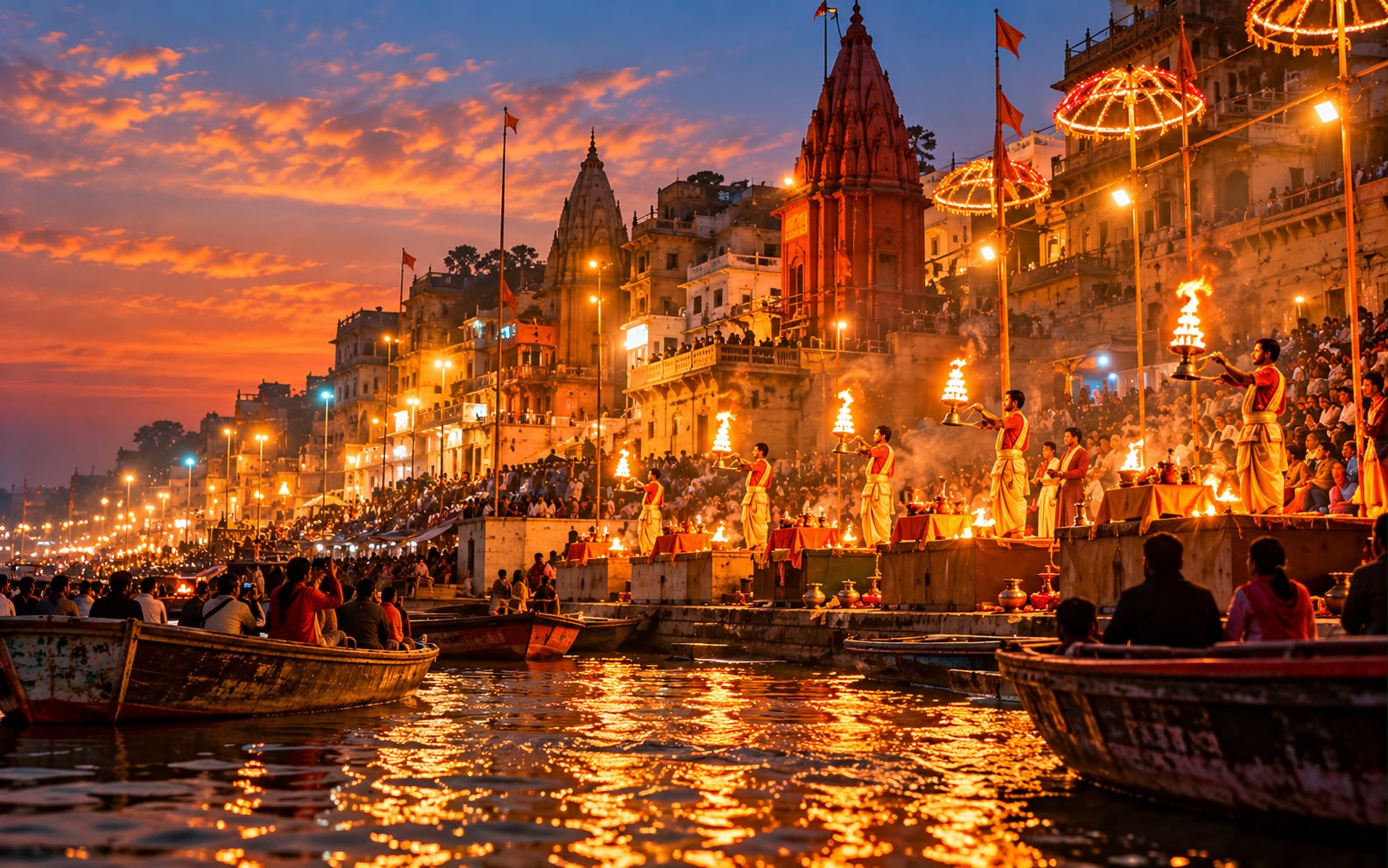
Varanasi in 2 days: the ghats, the aarti and Sarnath
The dawn boat is the single best hour in India and everything here is arranged around it. Plus the burning ghats and the rules that apply there, the aarti from the water, and the Buddhist site half an hour away.
- South Asia
- 2 days
- ≈ AED 250 / person
- Two days arranged around a sunrise on the river, which is the whole reason to come
Before you go
Varanasi is one of the oldest continuously inhabited cities on earth and makes no concession whatever to visitors — which is both the difficulty and the entire reason to come.
Two days arranged around two fixed points: the Ganga Aarti at Dashashwamedh in the evening, and the dawn boat on the river, which is the best hour in India and not a close contest.
One thing stated plainly, because it matters more here than anywhere. Photography at the burning ghats — Manikarnika and Harishchandra — is prohibited. People will offer to let you, for money. It is a scam, and it is also a cremation. Put the camera away and keep walking.
Part of an India trip? See Varanasi in 5 days.
Figure the budget below. October to March.
Before you go: the short version
Getting there and around
- Lal Bahadur Shastri Airport (VNS) is 45 minutes from the ghats, with flights from Delhi and Mumbai.
- The overnight train from Delhi is 12–14 hours.
- The old city is a maze of lanes too narrow for cars. Your hotel will be a walk from wherever the auto stops, and that is normal.
- Autos and cycle rickshaws for the rest; agree the fare.
- The ghats run about 7km along the river and walking them is the way to see the city.
The donation and guide approaches
- You will be approached constantly — for boat rides, guided tours, “donations for the dying”, and wood for cremations.
- The wood-donation approach at Manikarnika is the organised one. Someone explains that a poor family cannot afford the wood and leads you to a shop with a quoted price per kilo. It is a scam.
- Agree every boat fare before you get in, and expect it to be renegotiated afterwards if you did not.
Day by day
Day 1 — The ghats and the aarti
Walking order: Assi Ghat → north along the river (the ghats connect, about 4km to Dashashwamedh) → Vishwanath lanes → back to the ghat for the aarti. About 5km, flat, on uneven stone.
- 15:00 — Start at Assi Ghat, the southern end, and walk north along the river. The ghats run into one another and the walk is the single best way to understand the city.
- You will pass Harishchandra, one of the two cremation ghats. Walk past respectfully, and no photographs.
- 17:00 — The Kashi Vishwanath Temple, one of the twelve jyotirlingas and the most important Shiva temple in India. The corridor redevelopment opened in 2021 and changed the approach entirely. Non-Hindus may now enter, with security that is airport-grade — phones and bags are not allowed inside and there are lockers.
- 18:00 — Be in position for the Ganga Aarti at Dashashwamedh — fire, bells, conch shells and brass lamps, performed by seven priests on tiered platforms.
- Watch it from a boat rather than the steps if you can. Hire one from the ghat an hour before, agree the price, and you will see it from the river with the whole bank behind it.
- 20:00 — Dinner in the lanes, and the kachori sabzi and the lassi at the old shops are what the city eats.
Day 2 — The dawn boat and Sarnath
Walking order: the boat covers the river; Sarnath is a separate site with about 1.5km of flat walking.
- 05:00 — The dawn boat. This is the single best hour of any trip to India. Arrange it the night before, agree the price, and be on the water before the sun.
- The sun comes up over the far bank — which is empty sandflats by design, because the city is built on the west side only — and the whole 7km of ghats lights up at once, with bathers, laundry, yoga, and the first boats.
- Manikarnika burns continuously, day and night. You will pass it. Camera down.
- 07:30 — Back on land, and breakfast.
- 09:00 — A few hours off. The city is intense and this is a good time to not be in it.
- 11:00 — Sarnath, half an hour out, where the Buddha preached his first sermon after enlightenment — one of the four principal Buddhist pilgrimage sites.
- The Dhamek Stupa, 43 metres, dating in its present form to around 500 CE, and the Archaeological Museum, which holds the Ashokan lion capital that is India’s national emblem — the original, not a copy.
- 15:00 — Back to the city, and the Banaras Hindu University campus and its Bharat Kala Bhavan museum if you have an hour.
- 17:30 — The ghats again at dusk from the other direction, or a second aarti — the one at Assi Ghat is smaller and quieter and some people prefer it.
Costs and practicalities
Getting around, and what it costs
| Auto from the airport | INR 700–1,000 |
| Auto or cycle rickshaw in town | INR 50–200 |
| Shared boat for the aarti | INR 300–600 per person |
| Private dawn boat, an hour | INR 800–1,500 |
| Sarnath by auto, return with waiting | INR 800–1,200 |
| Sarnath museum | INR 300 |
| Dhamek Stupa site | INR 300 |
- Varanasi is cheap, and the boats are the one thing to agree a price on firmly, before boarding, every time.
Best time to visit
- October to March — 10–30°C, and the best of it is November to February. Mornings on the river are genuinely cold in December.
- Dev Deepawali, fifteen days after Diwali in November, lights every ghat with oil lamps and is the most spectacular night of the year here.
- April to June — 40–45°C, which on open stone steps is brutal.
- July to September — the monsoon, and the river rises enough to submerge the lower ghats, which changes the city entirely and stops the ghat walk.
Travel tips
- The dawn boat is the reason to come. Arrange it the night before.
- No photography at the burning ghats. Not for money, not discreetly.
- The wood-donation story is a scam.
- Agree every boat fare before boarding.
- Dress modestly — this is a pilgrimage city, not a resort.
- The lanes flood with sewage after heavy rain. Waterproof shoes in the monsoon.
- Expect to be overwhelmed. Most people are, and the second day is easier than the first.
What this trip actually costs
Two people, 1 night, mid-range comfort, excluding travel to Varanasi:
| Item | Cost |
|---|---|
| Hotel, 1 night near the ghats | INR 4,000 (≈ AED 156) |
| Food and drink, 2 days | INR 2,000 (≈ AED 78.10) |
| Dawn boat and aarti boat, two people | INR 2,600 (≈ AED 102) |
| Sarnath trip and entries, two people | INR 1,800 (≈ AED 70.29) |
| Autos, tips, incidentals | INR 1,600 (≈ AED 62.48) |
| Total for two | INR 12,000 (≈ AED 469) |
- Varanasi is among the cheapest cities in India and the boats are the main discretionary cost.
- A river-facing room costs little more and is worth it for the dawn.
- Hotel picks here are chosen on location, not on commission — always check prices and recent reviews before booking.
What to pack
- Shoes you can walk uneven wet stone in, and that you do not mind.
- Modest clothing, covering shoulders and knees.
- A warm layer for the dawn boat in winter — it is cold on the water.
- A Type C/D/M adapter, 230V.
Part of a bigger trip?
- Varanasi in 5 days gives the city and Sarnath more room.
- India in 10 days and 14 days place it in a wider route.
- India and Nepal in 13 days runs on to Kathmandu.
- Delhi in 2 days is the usual arrival point.
FAQ
Is two days enough for Varanasi? For the ghats, the aarti, the dawn boat and Sarnath, yes. Many people find two days is also about as much intensity as they want on a first visit.
Can I photograph the cremations? No. It is prohibited at both burning ghats, people will offer to arrange it for money, and it is a funeral. Put the camera away.
Is the dawn boat really worth a 5am start? Yes. It is the best single hour available anywhere in India and the whole city is arranged to be seen from the water at that moment.
Can non-Hindus enter Kashi Vishwanath? Yes, since the corridor redevelopment, with airport-grade security and no phones or bags inside. Take as little as possible.
Is Varanasi difficult? It is intense — crowded lanes, open cremation, persistent approaches and sensory overload. Most visitors find the first few hours hard and are glad they stayed.
Prices and entry rules change, and what you need depends on your passport; last checked 29 October 2026, so confirm with the embassy or your airline before booking.


